Changing Business Models

hikers on a mountain

Patagonia’s connection to the wilderness has a big impact on the company’s approach to environmental issues, says Vincent Stanley, vice-president of marketing at Patagonia. Photograph: Daniel Garcia/AFP/Getty Images

From the Guardian‘s Sustainable Business blog:

Patagonia plans global campaign for responsible capitalism

The outdoor clothing and equipment company says we need to develop very different measures of success if we are to prevent environmental collapse

In the true spirit of adventure, mountaineering and surfing company Patagonia reaches one summit and immediately searches for an even tougher peak to climb.

Fresh from taking a pot shot at our consumerist society with its challenging “don’t buy this jacket” advertising campaign, Patagonia now has the whole capitalist system in its crosshairs. Continue reading

Bicycle Information & Chitchat, UK Edition

We are not in the business of selling books nor promoting purchases at any particular outlet, but we do have a thing for bicycles.  More would be good.  Better regulations would be too.  Safety rules that everyone follows, check.  A book that covers these and other topics? Yes.  Will zany be more effective than serious-wonky?  Judge for yourself. Only certain island nations can pull off this sort of thing:

‘Cycling is the King of A to B. Whatever our differences, we love one another: Lycra mankini or tweed trousers tucked into your sock? Traffic lights – a suggestion or an order? Racer or hybrid, helmet or commando, freewheel or fixie? Nothing sours the bond.’ Zoe Williams Continue reading

Paddy Field – Kuttanad, Alappuzha

Photo credits: Ramesh Kidangoor

With its abundant paddy, Kuttanad has been termed the “Rice Bowl of Kerala”. Kuttanad is a large area made up of land from the three adjoining districts of Alappuzha, Kollam and Kottayam. Most of Kuttanad consists of paddy fields that spill out into vast stretches inland from the backwaters. Heavy monsoon rains bring top soil and minerals from the high ranges of the Western Ghats, depositing them in the low-lying Kuttanad region in a periodic replenishment that keeps the soil fertile.

Continue reading

Taking The Geek Out Of Greek

We have already sung Stephen Greenblatt‘s praises several times, but why stop there? He has done something remarkable, making classicism classy:

Glories of Classicism

FEBRUARY 21, 2013

Stephen Greenblatt and Joseph Leo Koerner

The Classical Tradition

edited by Anthony Grafton, Glenn W. Most, and Salvatore Settis Belknap Press/ Harvard University Press, 1,067 pp., $49.95

Over a thousand pages in length, with some five hundred articles surveying the survival, transmission, and reception of the cultures of Greek and Roman antiquity, The Classical Tradition is a low-cost Wunderkammer, a vast cabinet of curiosities. Take the entry on the asterisk: you learn that this ubiquitous critical sign, named from the Greek for “small star,” originated in Ptolemaic Alexandria, where the great textual scholar Aristophanes of Byzantium and his student Aristarchus of Samothrace used them to mark repeated lines in the Iliad and Odyssey.

Continue reading

A Few Etruscan Tombs

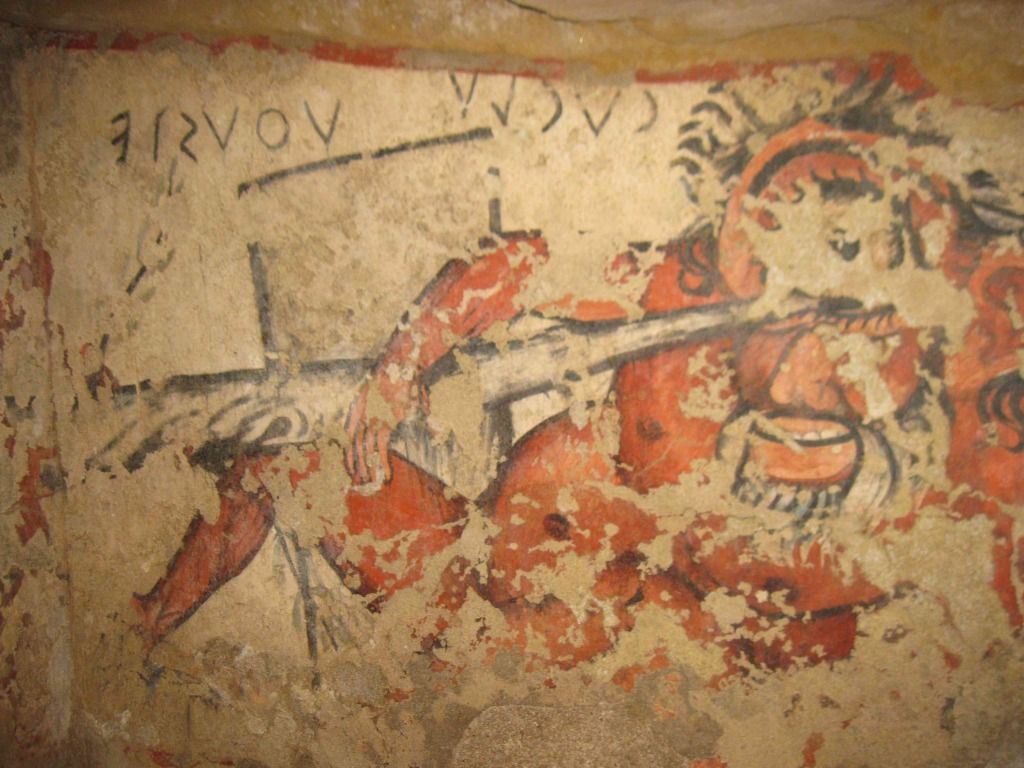
Polyphemus the Cyclops (Tomb of Orcus)

The Etruscans are, for all their great cultural influence on the Romans, a  poorly understood people. We know they once dominated northern Italy and much of its western coast and that they interacted extensively with not only the Romans but also many other native Italic tribes in the 1st milennium BC. Some of this contact is reflected linguistically: the modern English word “person,” deriving from Latin persona, entered the Latin language from Etruscan phersu Continue reading

If You Happen To Be In Brooklyn

This slideshow requires JavaScript.

In anticipation of Raxa Collective’s collaboration with colleagues in Ghana starting this month (more on which soon), we are particularly susceptible to any mention of Ghana in the news and El Anatsui has been on our radar recently.  There is plenty to make us optimistic about Ghana’s future, not least its contributions to fine arts.  This show just opening at Brooklyn Museum looks worthy of a visit:

The first solo exhibition in a New York museum by the globally renowned contemporary artist El Anatsui, this show will feature over 30 works in metal and wood that transform appropriated objects into site-specific sculptures. Anatsui converts found materials into a new type of media that lies between sculpture and painting, combining aesthetic traditions from his birth country, Ghana; his home in Nsukka, Nigeria; and the global history of abstraction. Continue reading

Thought For Food

Since the launch of this site in 2011 we have made a commitment to point out as many news stories, analyses and other documentation as possible with positive, proactive examples of how we can best deal with issues that matter to us.  However, some of the less pleasant information we find is essential reading or viewing. Case in point here with the BBC segment in a series from last year about food. Disturbing. Important. Worth an hour of our time:

In the past year, we have seen food riots on three continents, food inflation has rocketed and experts predict that by 2050, if things don’t change, we will see mass starvation across the world. Continue reading

Badami Cave Temple, Karnataka

Photo credits: Ramesh Kidangoor

The Badami Cave Temple in Karnataka was the capital of the early Chalukyas, who ruled much of that area of India during the 6th and 7th centuries. Badami is a treasure trove of Indian rock-cut architecture and sculpture. It is set in a picturesque countryside at the mouth of a sandstone ravine . The caves overlook a large lake known as Agasythya Teertha.

Continue reading

Coffee Rust

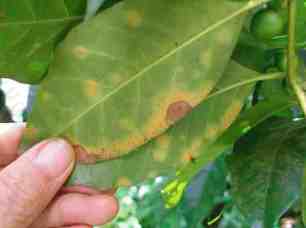
John Vandermeer.  A mild infection of coffee rust on a tree in Mexico.

John Vandermeer. A mild infection of coffee rust on a tree in Mexico.

Several contributors to this blog live(d) and work(ed) in Central America and know exactly what you mean. Those of us based in south India–where there is high quality arabica growing in the Coorg-Chikmagalur corridor–are hopeful that this “rust” is contained quickly.  So, Dear John, please succeed:

Until this year, John Vandermeer, an ecologist and coffee researcher at the University of Michigan in Ann Arbor, had never lost a tree to fungus. Continue reading

Collaboratively Clean City

Jose Beceiro, the Director of Clean Energy Initiatives eat the Chamber of Commerce in Austin, Texas notes the role of collaboration in his city’s remarkable economic development:

As one of the first smart-grid-powered communities, a revolutionary technology incubator, and the host of a conference promoting clean energy investment; Austin, TX has proven itself a leader in the clean technology sector, and the region is poised to continue making significant strides in building a strong clean  Continue reading

Mammals, Emotions And Human Intelligence

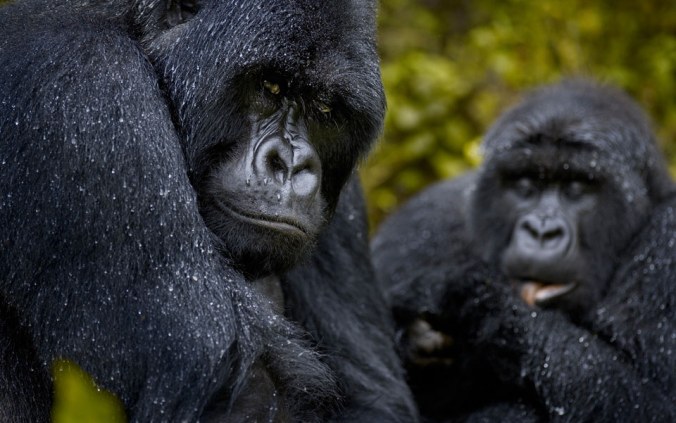
Close cousins: a gorilla family in Rwanda. Photo by Charles L Harris/Gallery Stock

Close cousins: a gorilla family in Rwanda. Photo by Charles L Harris/Gallery Stock

Another great item in a publication we recently started following:

‘If he grabs you, just go limp and let him throw you around. If you tense up, he’ll take it as a dominance challenge.’

‘Um. Okay.’ Continue reading

If Green Is The New Black, Perhaps Polar Bear Is The New Panda

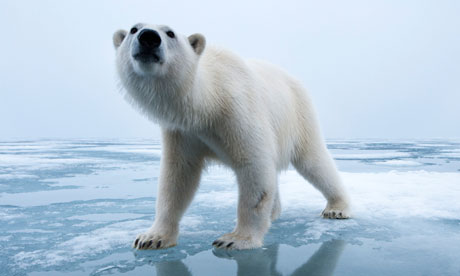
Some polar bears may have to be placed in temporary holding compounds until it is cold enough for them to go back on to the sea ice, say scientists. Photograph: Paul Souders/Corbis

Some polar bears may have to be placed in temporary holding compounds until it is cold enough for them to go back on to the sea ice, say scientists. Photograph: Paul Souders/Corbis

This story in the Guardian‘s Environment section, one of the longest stories that section has ever run, is worth the time to read.  It raises a kind of semi-doomsday scenario, and in the process heightens sensitivity to this particular magnificent charismatic megafauna.  Decades back, WWF leveraged the Panda into a strong iconic hot-button for the need of donations to conservation NGOs.  This article got us thinking whether the polar bear is now the hot button icon for increasing the sense of urgency needed to do something about climate change:

The day may soon come when some of the 19 polar bear populations in Canada, Alaska, Greenland, Norway, and Russia will have to be fed by humans in order to keep them alive during an extended ice-free season or prevent them from roaming into northern communities. Some bears may have to be placed in temporary holding compounds until it is cold enough for them to go back onto the sea ice. In worst-case scenarios, polar bears from southern regions may have to be relocated to more northerly climes that have sufficient sea ice cover. Continue reading

More On Internal Compasses

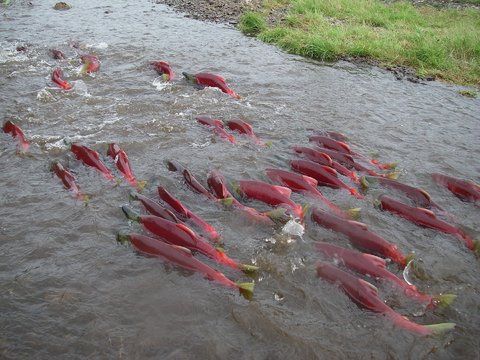
Tom Quinn/University of Washington.  Sockeye salmon migrating from saltwater to fresh water.

Tom Quinn/University of Washington. Sockeye salmon migrating from saltwater to fresh water.

More and more stories addressing the understanding scientists are developing about internal guidance systems:

Every summer, millions of sockeye salmon flood into the Fraser River in British Columbia, clogging its shivering waters with their brilliant blushing bodies.

Scientists and spectators alike have long been awed by the sockeye’s audacious struggle to swim upstream to spawn. And while it has been known for years that a salmon can smell its way up the river to find its natal stream, no one has been able to explain just how these beautiful and economically vital fish find their way back from the open ocean, 4,000 or 5,000 miles away, to the right river mouth. Continue reading

Kerala Temple Festival – Ettumanoor

Photo credits: Ramesh Kidangoor

The Siva Temple at Ettumanoor has a unique festival called Ezhara ponnana — meaning “seven-and-a-half golden elephants”. Each of the statues in the procession contain nearly 13 kg of gold.  Seven of the elephants are two feet high, only the eighth is one foot, giving the festival its unique name.  Continue reading