
Sanaga River, Cameroon
Sanaga River, Cameroon

We have referenced Françoise Mouly once before, but the art of Christoph Niemann many more times. This one is not fun, more of a gut punch; but at the source scroll down and see all the other covers on the same theme:
Christoph Niemann’s “Recipe for Disaster”
The artist expresses his sense of urgency about the emergency unfolding all around us.
News cycles, by nature, tend to document crises as discrete events. Suffusive emergencies—like the climate crisis—are captured mostly in the accelerating pace and frequency of such coverage. Continue reading

Santa Rosalia, Guatemala
Jordan Baumgarten for The New York Times
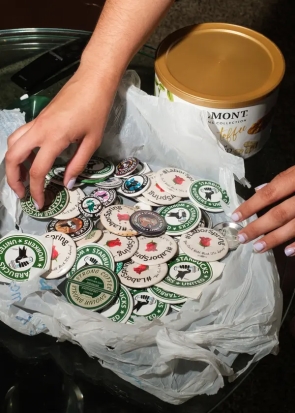
In the coffee business, we look up to the big players for inspiration. Sometimes we find something else. Starbucks can be a very admirable corporate citizen. It can also be rotten, as we are reminded in this op-ed by Megan K. Stack:
Inside Starbucks’ Dirty War Against Organized Labor
NOTTINGHAM, Md. — Agnes Torregoza came to this country when she was a toddler, brought from the Philippines by her parents. Her mother found a teaching job in the Baltimore County Public School District, and the family set about cobbling together a new life. Continue reading

Bangalore, Karnataka

Bear populations are plummeting in most of the world. But in North America “human-bear conflicts” have been on the rise. Photograph by Alex Majoli / Parc de la Villette / Magnum
On the rare occasions when the historian and elegant writer Jill Lepore has essays whose topics overlap with our interests on this platform, we say hoorah:
Throughout North America, they’re showing up in unexpected places. Can we coexist?
I keep a cannister of bear spray on a shelf by the mudroom door, next to a cakey-capped tube of sunscreen and two mostly empty and partly rusty green aerosol cans of OFF! Deep Woods insect repellent. Continue reading
St. Louis, Missouri
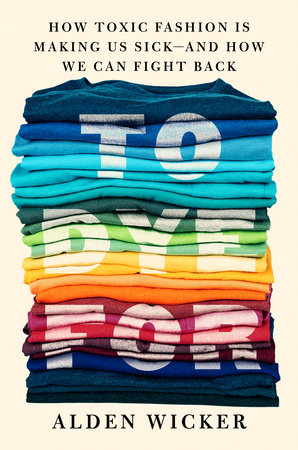 None of us wants yet one more environmental hazard to worry about. But ignorance is not bliss. Wired offers an interview with Alden Wicker about the book to the right, and the Fresh Air podcast with her is also worth the listen, especially if you have sensitive skin and/or have ever wondered if your clothing was the cause of certain kinds of discomfort. Women of reproductive age, especially, listen to both:
Your Clothes Are Making You Sick
This week, we talk to the author of To Dye For, a new book about toxic fashion and the abundance of harmful chemicals in our clothing.
HOTOGRAPH: ALFIAN WIDIANTONO/GETTY IMAGES
HAVE YOU EVER put on a new shirt and discovered that it makes you feel itchy? Or taken off a new pair of pants at the end of the day to find that the fabric has given you a rash? This problem is increasingly common as more chemicals are added to our clothing when they’re dyed or treated with additives that make them resistant to stains, wrinkles, and odors. Some of these chemicals are irritants that can cause breathing problems or skin issues. Others are toxic enough to trigger life-altering autoimmune diseases. Since the fashion industry operates within loose regulations, the problem of toxic apparel isn’t going away anytime soon.

Yaoundé, Cameroon

Illustration by The Atlantic. Source: Getty.
During my two years working in southern Chile I was close several times to going further south. In spite of my disappointment at the time, in hindsight I am fine with not having made the journey. Thank you, Sara Clemence, for getting that clear in my head:
Take Antarctica off your travel bucket list.
On the southernmost continent, you can see enormous stretches of wind-sculpted ice that seem carved from marble, and others that are smooth and green as emerald. You can see icebergs, whales, emperor penguins. Visitors have described the place as otherworldly, magical, and majestic. The light, Jon Krakauer has said, is so ravishing, “you get drugged by it.”
Travelers are drawn to Antarctica for what they can find there—the wildlife, the scenery, the sense of adventure—and for what they can’t: cars, buildings, cell towers. They talk about the overwhelming silence. The Norwegian explorer Erling Kagge called it “the quietest place I have ever been.” Continue reading
Oberpullendorf, Austria

Paris’ iconic zinc roofs can heat up to 194 degrees F on a hot summer day. JAN WOITAS / PICTURE-ALLIANCE VIA GETTY IMAGES
We have celebrated the many greening efforts made in Paris over the last decade, and today is a small but important addition to our knowledge of those commitments. Our thanks to Jeff Goodell in Yale e360:
A rendering of a rooftop terrace installed by the Parisian startup Roofscapes. ROOFSCAPES
Paris When It Sizzles: The City of Light Aims to Get Smart on Heat
With its zinc roofs and minimal tree cover, Paris was not built to handle the new era of extreme heat. Now, like other cities worldwide, it is looking at ways to adapt to rising temperatures — planting rooftop terraces, rethinking its pavements, and greening its boulevards.
The tree-lined Boulevard des Italiens is much cooler than nearby streets that lack trees. MBZT VIA WIKIPEDIA
There’s a long tradition in France of taking August off for holiday. Paris virtually shuts down as the temperature drifts around in the seventies, and people go to the beach or the mountains to cool off and relax. Think of it as an old‑fashioned adaptation to heat. People who stick around during August are often older or have jobs that require them to stay and keep the city functioning. Continue reading

St. Louis, Missouri

Hilary Swift for The New York Times
Bill McKibben’s occasional optimism notwithstanding, he and Al Gore are the two most visible alarmists on climate change. Even in the worst of circumstances both find reason to point out our remaining options for actually doing something.
Our thanks to David Gelles and the New York Times for rounding out the doom and gloom with a bit of hope:
Al Gore on Extreme Heat and the Fight Against Fossil Fuels
The past few weeks have him even more worried than usual.
It’s been 17 years since former Vice President Al Gore raised the alarm about climate change with his documentary, “An Inconvenient Truth.” Since then, he’s been shouting from the rooftops about the risks of global warming more or less nonstop. Continue reading
Chaffi, Uttarakhand
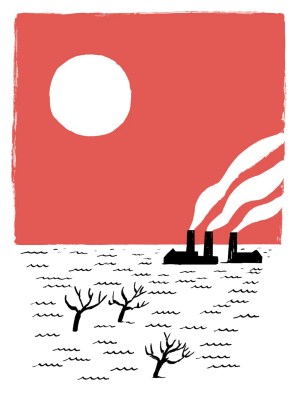
Illustration by João Fazenda
Bill McKibben acknowledges in his most recent newsletter that in spite of all his efforts over the decades, he and we all are failing on climate change mitigation. But he has not given up hope:
A rapid end to burning fossil fuel would arrest the heating that has caused extreme damage in recent weeks; and that rapid end is possible.
In the list of ill-timed corporate announcements, historians may someday give pride of place to one made by Wael Sawan, the new C.E.O. of Shell, the largest energy company in Europe. In 2021, Shell said that it would reduce oil and gas production by one to two per cent a year up to 2030—a modest gesture in the direction of an energy transition. Continue reading

male
Chopta, Uttarakhand
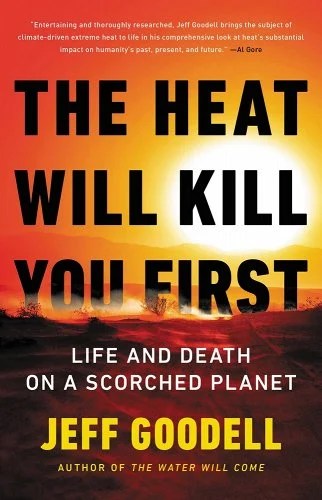 Jeff Goodell shares his opinion in the newspaper of record in the USA. It will serve as a preview of his book to the right, reviewed here. He has also spoken about this topic. There is no pleasure to be had here. Only awareness, and the question why we are not doing more:
In Texas, Dead Fish and Red-Faced Desperation Are Signs of Things to Come
In 2019, I happened to be visiting Phoenix on a 115-degree day. I had a meeting one afternoon about 10 blocks from the hotel where I was staying downtown. I gamely thought I’d brave the heat and walk to it. How bad could the heat really be? I grew up in California, not the Arctic. I thought I knew heat. I was wrong. After walking three blocks, I felt dizzy. After seven blocks, my heart was pounding. After 10 blocks, I thought I was a goner. Continue reading
Sanaga River, Cameroon

A branch of Blutaparon rigidum, collected on a 1905-1906 expedition to the Galapagos Islands, contains hundreds of potentially viable seeds. NEW YORK BOTANICAL GARDEN
We have touched on the topic of reviving extinct species only a few times previously, and as obvious as it seems we must mention that reviving plant species sounds like a more sound ambition. So, thanks to Janet Marinelli and Yale e360 for this story:
Back from the Dead: New Hope for Resurrecting Extinct Plants
Armed with new technology, botanists are proposing what was once thought impractical: reviving long-lost plant species by using seeds from dried specimens in collections. The challenges remain daunting, but researchers are now searching for the best de-extinction candidates.
In January 1769, botanists Joseph Banks and Daniel Solander found a daisy in Tierra del Fuego, at the southern tip of South America. Continue reading



 Organikos