Profile: Mereena & Sustainable Housekeeping

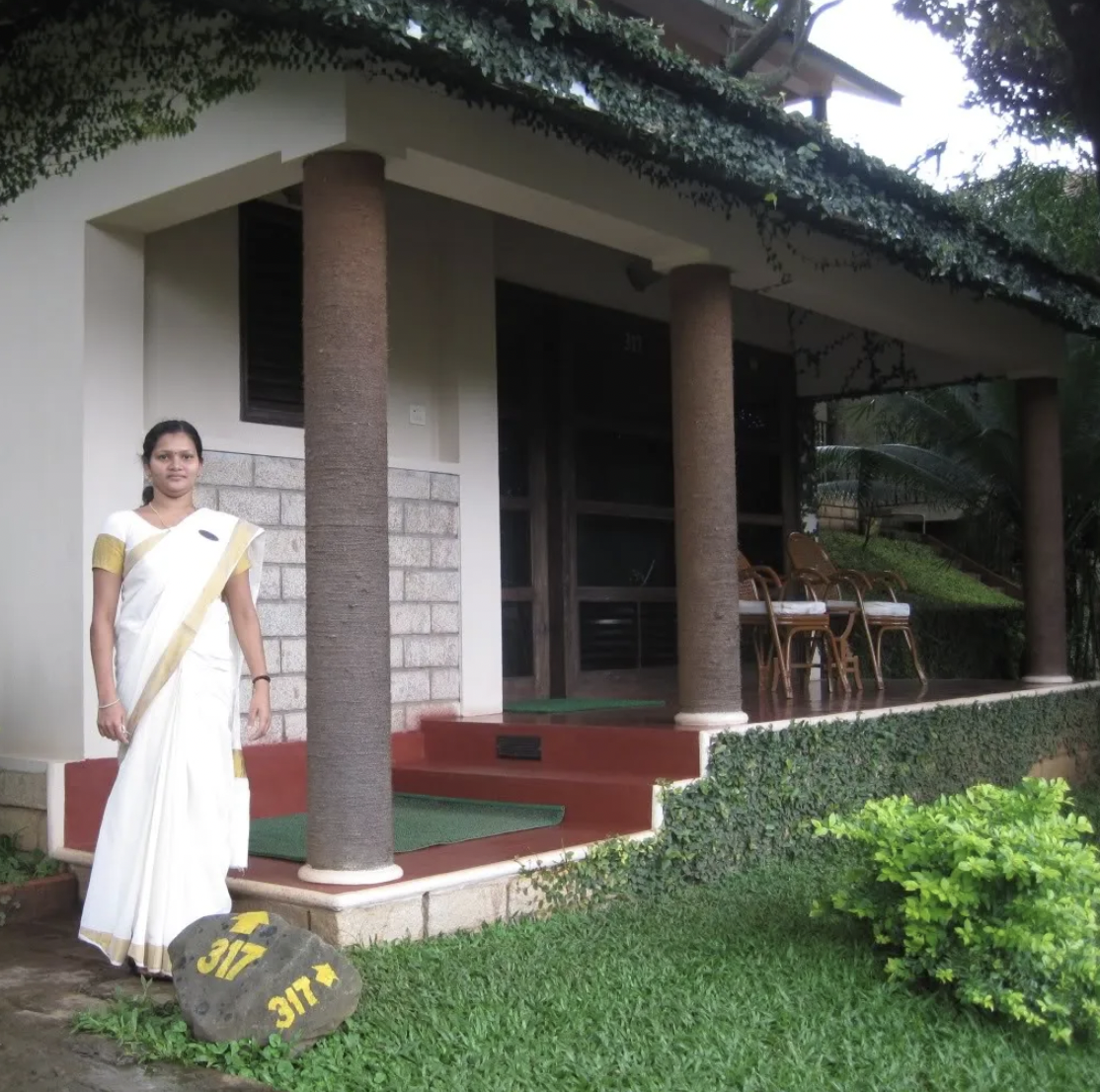
A couple of days ago I had the pleasure of speaking with Mereena, the head of the housekeeping department at Cardamom County. Mereena has been here since 2003, and started from the bottom rung of the housekeeping department ladder. Mereena explained to me how she was successively promoted six times.


She began as a trainee housemaid, and then progressed to official housemaid and then to senior housemaid. Next she became housekeeping desk assistant, then trainee housekeeping supervisor, and then housekeeping supervisor and finally Room Experience Officer and head of housekeeping. Taking full charge of the department required thorough and extensive knowledge of housekeeping but maintaining that authority has required managing responsibly.  In multiple senses of that term.

Continue reading

A Voice from Africa

Jambo! Greetings from Nairobi, Kenya. I am pleased to join the other Raxa Collective contributors and share some wonderful stories of entrepreneurial conservation from here in Eastern Africa! However, before I jump into it, you may be wondering how a little Asian-American girl from New Jersey ended up in Africa. I’ll tell you about myself before jumping into my first blog post!By way of background, I recently graduated from Cornell University’s School of Hotel Administration with a minor in Urban and Regional Studies. I’ve spent most of my academic and professional career in the hospitality industry. However, during my junior year at Cornell, I embarked on an adventure that would find me exploring an atypical “Hotelie” path.
I spent the winter of 2009 externing at the Tribe Village Market Hotel in Nairobi, Kenya, where I was exposed to the dynamic Kenyan culture. Nairobi was my pit stop before studying abroad in Barcelona, Spain. I had always held a keen interest in sustainability, I took a Sustainable Tourism class at Ramon Llull University, Turismo Sant. Ignasi, which raised my interest in this sector. While abroad, I was fortunate enough to do a bit of traveling throughout Spain, Italy, The Netherlands, and Morocco. The travel bug led me to a summer that changed my life and perspective on the meaning of sustainability and conservation.

Last summer, I interned at Panigram Resort, a socially and environmentally responsible boutique resort located in south-western Bangladesh (currently under development). For 60 days, my fellow interns and I were immersed in the beauty of rural Bangladesh’s vibrant culture, community, and natural beauty. As the sustainable hospitality intern, I worked on a host of project during the summer. For example, I helped develop a local community’s recycling business, oversaw the construction of a bamboo mud visitor center, modeled a carbon footprint calculator, and taught English classes to Bangladeshi children. Continue reading

Ramírez, Reading & Responsibility

The presenter introduced Sergio Ramírez with all the formal flourish that the Spanish language provides for; a laudatory salute that seems unique to places where poets serve as public servants.  The presenter mentioned the publications Ramírez has contributed to; the number of his essays, short stories, and novels; told of his political history and his creation of Nicaraguan publications and organizations of reform. The presenter was obviously very proud of having such an influential man in the room, and finally said, “I give you, author, poet, thinker, ex-president Sergio Ramírez!”

(c) Overdue Media LLC, used with permission

The man who has given talks at over forty academic institutions around the world (including Cornell University) took the podium. “Thank you for the very generous introduction,” he started.  And what he said next illustrates the difference between poets and politicians. Continue reading

Details and Progress

This afternoon I visited my favorite newspaper bag unit in Kumily to check in on the progress since Sunday and to clarify the structure they had set-up on Sunday morning, mostly in Malayalam. Here’s my report, which is heavy on details and light on style.

Each of the producers was previously associated with an Eco-Development Committee (EDC). These committees have been established by the Forest Dept. over the last fifteen years, and are divided by location, or in the cases of the Mannan and Peliyan, by heritage. Current participants represent nine different EDCs: Mannakkudy, Paliyakuddy, Korishomala, Kollampottada (divided into three), Vasanthasena, Spring Valley, and Mullayar. Each has put forth a representative, who will serve to facilitate communication among them. They have, for now and for the most part, elected to retain the division of these committees, perhaps partially out of habit, but certainly for convenience’ sake. EDCs exist in neighborhoods within 5km of the forest’s edge. Though we held the workshop in Vanasree auditorium, just around the corner from Cardamom County and in the same building as the office of the Eco-Development Range Officer, Sanjayan, and some have chosen to continue working there, some from more distant locations prefer to base their operations out of EDC offices nearer to their homes. I don’t know who will administer supplies to these offices, or how, when the operation becomes more complex. The Vasanthasena committee formerly created a newspaper bag unit, and a few of its members have prior experience and know-how. It has been proposed that all the producers unite under the auspices of this group, but they have yet to ratify this motion officially.

Those in attendance on Sunday morning elected three officers to govern the unit: a Convener, a President, and a Secretary. They will receive assistance from two ex officio secretaries and a ‘facilitator,’ all of whom are employed by the Forest Dept. The elected officials alone have access to the finances. Sasi Kumar, one of the ex officio secretaries, currently is charged with maintaining the registers. When I asked what policy regarding the registers they would pursue in the future, Shymala, the ‘facilitator,’ told me they had not yet concerned themselves with the specifics. Abie, who was translating for me, used the phrase “baby steps” to convey the meaning of her answer. Continue reading

They’re Real, Not Plastic

Earlier this year I would have thought blogging about plastic bags would be boring and quite redundant.  I have heard and read of the dire effects plastic bags have on the environment countless times.  And I am well versed in the “green tips” of bringing my own bag that are so prevalent.  Intellectually, I realize that plastic bags…well, suck.

I heard the implications and I pride myself to be eco-savvy yet I still would often be caught red-handed with those pesky plastic bags on a few desperate occasions. Continue reading

Nicaraguan 1st Graders Book It to 25wpm

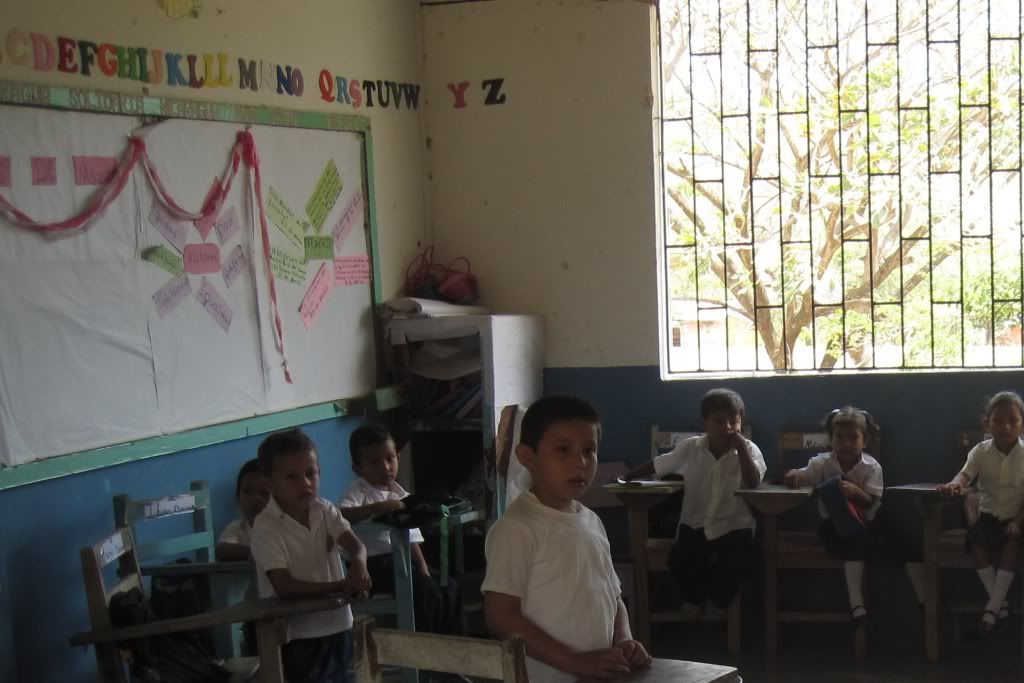
The José Dolores Estrada School, named after one of the military heroes who fought against William Walker’s army in the mid-1800s, is located only five or six kilometers away from Morgan’s Rock. JDE is a small public school with three teachers and around sixty to seventy students (the numbers vary widely each year or even by semester) that sit in mixed-grade classrooms to learn from whatever textbooks become available. On the walls, hand-made posters read, “What is a fable?” or give the definition of “traba-lenguas” (tongue-twisters) along with several examples. Cut-outs of volcanoes, whales, and ducks rest above a student’s project on “The Land of Lakes and Volcanoes.”

The three teachers responsible for the colorful and educational decorations came with José Tomás Gómez Valdivia (Nicafrance Foundation) and other teachers from La Cumplida for three days in Managua to attend the congress. I joined the delegation in their final day of sharing and learning and took notes on the conferences.

“The Situation of Reading in Nicaragua and Initiatives for Improvement” was the title of the first talk that José Tomás and I attended (the teachers went to whatever conference or workshop was most interesting or valuable to them). It was given by Vanessa Castro, a PhD from the Harvard Graduate School of Education. Dr. Castro has worked alongside the World Bank, IADB, UNESCO, and AED, and is now one of the leading investigators for the Nicaraguan group CIASES (Centro de Investigación y Acción Educativa).  Continue reading

The Transparency Paradox

When I lived in Singapore to do an internship aimed at rolling out the sustainability road-map of a major service solutions and facilities management company, my building neighbored “Singapore’s first eco-mall,” a beacon of consumerism just like any other mall, but with one main difference: an exclamation point punctuating its statement of eco-friendliness.

A true comrade of the Earth according to its interior walls and eco-kiosks, this mall was built with technologies that will likely soon become architectural norms. Its urinals are water-free, its windows let in natural light but with minimal heat, its roof harnesses solar power and rainwater, its lighting uses minimal wattage, it is constructed of environmentally safe materials, the list goes on and on… and is painted all over the walls. You get priority check-out if you bring your own bag and priority parking if your car is a hybrid. But for some it’s not clear whether the priority really lies in being an eco-mall, or in making sure you know it’s an eco-mall.

One of the challenges that experts and champions in the field of sustainability and corporate citizenship face Continue reading

From One Training Session to Another

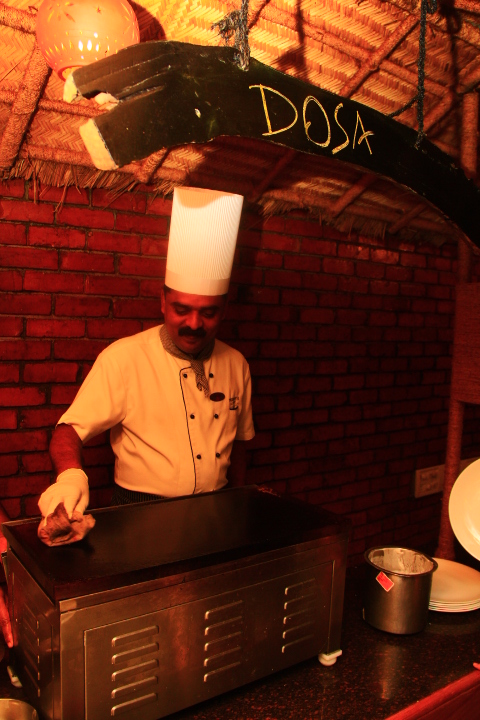
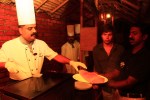
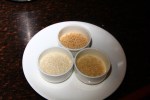
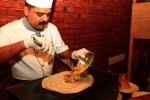
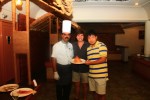
Dosa is a staple of the south Indian’s diet; a crispy cousin of the North American pancake; a usefully and impressively variable rice and dal-based fast-bread that is cooked on a sizzling griddle, and served with savory or sweet side dishes at any meal. Tonight, Sung and I had the pleasure of watching a master at work with the dosa: the head chef at Cardamom County, Chef Pradeep, who put on display several types of dosa for us to try. Per the new usual, Sung took some impressive pics (below). But the highlights were the flavors and the sounds, as wells as the nifty designs grilled into the dosa, the pattern of which is dependent upon how the batter poured onto the griddle (they’re not unlike the swirls in the foam of an artfully made cappuccino). There was Uttapam, which is pizza-like but with ingredients cooked into the batter; mushroom and cheese dosa; house-hold size dosas and restaurant-sized dosas; and masala dosa, which packs in spiced potatoes. We had a lot of fun with the whole experience, and learned a healthy dose about a tasty Indian treat. Check out the photos for a better sense of the dish (for those of you unfamiliar with it).

When Foxes Fly

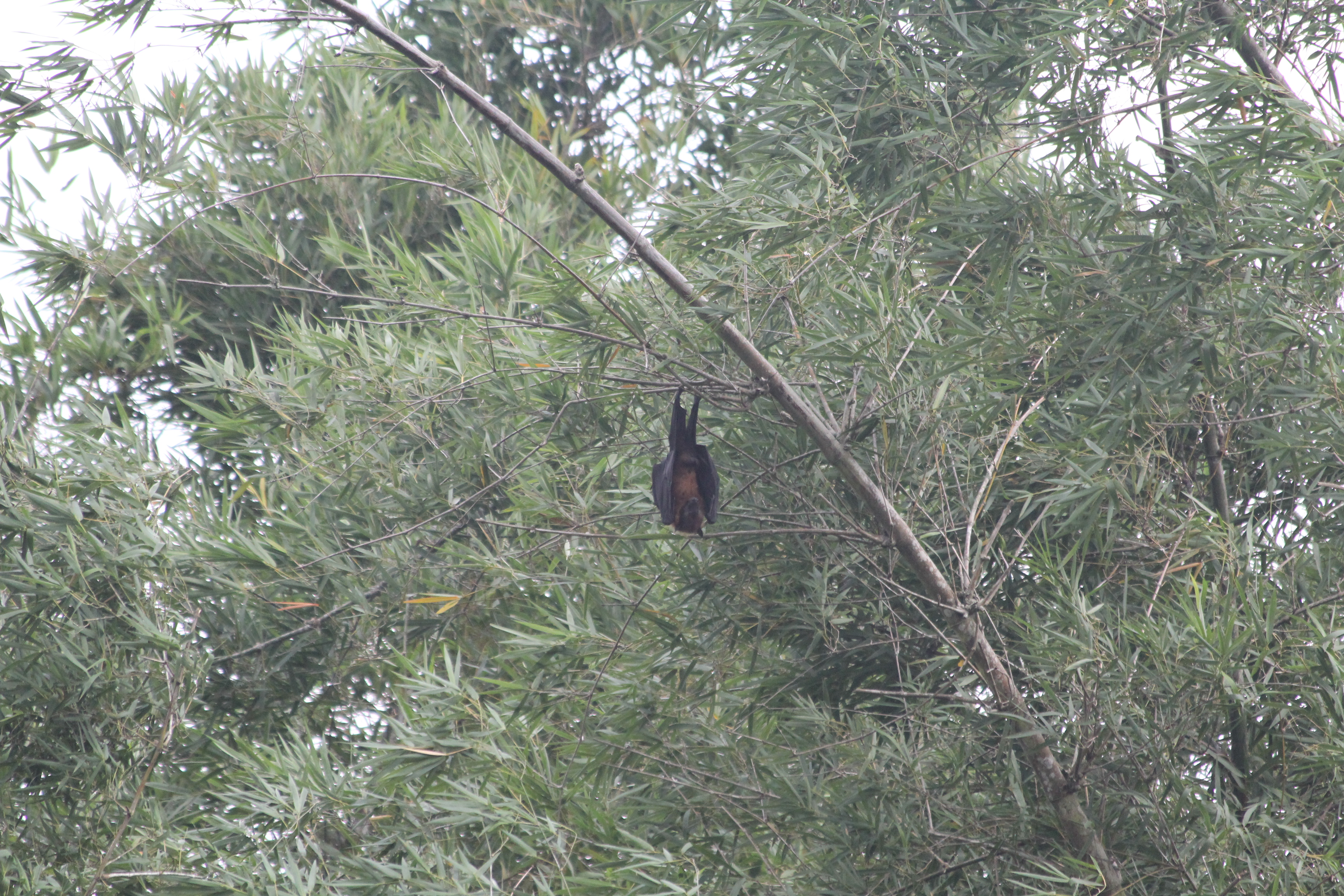
Cardamom County faces onto the Periyar Reserve. From much of the property, including most guest rooms, the view is clear onto a huge stand of bamboo.  In the upper reaches you can always see dark bundles dangling during the day time.  By late afternoon, the bundles start moving.  When will they transform into something recognizable?

When foxes fly.  That’s when.   And it is best when it happens before sundown because with a wingspan of up to three feet, it looks like a prehistoric raptor at first glance.  It is difficult to take good quality photos of these creatures in flight because lighting is not usually right.  Around 2:30 p.m. recently, on an extremely windy day the motion woke them and they took flight. Annoying to them, probably, but very fortunate for me.  Continue reading

Profile: Ratheesh & Wellness


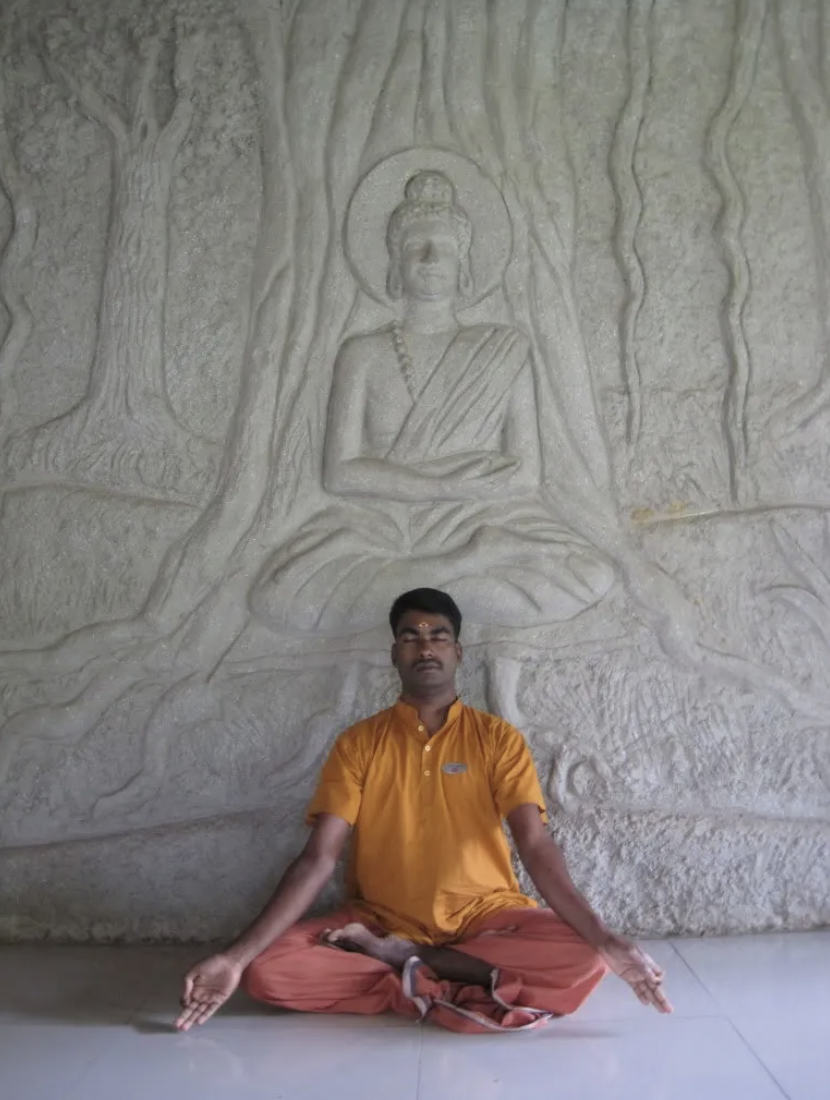
Lately I have been speaking and spending time with Ratheesh at the front desk and around the resort. Ratheesh is an ayurvedic therapist and practitioner and also the resident yoga teacher at Cardamom County. It was actually Ratheesh’s grandmother, who he respectfully refers to as Thankamma, who taught him yoga techniques from a young age. We also discussed what inspired Ratheesh to enter the ayurvedic trade and his response was his family on his mom’s side had always been interested in this 5000-year-old medicinal trade. Dr. Leela Kumary, Ratheesh’s aunt, who is an ayurvedic doctor first inspired him to pursue a career in ayurveda from as early an age as ten.

Having grown up in the backwaters of Allepey, Ratheesh talked about bathing in the waters of the half-salty, half-freshwater due to the opening and closing of the floodgates in-between the dry and rainy seasons. He also told me about his one and a half year training in Coimbatore, Tamil Nadu in Ayura and the following one year practical residency at the Nagarjuna Ayurvedic Hospital in Kaladi, Ernakulam, near Cochi. This was followed by a transfer to Nagarjuna Ayurvedic Hospital branch in Mumbai, Maharashtra for one year where he had a great time sightseeing and living in the big city, especially close to Bollywood. However, in the end Ratheesh missed Kerala, especially citing the south Indian cuisine he grew up with, and returned to practice ayurveda and teach yoga within the hospitality industry. Continue reading

Latin America Reads

Several hundred teachers sporting green canvas bags filled an auditorium at the Central American University (UCA) of Managua. The bags bore the Nicaragua Lee (Nicaragua Reads) and International Reading Association logos under the inscription, “Cantar Palabras, Dibujar Textos,” or, “Sing Words, Draw Texts.” A large banner across the top of the stage welcomed teachers to the eleventh Latin American and second National Congresses on Reading. The teachers were mostly from Nicaragua and Central America, but many South American countries, as well as Puerto Rico and USA, were also represented.

I was there accompanying the delegations from schools supported by Fundación Nicafrance. As I mentioned in a previous post, this foundation sponsors schools with other members of its social enterprise network: Morgan’s Rock Hacienda & Ecolodge, La Cumplida/Cafetalera Nicafrance, and Exportadora Atlantic, S.A. These are all intertwined with the Simplemente Madera Group.

The great highlight of the day’s proceedings was the eagerly-awaited arrival of Sergio Ramírez, who was vice-president of Nicaragua just after the revolution (86-90) and is probably the most celebrated poet and author of Central America since Ruben Dario, who still has a historic importance to Nicaraguan culture. Scores of teachers had copies of his latest book, La fugitiva, which they would ask him to sign at the end of his speech about the importance of reading to future generations of Nicaraguan society. This tall man and his deliberating voice, which rang across the auditorium, actually inspired me to wait in line and ask him to sign my shirt. This was the first time I’d ever asked someone for their autograph.

To find out why I had my shirt signed rather than a piece of paper or a Congress program (see the first link for an Excel sheet), stay tuned for the latter of my next two posts about this Congress and what I learned about the state of Nicaraguan literacy today.

Valuating Rainforest Ecotourism in Costa Rica

In my last post, I claimed that only a small number of studies have been done on valuating eco-tourism as an ecosystem service. I was wrong. After some more digging around, I’ve discovered that a fair number of studies address this topic, though only a small number of studies actually evaluate specific regions of the world. One of the most interesting reports I stumbled upon was from the Journal of Environmental Management. In 1998, Susan Menkhaus and Douglas Lober, two researchers from Duke University, published a paper that focused on Costa Rican rainforests and their ecotourism value. If you’d like to read the whole thing, it’s titled “International Ecotourism and the Valuation of Tropical Rainforests in Costa Rica.

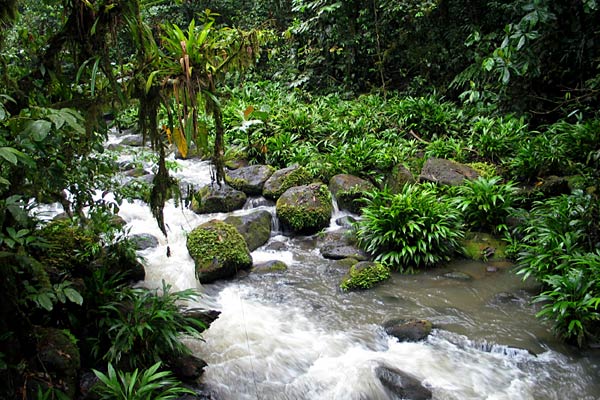
Rainforests provide dozens of ecosystem services. In Costa Rica, they serve the booming eco-tourism industry.

By way of background, Costa Rica is a textbook example of effective management of natural resources, tourism, and integrated public policy. It is widely recognized as the greenest country in the world, and it remains the most visited Central American country. Covering less than 0.05% of Earth’s landmass, Costa Rica contains a whopping 5% of the world’s biodiversity, has 12 different life zones, and boasts one of the highest land protection rates in the world. Nearly half of the tourists that come to Costa Rica engage in some sort of eco-tourism activities. Needless to say, Costa Rica is the best nation to take as an example for this study, which attempts to quantify the value of Costa Rica’s rainforests from a tourism standpoint. Keep in mind, however, that the authors only sought to calculate the eco-tourism value of the rainforests—not anything else related to the forests’ medicinal, timber, or biodiversity value. Continue reading

An Auspicious Beginning

The end of a remarkable weekend. A plan realized, an organization kick-started, exceptional levels of eagerness and dutifulness, and a very healthy dose of fun. Tomorrow I’ll post in detail about what was achieved this weekend, where the project will go from here, and my other general impressions. But until then, I have to admit that I’m riding a high, for the first time having been part of such a fruitful and meaningful collaborative project. Here are some pictures from today’s meeting, during which logistical concerns were ironed out and questions about printing and creasing were answered:


Forest Department & Social Entrepreneurship

Well, we’re back from our first day.  The reason I came for this internship, originally, was to support and document entrepreneurial conservation.  From meeting Diwia when I first arrived a couple months back, to meetings with various levels with the Forest Department’s hierarchy and front line, to today was one of those small arcs of history.  The Forest Department’s approach to conservation, leveraging the abundant mix of creativity, entrepreneurship, and energy in the local community, was a testament to the possibility of good governance.  One of my first posts when I arrived in Kerala, noting the news accounts about public sector corruption in this country, is balanced today by a more inspiring portrait of what that sector can and does do more than they get credit for.

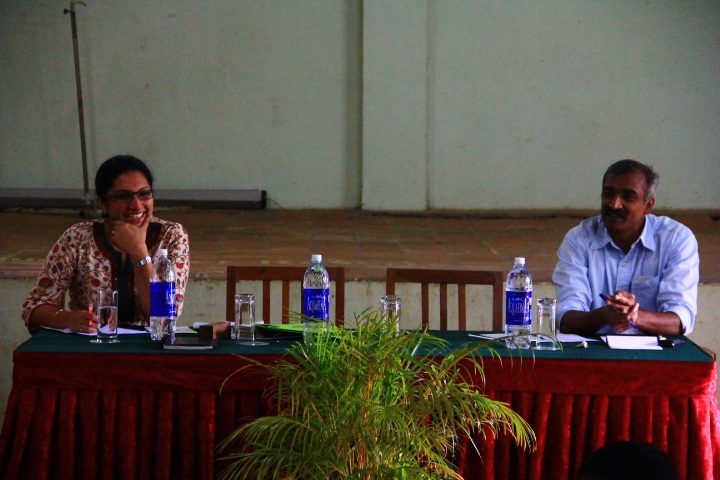
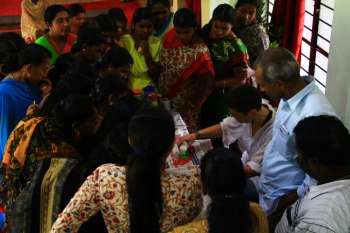
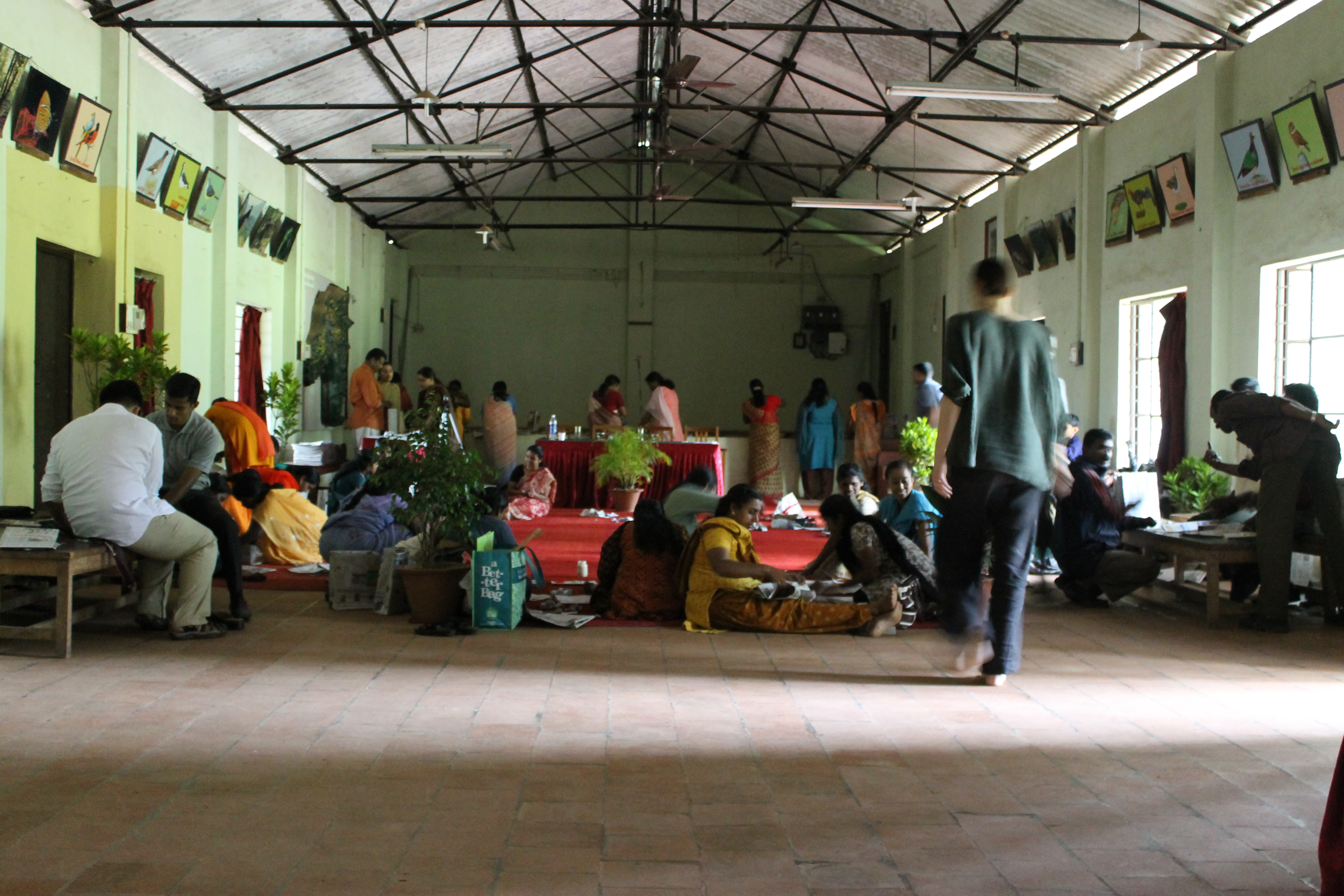
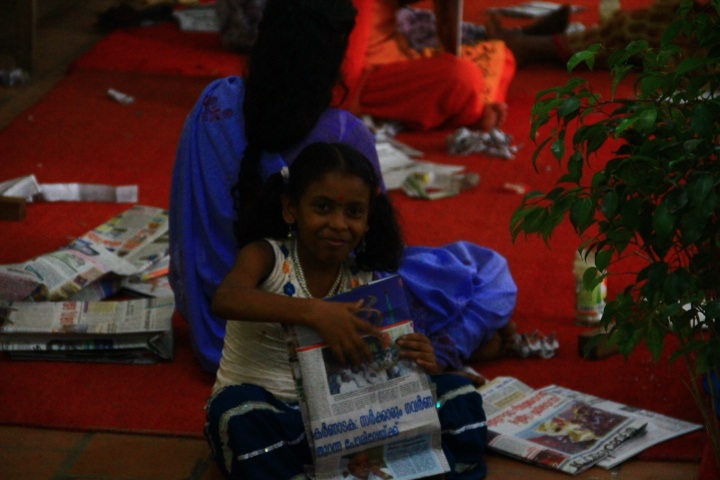
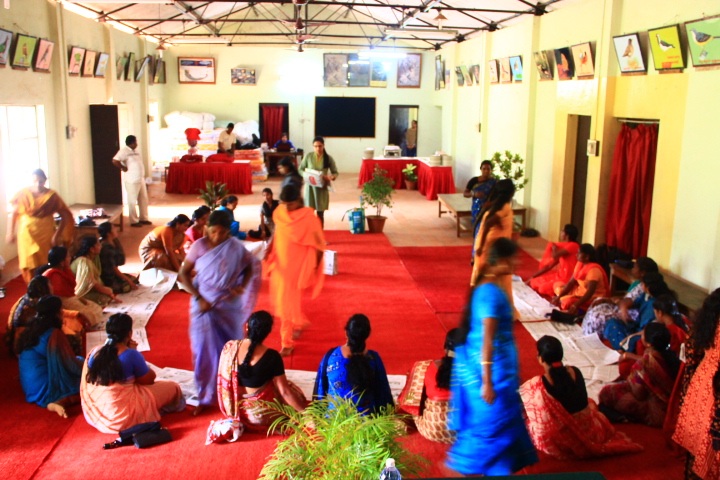
To describe the workshop as a success, I think, would be an understatement. The enthusiasm and enjoyment that infused the work, which no one seemed to tire of, was infectious, and I think everyone is looking forward to tomorrow morning. The fact that only three women said they couldn’t come back for tomorrow (which, I’ll remind you, is Sunday) morning’s session is particularly telling, and I hope the photos posted here are equally so. There were a lot colorful accents to the main event, notably the children who ran around helping their mothers (or made their own bags), the men on the side learning in their own way, and Diwia’s scolding the interns (myself included) and George for making too much noise. It was described as a party and a picnic, but in the end a whole lot of learning went on, and close to 300 bags were made.

Check out this video that Sung and I made this morning (set to the music of a South Korean pop star’s hit song, to honor Sung):

Check back again tomorrow at 11:30 EST for more live updates, and in the meantime read over the day’s happenings!


Equitable Origin–Certified Responsible Oil Production

Whether one believes that oil is the lifeblood of our modern society, or that we need to rapidly transition to more sustainable forms of energy, it is clear that society will be using petroleum for decades to come. In this post and in those that follow, I’ll describe my present work as well as underline the importance of responsibly produced oil. As it stands, despite the ubiquity of petroleum products in our global economy, there is no internationally implemented standard to monitor the social and environmental impacts of its exploration and production. Through a collective effort that brings together petroleum exploration and production companies (E&Ps), NGOs, academics, governments and indigenous and local communities, my company, Equitable Origin LLC, has created the first stakeholder-negotiated rating system for the oil and gas industry that is objective and verifiable.

Our standard, the EO100 recognizes and rewards world-class performers in the oil and gas industry while ensuring transparency as well as environmental and social accountability. It also allows certified operators to differentiate themselves quantifiably, based on their social and environmental performance, and to realize the added financial and brand value associated with certification. By developing this standard, EO is also creating a new marketplace for responsibly-produced oil and its derivatives, akin to those created for FairTrade Certified coffee, Kimberly conflict-free diamonds and Forest Stewardship Council Certified paper products.

If you’re interested in the work of Equitable Origin please visit our website.

Defensive Insects

My younger brother Milo has posted about Entomotography, sharing his excellent “macro” pictures of dragonflies in India. Yesterday I was walking in the woods at Morgan’s Rock when I remembered that I had promised to describe in more detail the cornizuelo tree, which fronts fierce fire ants and sports sharp spines on its branches. Since these trees are all over the place, I set my camera to macro mode and looked for a good specimen. Below is a video that shows just how diligently the ants patrol their home, both when no imminent danger is present and also when a threat is detected. At the end of the video I’ve included footage of a caterpillar.


When I first saw the little balls on the caterpillar’s back, I wasn’t all that surprised. Many insect species (and other animals like fish and crustaceans, for that matter) cover themselves with debris to disguise themselves from predators. What struck me as odd, however, was that this caterpillar, clearly a poisonous species (or at the very least an example of Batesian mimicry), felt the need to cover itself with crap (which, as the video shows, I discovered to literally be true) and thereby potentially avoid predation. Of course, it may be Continue reading

Forest Department Training and LiveBlog

Tomorrow is an exciting day of great import for the social enterprise we’re assisting the Forest Department with. If you haven’t read our previous entries (here’s Michael’s, here’s Amie’s, and here’s Diwia’s), we’re starting a sustainable micro-enterprise here in Thekkady aimed at employing local (mostly) women and making useful bags out of recyclable and recycled material, namely, excess newspaper. This evening, Diwia Thomas, who began a similar enterprise in Cochin, will arrive to provide a weekend training session that begins tomorrow morning at 10. We’re expecting upwards of 40 women to attend, all with the hopes of being part of this business. She will guide them through and teach them how to make quality bags, as well how to maintain and organize the operations of the business. All our meetings and conversations with Forest Department officials and local women should hopefully pay off tomorrow, and the operation should be on it’s feet by the end of the month.

Given how exciting this is for all of us, we will be hosting a live conversation about what is happening in the training session, hopefully deploying photos and videos to help you, our readers, get a sense of the event. This conversation will take place at coveritlive.com, a free liveblogging service. If you’re not familiar with this format, ‘liveblogging’ is often used for streaming important information about sporting and political events. We think it is also worth applying for this event.

So please join us! Tomorrow morning I’ll post a link, which will lead you here: click here.

We’ll be starting at around 9 AM (11:30 PM EST). If you’re in a different time zone, you can at least catch the beginning and maybe the end. It’s easy to post questions and respond on coveritlive, and the format will work much better with added voices.

See you tomorrow!

Prince’s House

Without words to describe the day, I present more photos from Sung. These were taken during our visit with Prince, who lives with his mother and father in the hills just a few km higher in altitude than the site where I hiked earlier in the week. Prince, a bellhop at Cardamom County, was raised on a 5-acre cardamom and pepper plantation. Although I had walked through other plantations while here, this was the first time I was able to actually look around and witness the lifestyle of a planter and his family.

There was a glut of sensory detail so the smells and sounds be-damned; the pictures will have to do. Note, however, that the cicadas were in full force, and that there was an incessantly barking dog (named Tiger); and that the cows bellowed, not so much in ‘moos’ but in rounder ‘mows;’ and that the busker (the man pictured below) and his little sister sang out of tune and without rhythm; and that the tapioca and cardamom and jack fruit and pepper go on for acre after acre; and that Prince continuously warned us to be careful while walking on the slippery dirt road (‘slowly, slowly’) always in the same cadence and tone, the ‘oh’ in ‘slow’ every-so-slightly drawn out and the first ‘l’ slightly rolled. None of this the pictures can say. Nor can they quite capture what it’s like to be in a cardamom field where the stalks have grown ten feet high (like being in a cardamom fantasy-jungle), nor how steep is the hill that Prince and his family climb everyday after getting off the bus. And of course, what perhaps gave me the greatest pleasure: Prince’s brothers are named Rince and Rinso. That is, they are together Prince, Rince, and Rinso. You just can’t make that up.

Fruit Hunters

There’s a particular fruit stall that I frequent on Thevera Road. Its wares almost literally spill out onto the street, with filled bins overflowing the boundaries of the shop interior, fruit stacked high on shelves going up the ceiling on both walls of the narrow space. The back of the shop has a few tables where people can purchase fruit drinks, but I think the majority of their sales are of the fruit themselves.

There always seems to be something new, depending on the season (or week within the season). One day I entered to find a table overflowing with small, reddish purple plums. I’d never seen what I would call “stone fruit” in India before, so I excitedly pulled out one of my cloth bags and started picking through the pile for the ripest looking specimens. When I see plums it reminds me of living in Europe—where I used the multiple varieties in my version of the classic Tarte Tatin. Before living in Paris I actually had no idea there were so many types of plums, but as summer progressed new varieties would arrive at the Marché, each with more melodic names than the last: Reine Claude, Mirabelle, Belle de Louvain… and with each addition I would remake the tarte, and the family would pronounce that each one was the “perfect” plum for the recipe, eaten of course with a spoon of crème fraîche and the guilty expression of one caught licking the plate upon completion.

Here in India I brought the bag of plums home Continue reading

Moments of Peace

We will have more to say about cars in India.  Michael made brief mention here, but the environmental questions of an emerging middle class in countries as populous as India, most of whom see cars as a definition of progress and success (thank you Mr. Ford and Engine Charlie!), are blog-cloggingly numerous.  So we will tread only occasionally into this terrain.  And when we do say more, we will focus primarily on one form of treachery: the horn and its contribution to noise pollution.  Reading Mr. Egan’s account of a unusual moment of mass inspiration in an erstwhile car-struck city reminds us of our need to elaborate on our own plans for inspiring tranquility in the land of please-honk…