Arthropods and Sunsets

While walking on a trail today, Pierre and I came across a spider with a lime green back. As we approached it, it bared its behind at in our direction and dripped forth some dangerous-looking white liquid. They were very small droplets that didn’t spray towards us, but merely fell down to the dirt below the web. We paused to photograph this spider, keeping our distance in case what we had witnessed was just the priming of a more serious discharge mechanism, and then went on our way.

As I thought back on this spider I realize that we may have simply walked in on its moment of defecation, and incorrectly interpreted the droplets of excrement as an attack. A quick Ecosia search showed me that spiders’ poo is often white liquid that leaves a chalky residue, so I am starting to believe that what Pierre and I saw was not a direct assault but perhaps still a method of self-defense in some cases.

What we watched later in the day, however, was a clear attack. A millipede (which I incorrectly identify as a centipede in the short video I took) was beset upon by a fast-moving bug that darted at its writhing, myriapodous prey without mercy. Unfortunately, Pierre and I were on the way to Sunset Hill (see my previous post) so we had to leave at the risk of missing what we hoped would be a great view of the sunset.

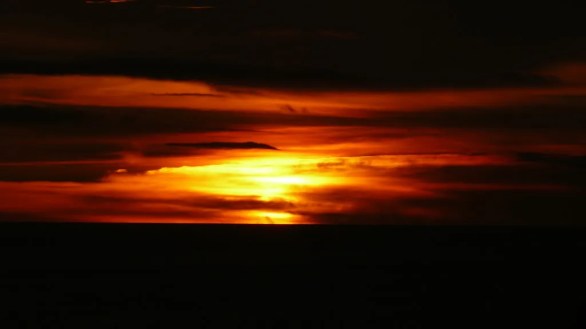
When we got to the top of the hill, we were rewarded with the best sunset I’ve seen from the point so far out of the three times I’ve been up there. I think the better sunsets must be during the dry season, when there aren’t quite as many clouds covering the sun as it descends over the ocean horizon.

A Staff Tour

On its face, there is nothing remarkable about a company picnic. If what I’ve learned from media representations and other secondhand reports stands up, it seems that they happen just about everyday in some part or another of the world, and that they all involve a bit of hair-letting, whether with ice-cooler beer at the neighborhood park or mini-fridge delectables in Vegas. It is this understood relaxation—or evisceration—of daily norms, of one’s decorum, coupled with the acceptance of its temporality—because of course, work does go on the next day, and you must confront those who yesterday saw you transformed—that gives these professional gatherings their almost sacred quality in the religion of the workplace. Whether mentioned in hushed tones or all too self-consciously laughed off, the company picnic/outing/soiree is, in the daily grind’s cosmology, the potential site of the divine, of the disclosure of truth and the unmasking of custom.

So I don’t think I overstate it when I say that yesterday I bore witness to (and, yes, sometimes partook in) culture. Twenty hours in a bus through the hills of Tamil Nadu is culture, and my inability to draw from my fellow travelers a suitable translation of its subtleties (I mean, who can speak fluently about his own culture?) made it that much more profound. No, this may not have been ‘culture’ in the sense that the Martial Arts show down the street purports to be, nor is it ‘culture’ in the same way that the locally-inspired cuisine at Cardamom County’s All-Spice Restaurant is.

This was culture in the minute, unsalable sense. This is that culture which happens in the infinite, petty moments between friends. Continue reading

Cars for Children

Full disclosure: I feel sort of awkward drawing attention to this story. It describes one of the most unsettling and simply bizarre state initiatives I’ve heard of in a while, and I’m not entirely sure the matter merits space on this site. Alas, my provocative side gets the best of me sometimes and I am compelled to link to it, if only because it’s consistent with the problems I promised to raise yesterday, not to mention it’s pertinent to India and that it points to some of the truly hard questions we as a global population will have to ask ourselves in the coming century. These questions bear spiritual, physical, cultural, and ethical import, and how we answer them…well, that’s just more than I can deal with in this format.  Continue reading

Which God?

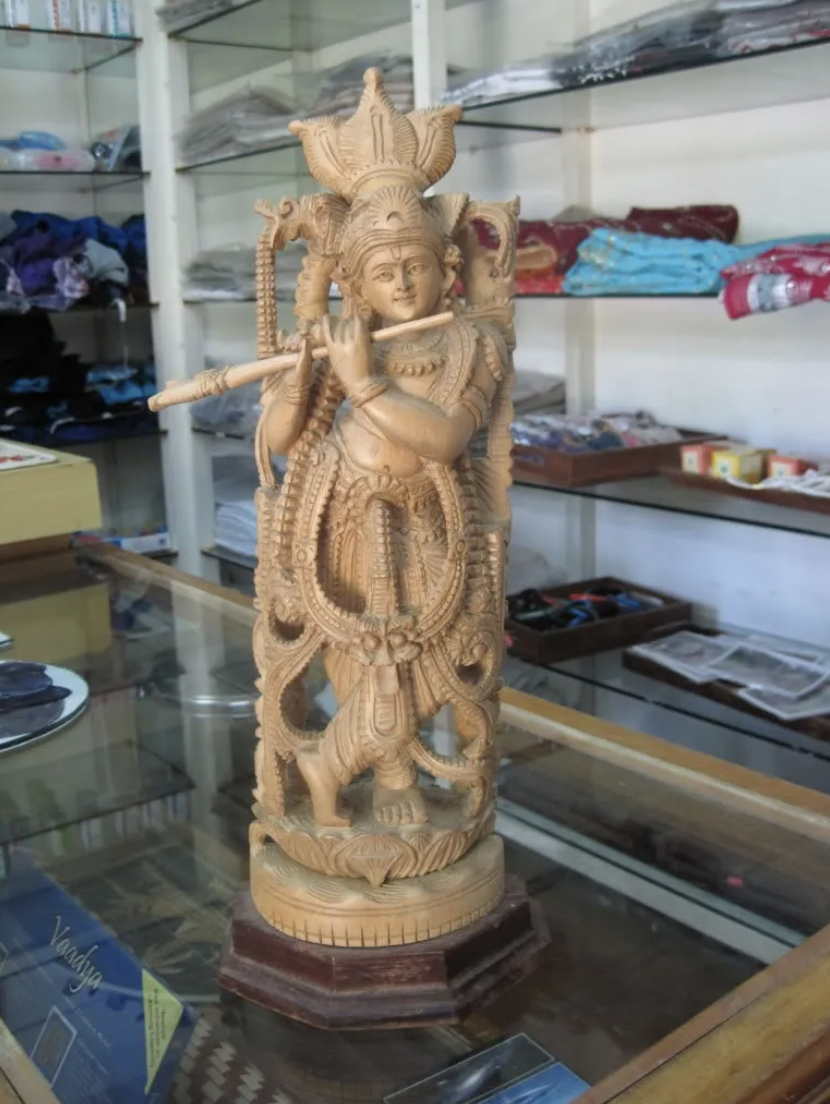
The other day I was working in the Ants gift shop with its manager Manoj, who also represents the helm of the guest relations experience department. When I began asking about the various products offered in the gift shop ranging from vibrant dhotis and saris to spice and herb books as well as delicately carved houseboat models, I noticed two sculptures of what appeared to me to be Hindu gods. It turns out the first god was Krishna, the young boy playing a flute. The second was the well-known elephant headed god, Ganesha.  If you’re not yet aware, Hinduism is a polytheistic religion. And by polytheistic that means there are over a whopping 330 million different gods in Hinduism. Continue reading

Carbon Emissions Series: Air Travel Efficiency

One of the more interesting responsibilities of my current internship here in DC is to peruse news articles and company/NGO reports that relate to corporate social responsibility. Last week, one particular report caught my eye because of its relevance to travel and tourism. Brighter Planet, a sustainability research and reporting company, recently published a white paper on airline efficiency. The paper, titled “Air Travel: Carbon and Energy Efficiency,” struck me as ironic. Air travel is a highly emissions-intensive mode of transportation and seemingly incompatible with sustainability. It accounts for 2% of global greenhouse gas emissions, a large number for a single industry.

Brighter Planet’s report, however, did not seek to justify flying. It instead analyzed a decade’s worth of data on a host of fuel consumption metrics on all major airlines. What the research found was intriguing and useful. The efficiency of a flight that you take is influenced by countless factors, but there are five main “efficiency drivers” that most significantly impact the GHG emissions of a flight: aircraft model, seat density, load factor, freight share, and distance. I’ll do my best to explain each of these briefly. Continue reading

Kayak Surfing with a Friend

Today I met Pierre de Chabannes, a young Frenchman interning at the Ponçon’s La Cumplida farm in Matagalpa. A student at a French University, he is working on repairing and improving the current hydroelectric dam/canal system in place at La Cumplida so that the farm can produce enough electricity to supply the surrounding area in Matagalpa.

After showing Pierre around the ecolodge, we decided to go kayaking in the cove. We went out past Morgan’s Rock and then crossed over to the other side of the cove before returning to the coast, where we caught a wave onto shore and tried surfing a couple times. Eager to surf some more, Pierre switched his seat to the back of the kayak (we’d had them in the middle), where he thought it would allow him to control the direction better, as well as prevent the nose of the kayak from plunging into the water and causing a flip (which had happened to both of us already). Controlling the direction was also useful because we had both been pushed parallel to the wave we were riding several times despite out best efforts. When he switched to the back seat, Pierre surfed all the way to shore with little difficulty, so I soon made the same change. Continue reading

Central American Pygmy Owl

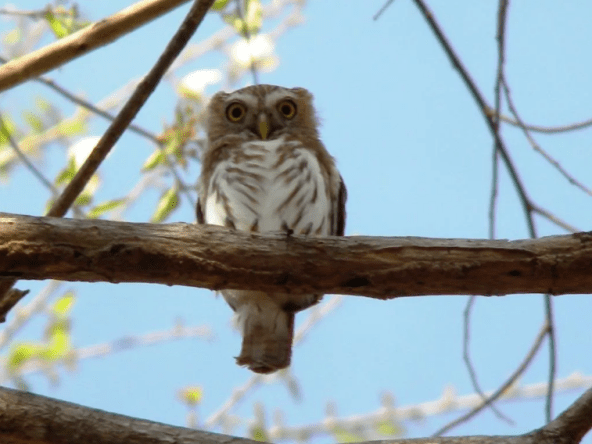
Today Harvey and I went on a nature walk with a couple guests from California. Interested in seeing birds, they had brought a pair of binoculars along, which we soon had an opportunity to use. We were walking along what seemed a deserted trail when Harvey suddenly motioned for us to stop and pointed up into the trees on our left. We saw nothing, and Harvey had to lead us along the branches with his finger to show the little fist-sized lump of white and light brown that was a pygmy owl. With the help of the binoculars and Harvey’s guidebook, we were able to identify it as a Central American pygmy owl. Without the binoculars it would have been impossible to distinguish between the three or four species of owl, since they are all roughly the same color and only differ in markings and patterns on their chest, head, and tail feathers. Although I couldn’t get a picture since it was too far away (still no zoom on the camera), here are some photos that Bismar took last summer, the season when trees’ foliage is much less dense and in some cases nonexistent.

It is winter (the rainy season) here now, and therefore very impressive that Harvey was able to spot the tiny bird through all the leaves without the help of a flashlight at night, which is when one usually sees the owls.

A Thousand Miles

I recently watched a video that became a personal challenge.  It brought to mind that famous Lao Tzu quote, “A journey of a thousand miles begins with one step.”

After watching this video, I arrived at the equation: small changes = sustainable.  In other words, sustainability is the thousand mile journey; small changes are the baby steps that get us there.  This video highlights our ability to grow as we challenge ourselves to do something new for a mere thirty days.  I thought and thought of something that could be worthy to merit a thirty-day challenge; however, it was then that I realized that I was taking the small step out of the equation—no task is too small towards my sustainable journey.

Continue reading

The Fundamental Question

It’s something I ask myself every day. I wake up, untangle myself from my bedding, and ask…Why on earth am I here on this planet? I reassure myself with some grounding answers, and once I get a glimpse of the world outside my window I answer like this…

Sustainability is my passion. Sustainable societies. Sustainable economies. Sustainable environments. Got the idea? Basically, my goals focus on sustainable lifestyle for sustainable futures. To achieve this, I not only try practicing an enduring lifestyle, but I also live to promote the conservation efforts of others around the word.

Having been raised in a developed country where varieties of information seem endless, it excites me when less informative, developing countries make strides towards conservation.  Here, I will share my excitement as I discover more about global conservation initiatives, and, in turn, hopefully my accounts will inspire citizens of all originations to join these efforts to conserve and protect the beauty this planet and its inhabitants have to offer.

An Introduction

Before I post again about things of substance, I wanted to take a moment to introduce myself to our readership, to share my interests and goals, and to spell out more clearly the reason to the madness of my earlier posts. If I’m not mistaken, my fellow contributors will be doing the same over the next few days.

I am, nominally, Michael Muller. In the fall, I’ll be a senior at Amherst College, where I study, among other liberal arts ‘disciplines,’ Political Science, in particular political theory and the history of political thought. I have a peculiar fascination with how different groups’ and individuals’ concepts and philosophies affect and create attitudes, and how these attitudes influence action. If this all sounds highfalutin or like pseduo-psychology, you’re on the right track.

Self-deprecation aside, however, I also have a passion for interpreting and, if possible, correcting injustice. Thanks in large part to my upbringing, I tend to identify with the cause of protecting the less-protected, whether it’s a social group, eco-system or idea. Of course this tendency is all well and good in theory, but its tendance requires greater sedulity in practice. When Crist offered me the opportunity to come work and write for Raxa Collective this summer, to identify problems with and solutions for conservation initiatives in Kerala, I immediately snagged the opportunity, understanding it not only as one that would allow me to effect change, but also one that would test, probe, relax and strengthen my still-developing convictions.

In my posts over the next four weeks, besides providing personal insight into the wonders of the Periyar, Kumily, etc., I hope also to problematize and contextualize my own experiences, to illuminate some of the complexities inherent to preservation and conservation in a rapidly developing nation (and world), and offer possibilities for readers and travelers to get involved in the conversation.

With that in mind, I will try to offer non-political entry points into political questions, while not neglecting or forgetting the reason I’m here, or, for that matter, why anyone from outside Kerala would come here: the impossible rarity of its natural and cultural riches.

Thanks for reading, and I look forward to comments. Let’s have a conservation conversation*!

*Sorry.

Damn Dams and Macaque

A couple of days ago, I hopped on a motorcycle (my first in 21 years!) helmed by Saleem, and headed across the border of Kerala into Tamil Nadu. I hadn’t realized until this trip just how proximate the neighboring state was, and that I had actually walked into it several times without realizing I had done so.

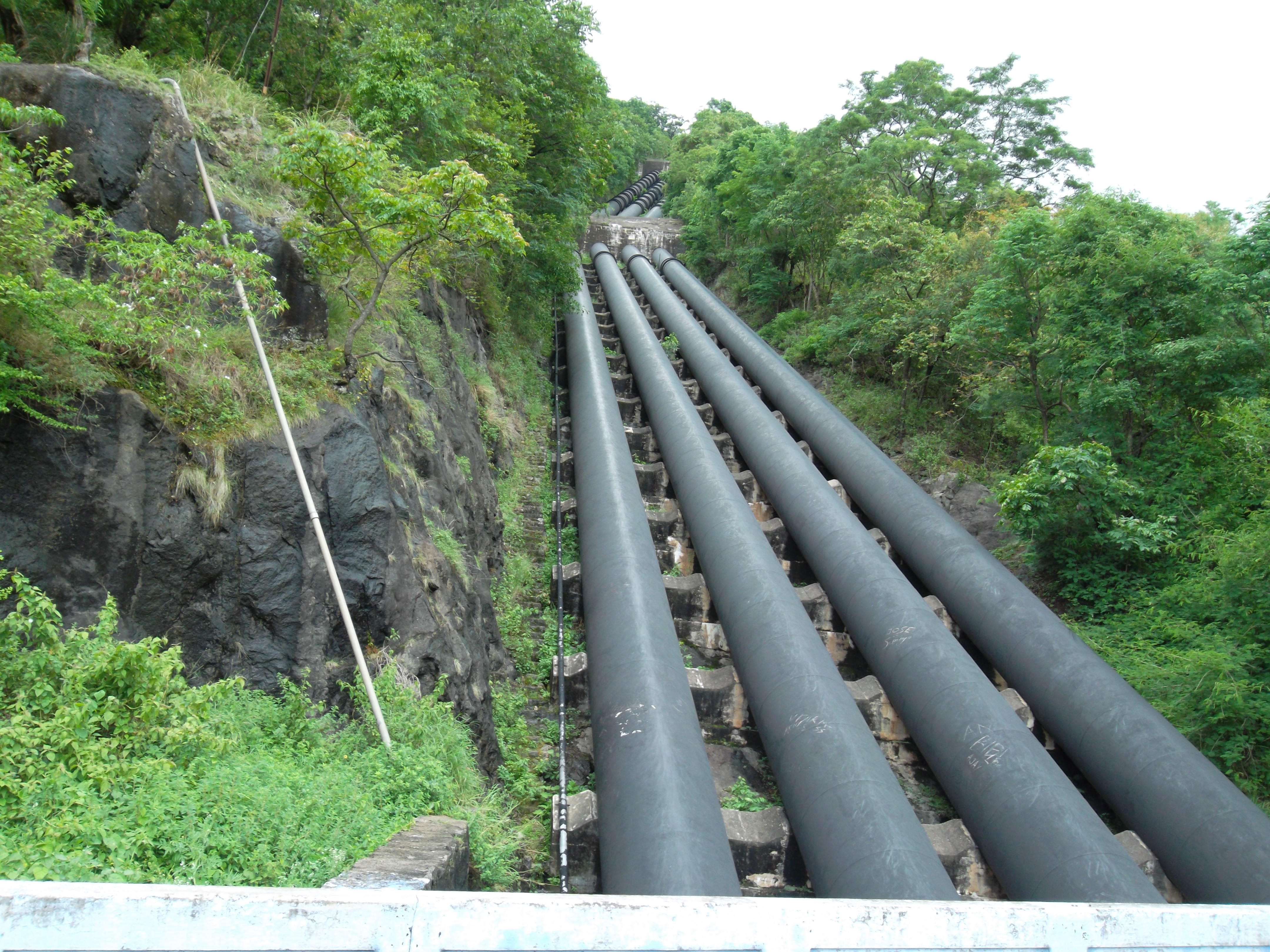
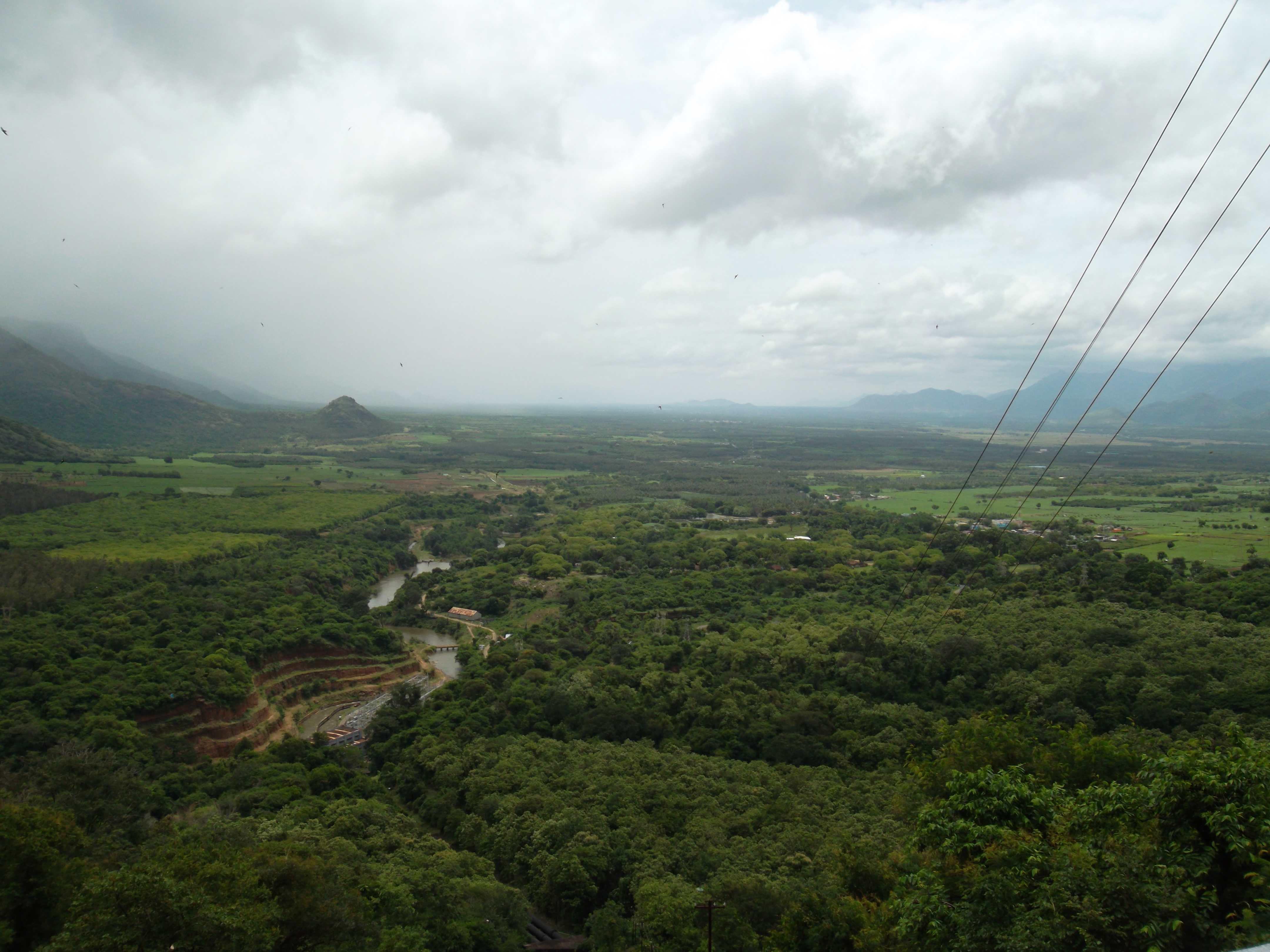
Saleem had plans to take me through the measure of forest that extends beyond Kerala to the penstock pipes that carry water from the Periyar River down to Tamil Nadu and a hydroelectric plant. These pipes are an attraction unto themselves, and looking over the slope down which they run provides a scenic view of the lush farmland of this TN valley.

At that time, I didn’t know– and Saleem only hinted at– how fraught with political tension the very spot we were standing is (and has been) to the Tamilians and Keralans. The provenance of this conflict is a century-old treaty between the Princely State of Travancore (which is now Kerala) and the Secretary of State for India, representing what is now Tamil Nadu. Essentially, this treaty gave to Tamil Nadu, an otherwise arid area, the right to use water from the Periyar River for irrigation– for 999 years. This agreement, for all intents and purposes, created the Tamil Nadu you see in the picture above. Continue reading

A Kipling Character at Morgan’s Rock?

It happened today.

I was on the Campesino Breakfast Tour with guests. We drove through the finca till we got to the Aguacate Farm, where the chickens, ducks, and cows are kept. Don Juan taught us how to milk a cow; the lactating mother was mooing with discomfort, eager to be relieved of her burden. Sitting on a one-legged stool that was tied to his waist, Don Juan expertly sent streams of white into a gray pail, and the guests crouched to do the same with early morning alacrity.

We filled up the pail, thanked Don Juan, and made our way to the chicken barn. Through the dim light and faintly unpleasant smell, about 180 chickens skittered about, clucking indignantly at the disturbance. A rake and shovel leaned against the wall, a wooden stick with little rawhide strings hung from a column, and a leather belt was wound around a rafter in the corner. The man who takes care of the chickens took Harvey aside and whispered something in his ear, then proceeded to lead the guests through the barn to show them the coops and water-troughs. While the guests were distracted, Harvey approached me.

And then it happened.

Continue reading

Sri Lankan Frogmouth

Early yesterday morning, Gourvjit and I met Saleem and Deepthi, a graphic designer who was collecting information about wildlife in the Periyar, for a trek into the forest. Because Gourvjit and I had recently been with Amie and Milo on a path typically followed from the boat landing–which was where we were meeting our guide this morning–to avoid touring the same land we asked the guide to lead us on a different route. He told us there was one which might yield some interesting wildlife sightings, but that the terrain would be a bit more difficult. We took the challenge, of course.

What our guide had neglected to tell us then, but which we soon realized, was that the route he had planned for us to take wasn’t really a ‘route’ at all. That is to say, to make our way we had to cut through 7 ft tall elephant grass and other underbrush, and we followed no well-worn groove in the dirt, or footpath. But in this manner we carved our way up a hillside, conquering some slippery rocks under foot, to a clearing, from which we could see a broad landscape of savannah hills and waterways.

Yet on the way down from the clearing these minor travails were justified as, after tramping through another patch of thick grass, our guide told us to be still while he pointed to what looked like a lump of tree–but with eyes. Deepthi whispered to me that we were seeing a Sri Lankan (or Ceylon) Frogmouth, a nocturnal bird native to the Western Ghats, whose skill at camouflage makes you about as likely to spot it as one of the Periyar’s 50 tigers. I can say very honestly that I have never seen a bird I was so taken with, with its wide-set and perfectly round eyes, and its blocky, brown, and perfectly rigid form. Because the Frogmouth hides in the daytime by keeping still, we were able to get unusually close to it for a good while before it was threatened and flew off to a tree with thicker foliage.

It was a really unique experience to see this bird, and one I’ll not soon forget. Luckily, Deepthi was able to capture some great shots of the bird. Check them out!

Finca Work

I had more butterfly luck this morning when, exiting the trail from my lodgings onto a dirt road, I spotted a Hamadyas glauconome glauconome, commonly known as the Guatemalan or Glaucous Cracker, on a tree nearby. Although I didn’t know it at the time, the males of this species can create a cracking sound while flying. I had heard this sound from flying insects several times as I biked along the road during my stay here, but had never been able to identify the source. The specimen photographed here was a female, however, because once I got close enough to take the shot, it flew away silently. After breakfast, I was crossing the long suspension bridge that leads to the bungalows and one of the trees next to the railing, whose canopy was roughly level with the bridge, had flowers that had attracted another butterfly. Despite the length of time that the butterfly stayed at the flowers to collect nectar, I have not been able to identify it from the various photos I took, because it never opened its wings to show the markings that would give it away in a guidebook.

However, one animal I have been able to identify is a little lizard that I found while walking a trail. More specifically of the family Polychrotidae, or an anole lizard, the species I was lucky enough to encounter was the indigo-throated anole, Anolis sericeus. I have learned that all anoles have at least some ability to change color, they all have dewlaps, which are cartilaginous frills below the neck, and, like many lizard families, they can relieve themselves of their tail if sufficiently threatened. Fortunately my presence was only frightening enough for the anole to reveal its beautiful frill and, as I approached for a close-up, run off.

When I was done with my little hike, I headed to the finca, where I was to see the recently planted saplings and the cleaning of last year’s crop area. Continue reading

Sunset Hill

The right arm of the Ocotal cove, the hill directly visible from the restaurant and beach, is just as important a landmark as Morgan’s Rock itself, since it is actually part of the property and is not hidden from view at certain angles. When one looks out at the ocean from the ecolodge, one sees this hill first; the rocks at its base withstand the constant onslaught of thundering waves, and the steep rocky slope is almost completely covered in verdure.

The prominence might be called Sunset Hill, due to its function as the lookout point for guests who wish to watch the sun descend into the ocean from a high vantage point. From most locations on the property, viewing a full sunset is impossible since the Hill is in the way.

I left the ecolodge in the morning today to climb Sunset Hill and see what the trail was like without the dim lighting that would accompany a sunset. Before approaching the hill, I found two low-hanging coconuts and cut them with some stem as handles—I knew it would be a hot and long climb and wanted some refreshment at the top. Despite the additional weight, the climb was not too difficult, but I was left sweating when I reached the first stop: a bench set in the trough of the two wave-like hills with a view of the whole cove and ecolodge. Setting the larger coconut aside, I grabbed the other and used my pocket-knife (Wenger Swiss Army, Patagonian Expedition Race Edition) to cut a channel through to the small orb holding the water. The can-opener proved the perfect tool for this job, since the blade was short enough to present little danger to my fingers in case of a mishap, and I could also apply significant pressure to leverage chunks of husk out of the way without fears of bending or breaking the metal.

After a few minutes I had reached my goal. This fact was drawn to my attention mostly by the popping sound and burst of water that sprayed up to soak my face. Setting my dripping glasses aside (I only wear my old pair while hiking, in preparation for these unforeseeable events) to dry, I widened the hole slightly and titled the large vessel back to drink the refreshing water.

I am used to drinking coconut water from the fruit itself, but in a very different fashion: street-vendors in Central America and India use a machete to hack the top off the coconut and stick a straw in the near-perfect circle they’ve created. Using my tiny tool to pry open the fruit’s tough skin and press my lips to it like a certain Tom Hanks character made me feel much less touristy than I do when I buy a street-coconut. After all, I had not only selected the fruit off the tree myself, but had also carried it up a significant slope and used its water to cool off before continuing the climb to the Sunset Summit.

To reach the summit, one merely has to climb the stairs set into the hill. This is not a great challenge, but in what was now a midday heat, the stairs were unwelcome. However, compared to the tall limestone steps of Tikal temples, or the uneven sandstone tomb-paths of Petra, these simple wooden planks set into the earth were nothing—a mere ten-minute task, if that. When I completed my ascent, it was instantly clear why the hill has been chosen as a sunset lookout. The height of the hill, along with its projection from the mainland by roughly a kilometer, presents a worthy view even without the sun setting over the water. A little lizard, which I later identified as a rose-bellied spiny lizard, was resting in the full sun that fell on the top of a railing post.

I enjoyed my second coconut in a cooler location: the middle of the stairs, where the overhanging branches of bushes and trees create a tunnel blocking the sun. A little more cautious, I avoided getting sprayed, and slowly consumed my drink before descending the hill and returning to the beach. On my way there, I saw a pair of mating butterflies that I believe to be Papilio thoas nealces, and once I got to the beach I found a Draedula phaetusa. As I walked from the beach to the road, a Microtia elva fluttered along the path and rested a while on a nearby bush. It was a lucky day for butterflies, and I look forward to photographing and identifying more of them, especially once I have a camera that can zoom!
Newspaper Products

In the bathrooms at Morgan’s Rock, the trash cans are little green plastic bins covered in what appears to be painted wickerwork. However, closer inspection reveals that the woven material covering the bins and little caps is in fact newspaper that has been twisted into long strands and braided into shape. Despite the paint job, one can still see the letters and broken images on the baskets, and this simple artisanal craft adds a creative and rustic touch to what would otherwise be a banal bathroom fixture.

The bungalows are equipped with the above rectangular variations of newspaper bins for composting, recycling, and trash, and seeing the different colors next to each other convinces me that the unpainted version is the most attractive. Unfortunately, it is also the least common, as all the bathroom trash bins I’ve seen look like this.

I spoke to Alba, the General Manager, about the bins and asked where they were made. She answered that several towns in and around the Rivas area have handicraft shops, and that as part of community support Morgan’s Rock purchased these sorts of things for both utility and decoration. Rivas is a city and a department (sort of like a province, I think), so I will need to find out how widespread this newspaper craft actually is, because there could be an important collaboration between Nicaraguan and Indian newspaper craftspeople (Kerala in particular has been working on an utilitarian recycling over the past few years).

FRA and Periyar

In my last post, I wrote about and linked to some writing about the Forest Rights Act of 2006, legislation which gives added to protection to tribal communities with a traditional claim on protected and preserved land in India. I ended by speculating about the difference between policies and practices regarding human-animal cohabitation at other wildlife sanctuaries and the one where I’m staying, which is in the Periyar Forest.

Well, I’ve spent the past couple days learning firsthand about the tribal community in around Kumily and Thekkady, and I can now with confidence confirm that the tribal heritage development and preservation initiatives in this area are indeed succeeding, and perhaps to a greater degree than at other parks. ‘Success’ is here defined as a community gradually finding sources of income that do not require the extraction of resources from the preserved environment.

To this end, in the Periyar there are four Community Development Committees, as well as numerous agencies designed to regulate and control interactions between the tribal community and the forest, and the tribal community and the market. I guess in the past tribal community members had been treated unfairly by buyers of their agricultural product (which is mostly pepper). Part of the CDCs’ job is to ensure that farmers are made aware of fair market prices and meet only with honest middlemen.

I met with the chairman of one of the CDCs and he told me about the economic and political structure of these relationships. He also told me that, at least within the Mannan community, more young peope are going on to professional schools and receiving advaced degrees, and that close to 50% of the tribal population now makes its primary income from outside the forest.

While these may be informal indicators of change and improvement as the Forestry Dept. defines it, they do point to developments in Kumily and India in general that it seems almost like you watch happening before your eyes on the ground.

More Wood

The finca connected to Morgan’s Rock, part of the Agroforestal forestry business whose owners also run MR and SM, is in the process of clearing the brush covering a large swath of land where new trees will be planted. The trees are going to be more separated than in the past so that more of them can grow to full potential faster. Some of the previous plantation plots have suffered from underdevelopment as a result of too much competition between cramped trees. As a result, these confined trees grow straight up and don’t mature in width as quickly, staying thin and branching upwards to reach the sun. One of the positive effects of this growth is that the branches are very straight instead of curvy, but there is less wood. Over the years the finca has planted over 1.5 million trees for harvesting, and 100,000 for reforestation.

When I arrived at the new plot of trees, Israel, supervisor of the workers clearing the land, showed me the distance difference between saplings, marked by long wooden stakes in the ground already cleared. There would be about a meter more between each tree and row. He pointed to the plantations on our right and started saying the names of different trees interspersed in the endless rows. “Caoba Africana, roble, cedro.” African Mahogany, oak, cedar. Other semiprecious-wood trees in the plantation are teak and pochote, which is covered in stubby spines from top to bottom. Every now and then I could see a tree with a yellow line painted on it, marking it for cutting in the coming months. Israel told me that at the moment they are culling about 20% of each tree plantation to promote the growth of healthy trees and cultivate wood for Simplemente Madera. This amounts to roughly 500 trees for each plot where healthier trees are busy growing to optimum maturity. A potential project would be following one of the trees marked for culling through the steps of cutting, processing, preparing, and buying; in “The Omnivore’s Dilemma,” Michael Pollan followed a calf from youth through fattening, slaughtering, processing, and the final consumption.

Just Wood

Simplemente Madera,” which means “just wood,”  is a Nicaraguan sister company to Morgan’s Rock that primarily uses sustainable wood sources—one of them is the tree plantations at Morgan’s Rock—certified by SmartWood according to the criteria set by the Forest Stewardship Council, an international NGO that sets standards for sustainable forestry worldwide. Providing furniture and architectural services, the company helped design and furnish Morgan’s Rock, and provided most if not all of the woodwork in several Nicaraguan houses and hotels.

Collaborating with the World Wildlife Fund and International Finance Corporation, in 2005 SM worked with a Nicaraguan indigenous community to develop the inspiringly magnificent One Tree program influenced by a similar project in the UK. SM is also attempting to salvage wood felled by Hurricane Felix and provides wood and carpentry services to the eco-surfboard company Ocean Green (which now offers 15% off your surfboard if you book a stay at Morgan’s Rock).

Based on fairly thorough browsing, the SM website hasn’t been updated since 2008. Keeping the information current would help make SM a more relevant member of the online carpentry community and generate further popular publicity for Morgan’s rock.

Sea Kayaking

Yesterday afternoon Harvey and I tried kayaking around the cove. Since the waters were very calm once we got past the waves, we decided to also paddle out of the cove and even past the literal Morgan’s Rock, a jagged tooth of rock sprouting from the ocean with a couple tufts of grass growing on it here and there. The Rock is actually part of the neighboring cove even though it doesn’t look it from the Ocotal beach (the ecolodge’s). We sat around for several minutes at a time, just feeling the waves lift and lower us on the water. It is an eerie feeling when you are so low in the kayak that you watch a swell block out the horizon and rise above your head, only to carry you up set you back down as it passes you, not truly a wave until it reaches the beach. Even with these peaceful pauses, the speed with which we were able to reach the rock told me that reaching San Juan del Sur by kayak within four hours was easily possible. After making sure that the next day’s weather would be safe, I made plans to set out early in the morning for SJdS with a fishing boat, the Eco I, as an escort.

*

Today I left the beach at around 6:50AM. It was high tide, and there were many small waves crashing onto the shore and my kayak as I tried to make my way over to the fishing boat anchored a couple hundred meters out. Once I was properly soaked, I got past the waves and greeted the two fishermen, Jacinto and Alejandro, passing them my backpack after removing my large water bottle and sunglasses. Jacinto checked his phone—it was 7:00AM, time to start. I shoved off the Eco I and started paddling.

The monotony of the trip was broken by scenery and “visits” by animals. A needlefish jumped out of the water a couple yards in front of me; frigate birds would start a dive towards the water and suddenly pull up, their prey apparently swimming for cover; over a dozen butterflies (not all at once) fluttered wildly over the waves of the open ocean–a comical sight. I couldn’t help thinking that if I was only a few miles further off shore, I may attract dolphins. However, despite my motored escort boat I didn’t feel safe kayaking out that far, and my job was to determine the duration of a trip to any of the coves south of Morgan’s Rock. Throughout the trip the coastline was a comforting danger—I could easily see the waves crashing violently into the many rocks protecting the shore, so I always maintained my distance from the coast even though there may be less wind to slow my voyage.

Huge rock formations and green forests provided most of the interesting landscape, although I also passed the well-known surfing beach, Maderas (which I will save more details on for a future post) and the Survivor filming site Playa El Toro. While in the open ocean I took two or three breaks of about a minute each to drink some water and stretch my fingers and shoulders, as well as to rearrange the Buff I had put on my left shoulder to block some of the harsh rays poking through the clouds (one of which, by the way, looked stunningly similar to a hummingbird’s head, with eye detail and everything). Once I entered the San Juan del Sur bay, passing the immense US Navy Hospital Ship on my right, the wind picked up to the point that I had to take several more breaks to loosen my shoulders. I had no idea how long I’d been kayaking, but I was ready to ride a wave onto shore and use my legs for a change. When I was a couple hundred meters from the beach, the fishing boat pulled up behind me and dropped anchor. I went ashore and bought the fishermen and myself a drink and some snacks, then kayaked back to the Eco I and tied my craft to the larger one. From leaving the Eco I at Morgan’s Rock to returning to it from the San Juan del Sur shore, the trip had taken two and a half hours.

Our ride back was much more relaxing, and I asked Jacinto questions about potential and current ocean excursion offerings while Alejandro fished and made a comment every now and then. One fun activity that Jacinto mentioned is diving with an air-hose the way it used to be done with huge brass helmets (except now one simply uses a mouthpiece), so I plan on trying that out as soon as possible.

Kayaking in the sea brought back memories of the last time I had a paddle in my hands: while exploring the blue caves in the cliffs of Koločep, an island off the coast of Dubrovnik, Croatia. Although the Adriatic Sea is radically different from the Pacific Ocean, my arm muscles certainly thought the same of the two experiences.