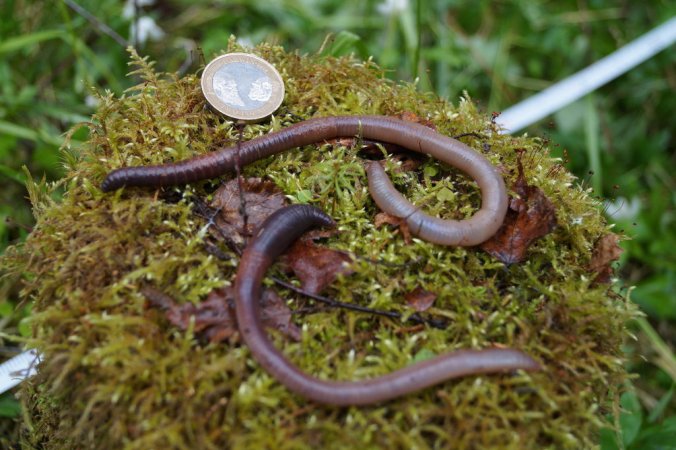
In my daily scan for information related to the environment, I invariably learn something that surprises me. Like the fact that the earthworm, which provide valuable ecosystem services, can also represent danger on a global scale:
Worms are wriggling into Earth’s northernmost forests, creating major unknowns for climate-change models.

Earthworms recently have spread to Alaska’s boreal forest. In some areas, the biomass of earthworms is 500 times greater than that of moose, a keystone species. Lance King/Getty Images
Cindy Shaw, a carbon-research scientist with the Canadian Forest Service, studies the boreal forest — the world’s most northerly forest, which circles the top of the globe like a ring of hair around a balding head.
A few years ago, while conducting a study in northern Alberta to see how the forest floor was recovering after oil and gas activity, she saw something she had never seen there before: earthworms.
“I was amazed,” she said. “At the very first plot, there was a lot of evidence of earthworm activity.”
Native earthworms disappeared from most of northern North America 10,000 years ago, during the ice age. Now invasive earthworm species from southern Europe — survivors of that frozen epoch, and introduced to this continent by European settlers centuries ago — are making their way through northern forests, their spread hastened by roads, timber and petroleum activity, tire treads, boats, anglers and even gardeners. Continue reading →


 Organikos