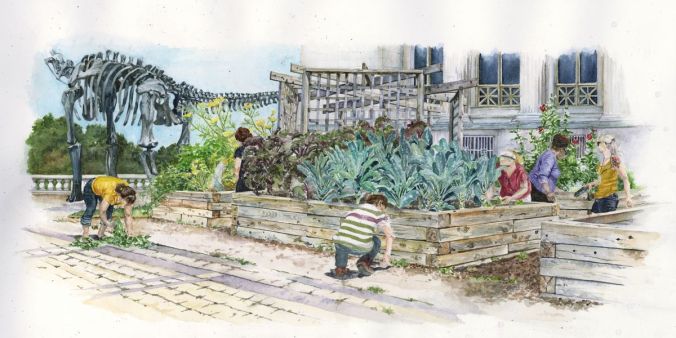
Greening Museums

garden_drawing

Illustration by Emily Woodworth

There have been moments in recent months when continued attention to the little details we see, and link to concerning incremental improvements in environmental sensitivity, social responsibility, or any other sustainability metric seems akin to “rearranging the deck chairs on the Titanic.” Political turmoil, and specifically political commitment to dismantle environmental protection in various influential countries, might make incremental change seem even less significant to some. These deck chairs are different. Every instance of care and action is a data point worthy of attention, and we will continue to connect the dots. Today, from the Field Museum of Chicago and their awesome Green Team:

THE FIELD MUSEUM’S GREEN TEAM

A Greener Field (the Museum’s “green team”) began as a grassroots recycling effort in 1989, and now has over 40 members representing every area of the Museum.  Staff members who share the Museum’s commitment to improving sustainability attend monthly meetings which provide an outlet for them to share successes and challenges in terms of greening their departments, as well as a vehicle to initiate and help implement institution-wide programs.  From bike sharing programs to recycling and composting Continue reading
Undiscovered Species in Natural History Museums

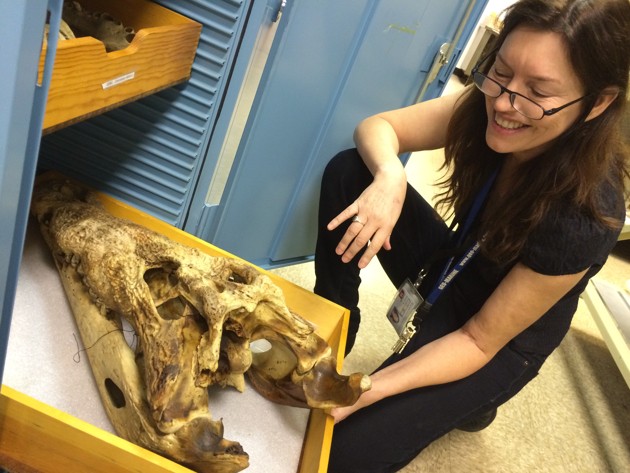
Evon Hekkala and a crocodile skull at the AMNH. Photo by Ed Yong.

We’re big fans of museums, especially those of natural history with specimens of life in the world that are invaluable to science. Now, in a piece for the Atlantic, Ed Yong (previously here) writes about the dozens of new species being identified many years–or in the case of some Egyptian mummified crocodiles, millennia–after their collection. These specimens, Yong reports, can inform us further on the evolution of animal body types, on cycles of diversity, and on the origins of epidemics, among other things:

In the darkness of the Akeley Hall of Mammals, swarms of kids gawk at beautifully staged dioramas of Africa’s wildlife. The stuffed safari, nestled in the American Museum of Natural History (AMNH) in New York, includes taxidermied leopards stalking a bush pig, preserved ostriches strutting in front of warthogs, and long-dead baboons cautiously considering a viper. In one corner, in a display marked “Upper Nile Region,” a lone hippo grazes next to a herd of lechwe, roan antelope, and a comically stern shoebill stork.

“This is my favorite one,” says Evon Hekkala, pointing to the display. “There’s a taxidermied crocodile tucked away down there.”

Continue reading