Exploring Iceland

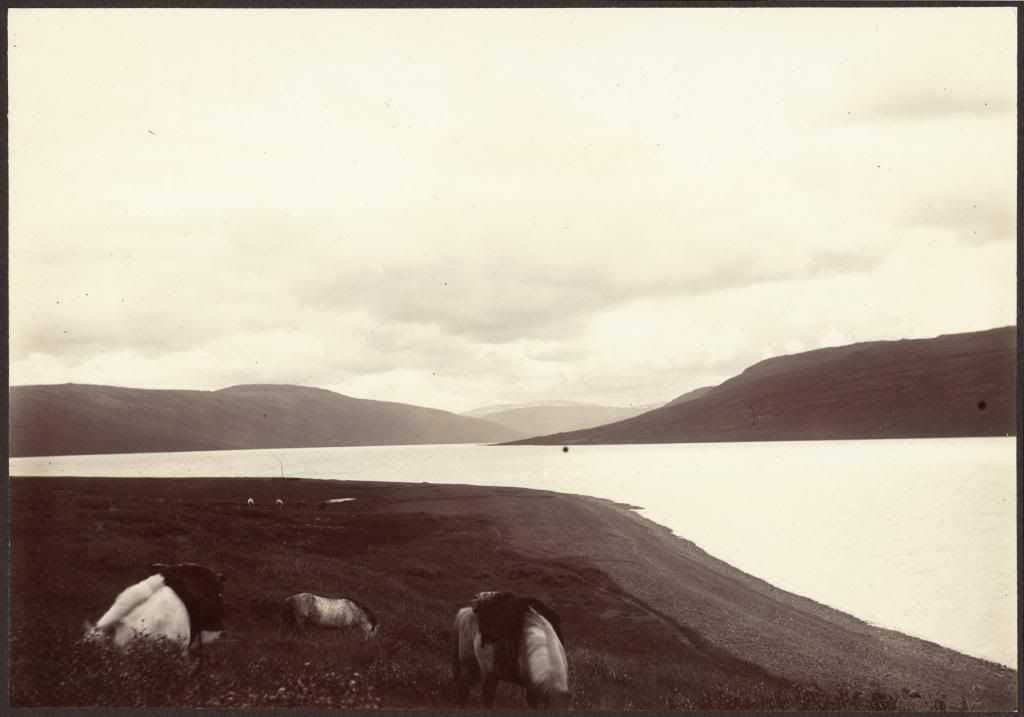
The head of Skorradalsvatn. Collodion print ca. 1900 by Frederick W. Howell. Bequest of Daniel Willard Fiske; compilation by Halldór Hermannsson at the Fiske Icelandic Collection of Cornell University.
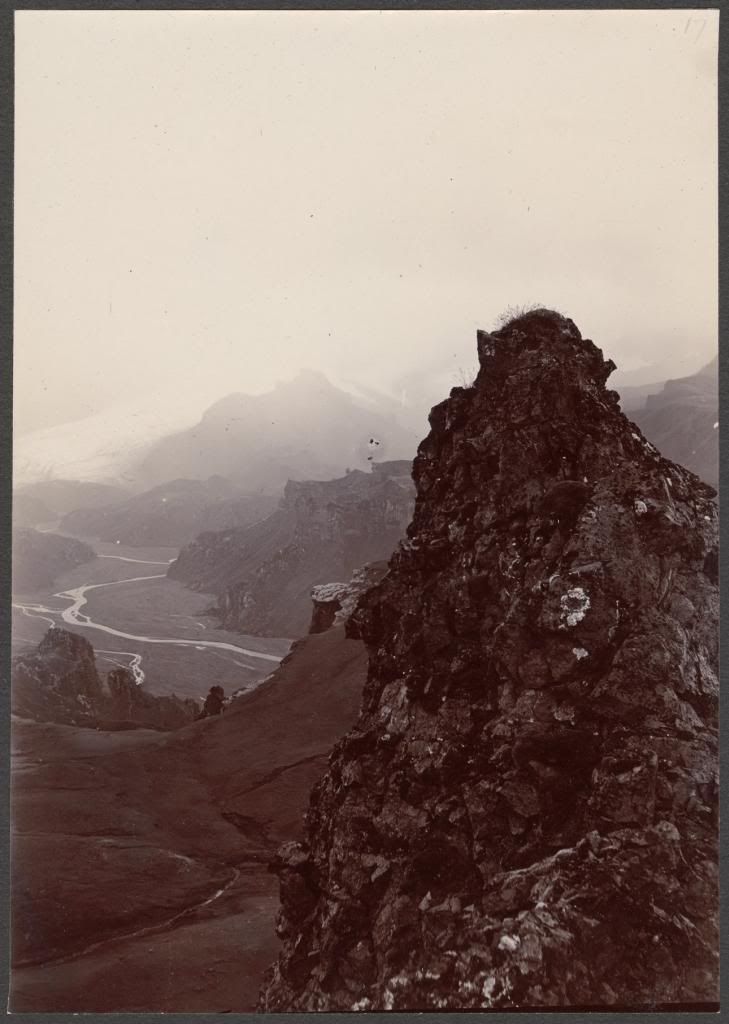
Þórsmörk. Head of Krossárdalur. Collodion print ca. 1900 by Frederick W. Howell. Bequest of Daniel Willard Fiske; compilation by Halldór Hermannsson at the Fiske Icelandic Collection of Cornell University.

It was mentioned a week or two ago that Iceland is in the air. For me, Iceland is on my mind, in my laptop, hidden throughout the Cornell libraries, and scattered about my room. After a couple essays for an environmental history course last year and some preliminary research for finding an honors thesis topic in the history major, I discovered that, thanks primarily to Cornell University’s first librarian, we have one of the largest collections of Icelandic material in the world. Since one of my projects for the environmental history class had shown me that Iceland was an interesting place to examine more closely, I did some more research and found the topic of European travel there during the eighteenth and nineteenth centuries engaging enough to choose as an honors thesis subject.

One of the places in Europe with the most spaces left blank by cartographers through the eighteenth and nineteenth centuries, Iceland’s inner regions were not fully mapped until 1901. Continue reading
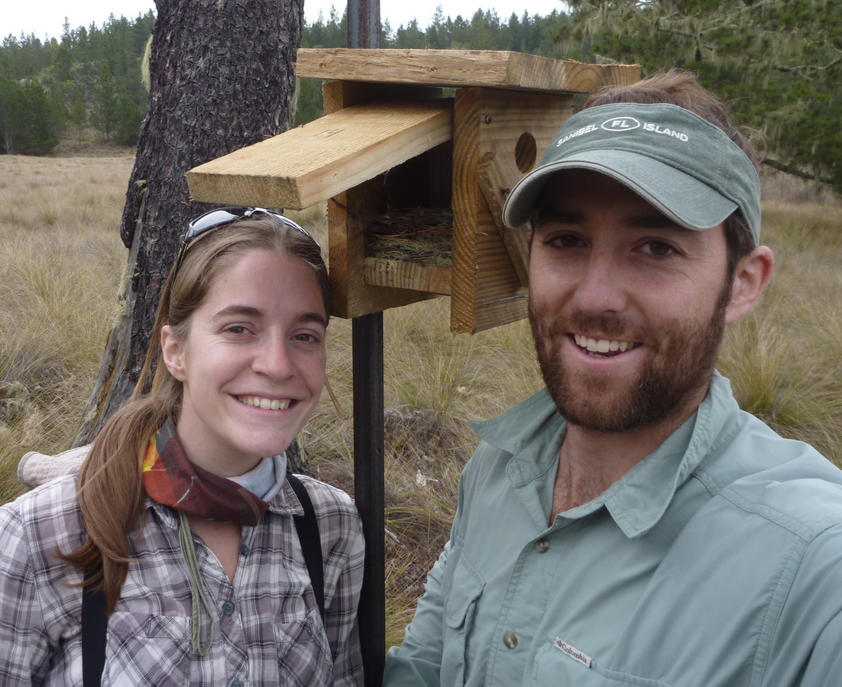
Tracking The Golden Swallow

Marisol and Justin

Marisol and Justin

Dear La Paz Group followers,

I’m excited to have been invited to share with you current updates from the Cordillera Central of the Dominican Republic where I am active in uncovering the life history traits and conservation strategies surrounding the Golden Swallow (Tachycineta euchrysea), a threatened passerine endemic to the island of Hispaniola. Continue reading

Red-tailed Hawk Chicks Hatch on Earth Day at Cornell University

Photo by Cornell Lab of Ornithology

If you were up around 6AM this Earth Day you probably didn’t think to check the Cornell Lab Bird Cams, but if you had, you might have seen two hawk chicks hatch into their nest atop a light pole on one of Cornell’s athletic fields.

According to the Lab’s news release, the third chick (i.e. the egg in this picture) is due to hatch in the next 48 hours, so keep a close watch by following the link in the photo, and enjoy your Earth Day! As you check out the live feed, you’ll probably see the father hawk, Ezra (named for Cornell University’s co-founder Ezra Cornell), or the mother, Big Red (after Cornell’s sports teams) taking turns incubating the egg and chicks.

Be sure to refer to the Red-tailed Hawk cam frequently asked question page, and also check out the Great Blue Herons in Sapsucker Woods!

If You Happen To Be In Ithaca

Not sure what to do this upcoming Earth Day?  If you happen to attend Cornell University here’s a suggestion: If “Nature never stands still”, taking an interdisciplinary approach toward her recovery and restoration seems like a logical step.

We especially like the circular nature of choosing Dr. Kareiva to give the 2013 Iscol Distinguished Environmental Lecture. Kareiva received his PhD in Ecology and Evolutionary Biology from Cornell University in 1981 and after serving on the faculties of Brown University and University of Washington he is now the Chief Scientist for The Nature Conservancy. Continue reading

Salamanders Announce Arrival of Spring in Ithaca

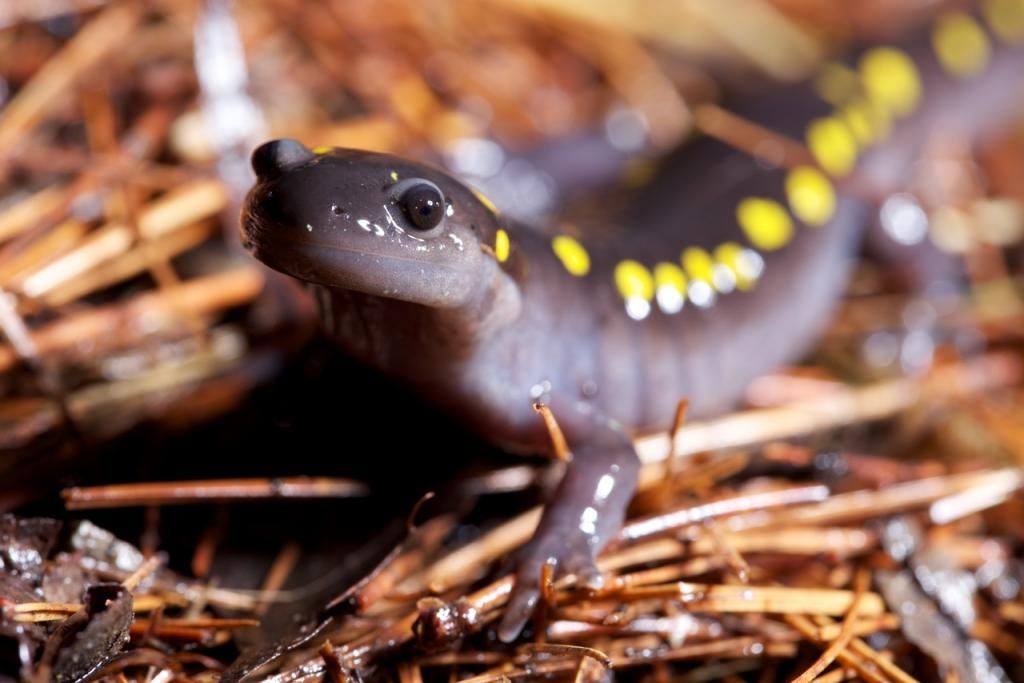
Spotted Salamander by Brian Magnier

Last night, at forty-odd degrees Fahrenheit and under a light drizzle, the salamanders of Ithaca’s Bull Pasture Pond signalled that spring has come. Before I explain, let me tell you a little bit about salamanders:

“The Americas have far more kinds of salamanders than all the rest of the world put together,” the Conant and Collins Field Guide to Reptiles and Amphibians reads in its introductory passage to the order Caudata. Species in eastern and central North America range from barely two inches to nearly four feet long, and some species are practically fully aquatic while others prefer only damp environments. Most of them are active at night and hide during the day, which is an easy way to differentiate them from lizards (except for the gecko family of lizards, which is primarily nocturnal). Other key differences are that lizards have scales on their bodies and claws on their toes, while salamanders have smooth or warty skin (just look at the slime in these photos) and no claws.

Continue reading

Integrated Pest Management (IPM)

Photo by Milo Inman, India

During my last post I mentioned this agricultural strategy in passing, and I’m actually fairly surprised that the topic hasn’t come up anywhere on the blog before. After all, IPM is an increasingly effective and interdisciplinary way to curb economic losses in crops around the world, and one that often attempts to reduce reliance on environmentally unfriendly chemicals like pesticides.

Completely eliminating an agricultural pest is not the ultimate goal of IPM. In fact, due to ecological intricacies and the risks of removing certain species from an ecosystem, merely lowering the number of pests to numbers that do not cause significant economic damage is more advisable. Achieving this reduction in pest populations “requires an understanding of the ecology of the cropping system, including that of the pests, their natural enemies, and the surrounding environment,” according to Professor Anthony Shelton of the Entomology Department at Cornell University. For example, knowing that a certain pest caterpillar species has certain predator species, a farmer might introduce some of the natural predators into his crop to prey on the harmful caterpillars. If the farmer also physically removes the caterpillars by hand and the pest population dwindles to zero, the natural predators might turn to a beneficial insect, like a pollinator, or even attack the crop itself. This is a very vague and hypothetical example but one that reflects the need to understand causes and effects in an ecosystem if one is planning to employ IPM effectively.

Continue reading

Young Explorers

I recently discovered that National Geographic offers grants to researchers, conservationists, and explorers between 18 and 25 years old to pursue projects around the world in archaeology, filmmaking, biology, adventure, and exploration, to name a few fields. These Young Explorers Grants, which generally range between $2000 and $5000, can often be a perfect catalyst for more or future funding for people trying to fulfill a lifelong research dream or experiment with a concrete fieldwork idea — after all, having National Geographic’s name on your list of supporters is pretty impressive, and a sign of great potential!

This morning, I attended a workshop given by several members of the National Geographic team hosted by Cornell University and sponsored by the Lab of Ornithology, The North Face, and other groups, which gave an overview of NatGeo’s mission as well as quite specific examples of research possibilities from past and current Young Explorer Grantees. Continue reading

50 Years Onward, Progress Via Anthropology

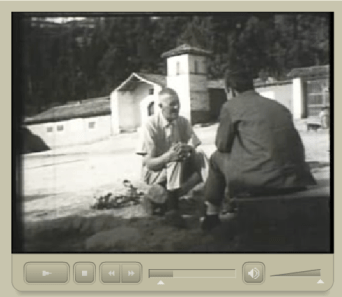
Anyone born in the USA between 1930 and 1970 would recognize the two CBS journalists in this brief documentary.  Some born elsewhere in that period might recognize them as well.  Probably few outside small towns in Central New York and Central Peru would recognize the name of the professor featured here.
So That Men Are Free
McGraw-Hill Films (1963)
Reporter: Charles Kuralt
Presenter: Walter Cronkite
 

I’m Walter Cronkite. We take you to one of the remote areas of the world to the high Andes of Peru. CBS News correspondent, Charles Kuralt reporting…The seeds came here in the head of an anthropologist, a man usually the observer, not the creator of change.  Dr. Allan Holmberg of Cornell University…

Continue reading

We are the RCDT

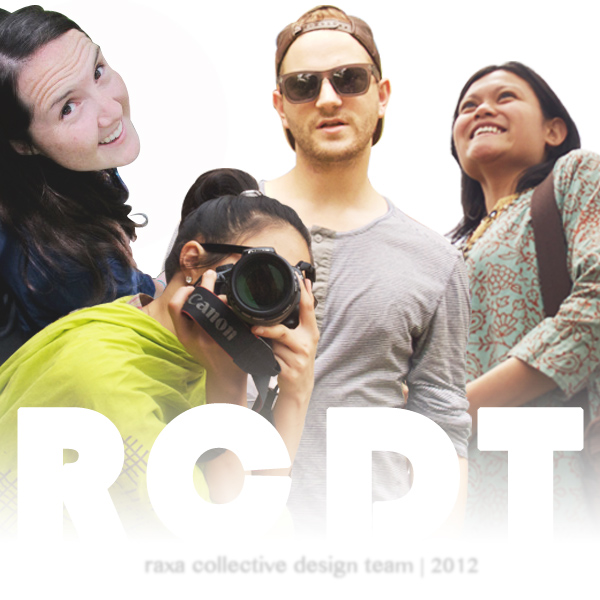
We are a group of adventure seekers, lovers of unusual things, and creators of the useful and the beautiful. In short, we are a collection of design and engineering students collaborating this summer to create renovation and design proposals for several projects under the management of Raxa Collective. And together, we make up the first ever RCDT – Raxa Collective Design Team. 

(from left to right)
Siobhan Powers
recently graduated from Cornell University with a degree in environmental engineering and will return for a 1 year master program.

Karen “Chi Chi” Lin is a 5th year architecture student at Cornell University.

Jonathon Dominic Spada is a 2nd year graduate student in interior architecture at the Rhode Island School of Design with a hotel management and facilities design degree from Cornell University.

Rania Mirabueno is a 2nd year graduate student in landscape architecture at Cornell University with an undergraduate dual degree in architecture and music from University of Colorado at Boulder.

The blend of disciplines, skills, talents and personalities bring forth innovative design solutions to several projects under review. The design team is turning out proposals for a renovation and expansion in Fort Cochin, a green field site in Marari Beach, a renovation in Alleppey, and a renovation in Thekkady. Facing sleepless nights, over-consumption of coffee, and the elements in our outdoor studio, these super heroes will stop at nothing to bring good design and environmental friendliness to southern India!

Birding in Ecuador: Trogons, Toucans, and Tanagers!

Until I catch up on my school-posts, I won’t be writing much about Mindo. I do, however, have videos and photos that I took on Mari’s camera, so check them out! The round glare you often see is the lens of the camera reflecting against the scope that provided most of the zoom to capture the images—I discovered the annoying way how difficult it is to perfectly align the two device’s lenses. Thus, some of my footage has required heavy splicing to edit out the seconds spent trying to focus the scope (which in addition had a bad leg) in one hand while keeping the lenses in line with the other hand. Unfortunately, the most evasive bird, the Golden-winged Manakin, was the subject of the most troublesome equipment management.


Continue reading

Birding in Ecuador: Mindo Manakins

As I had a spare couple days on mainland Ecuador before flying to the Galápagos, I took a very brief trip to Mindo for a day and a half, where Mari Gray, a pre-kindergarten teacher at the Tomás de Berlanga school in Santa Cruz, told me I should be able to see lots of cool birds. Perhaps not too coincidentally, my host in Quito had asked me if I’d heard of Mindo just a few hours after Mari emailed me about the town, similarly informing me that the biodiversity was incredible, particularly for birding.

club

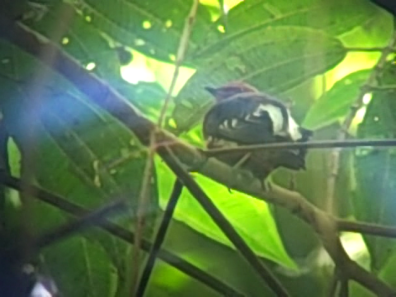
male Club-winged Manakin photographed by the author through binoculars

Even after taking a pretty intense ornithology class at Cornell University and working for the Lab of Ornithology, I don’t really consider myself a birder. When I went on a number of field trips for the class it was the first time I’d really used binoculars with the intent of just spotting birds, and I don’t even know the difference in calls of an American Robin from an Eastern Bluebird, though I can tell you their species, genus, family, and order, as well as those of 149 other common North American birds. Still, when I read that over three hundred bird species reside in the Mindo area, I knew it was an opportunity that nobody should pass up, and this was confirmed by one of my ornithology classmates who knew beforehand over half the bird families we learned. Then I read that the Club-winged Manakin, a bird I’d learned about in class, was fairly easily seen performing its lek courtship display, I knew it was an opportunity I could not pass up.

A lek, although the basic monetary unit of Albania, in this case is the Swedish-based term for a small area where males of a species communally display for females in the hopes of attracting one or more as a mate (the Manakin family, Pipridae, is polygynous, i.e. males have several female mates). Continue reading

The Big Idea

You may or may not have attended university. Maybe you studied science.  Or wish you had.  Or will.  Still, nothing prepares you for the big idea, presented with charisma that is as impressive as the idea.  Click to the right (Krulwich wonders) to see this idea laid out courtesy of one of our favorite science communicators:

Here it is, in a nutshell: The logic of science boiled down to one, essential idea. It comes from Richard Feynman, one of the great scientists of the 20th century, who wrote it on the blackboard during a class at Cornell in 1964.

Heart Throb

There’s something about drums. Like dance, they have an almost primordial capacity to rouse even the most complacent person to action.  The sound connects with the heartbeat and makes it impossible to stand still. Personally I can’t decide whether I prefer West African Djembes, Indian Tablas or Japanese Taiko. Percussion seems to be by nature a communal activity, and the bottom line is that I love the way the sound makes me long to participate.  Continue reading

I Belize I Can Fly

Guest Author: Robert Frisch

The tiny islands or “cayes” off the coast of Belize sit in the middle of beautifully serene coral atolls and are surrounded by the world’s second largest barrier reef.  Like shallow lakes in the middle of the ocean, the atolls host several UNESCO world heritage sites and some of the best snorkeling and scuba diving in the world.  My team, consisting of three Johnson  students and an MPA student from the Cornell Institute of Public Affairs, found itself tasked with providing consulting services and business advice for the owners of one of these cayes in what turned out to be the most unique spring break of my life. Continue reading

Sustainable Water System in Your Own Garden!

In my opinion, the major benefit for attending Cornell is an opportunity to meet diverse industry leaders face-to-face. This week I was fortunate enough to meet the Sales Director of Aquascape, a water-gardening company dedicated to creating/installing a sustainable and, at the same time, beautiful and decorative water features in your garden. The main way they recycle the water is through rainwater harvesting – by capturing, filtering, and reusing the rainwater. Instead of letting it flow back into the body of water, we could be converting the impervious surfaces (which cause stormwater runoff) to permeable surface that allows us to capture and reuse the rainwater. With this captured grey water, you could be washing your car, irrigating your garden, reusing in water features, etc.

Image Continue reading

Fence Art?

Cornell University and the City of Ithaca began fencing the bridges that run over several of Ithaca’s famous gorges some time in 2010, for safety purposes. Many have opposed these barriers, partly because the fences inhibit a full view of the famous natural beauty of Ithaca’s gorges, a huge part of Ithaca’s identity and college appeal. In fact, “Ithaca is GORGES” t-shirts or bumper stickers are a very common sight on campus, and parodies (Ithaca is SQUIRRELS) are becoming popular.

A common sight that is not quite a parody, however, is “Ithaca is FENCES” stickers. They can be seen on every bridge on campus, and on t-shirts. You can read about the messy details of the fence controversy here; the main reason I give this example of protest is its unconventional form: stickers placed on telephone poles or fence posts that play off a famous (at least locally) play on words. Continue reading

The Buzz

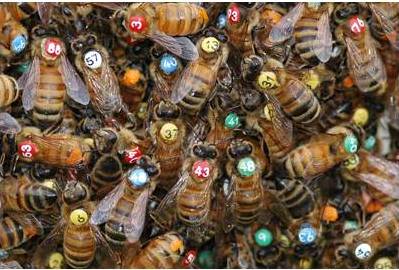
Bee swarm labeled for individual identification. Photo:Thomas Seeley

Cornell professor and chair of neurobiology and behavior Thomas Seeley has been fascinated with bees for much of his life. His new book Honeybee Democracy (Princeton University Press) steps way beyond entomology and apiculture by suggesting the swarming habits of Apis melllifera in decision making as “analogous to how the nervous system works in complex brains.”  Continue reading