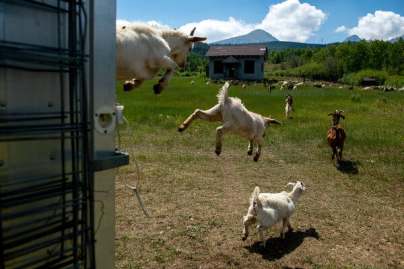
Goats’ Appetites Put To Work

Goats made their first appearance in our pages as a matter of pure visual fun. Then there were several in a row that touched on companionship as well as culinary aspects. Finally one treated goats as workers.  That was five years ago. Today Coral Murphy Marcos tells the story, with photographs by Amanda Lucier, about a family, plus one intern, at the cutting edge of fighting fire with appetite:

The Unconventional Weapon Against Future Wildfires: Goats

When megafires burn in unison and harsh droughts parch the West, local governments, utilities and companies struggle with how to prevent outbreaks, especially as each year brings record destruction.

Carrying an unconventional weapon, Ms. Malmberg travels the American West in an Arctic Fox camper, occupying a small but vital entrepreneurial niche.

Ms. Malmberg, 64, is a goat herder and a pioneer in using the animals to restore fire-ravaged lands to greener pastures and make them less prone to the spread of blazes. Continue reading
Hooved Fire Prevention

Image: Renee Lewis

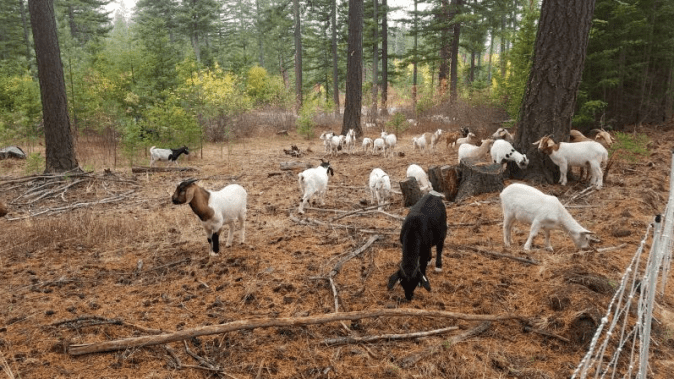
Goats have appeared on these pages in various guises, including being part of urban park maintenance. Thanks to environmental reporter Renee Lewis and the Earther.com for sharing this good news fire prevention story.

Firefighting Goats Devour Fuel Across the West Before it can Burn

Roslyn, WA—After one of the worst fire seasons in recent memory in the Pacific Northwest this summer—with the unforgettable smoke-pocalypse that socked in the region with thick smoke for weeks—a new tool is being added fight against wildfires: goats.

“More and more, people are looking at goats as a tool for fire suppression,” said Craig Madsen of Healing Hooves, a company based in Edwall, Washington, that maintains a herd of about 250 goats that are used for natural vegetation management.

The goats bleated loudly and walked towards Madsen as we approached the plot of land where the herd was busy grazing.

“The goats are complaining because of the rain,” Madsen said, as a cool, fall shower began.

Madsen stood under the overhang of the trailer he uses to to transport the herd, across the road from the land where the goats were grazing. The guard dog, Gigi, sat under a tree keeping watch as the goats—bucks, does, and kids—worked together to devour everything within reach.

Every car that drove by stopped to look at the unusual sight, and many asked Madsen about what he was doing out there with all those goats.

Continue reading

Weed-whacking Goats in New York City

Photo © babygoatsandfriends.com

Goats are fun creatures, providers of milk, cheese, and meat, and also simply petting experiences. Apparently, they can even be rented out as lawn-mowing weed controllers, eating unruly plants where pesticides would otherwise be used. And certain parks in New York City are getting goats on contract to meet that need, as Olga Oksman reports for The Guardian:

Overexcited children and reporters mill around the fence enclosing part of the Prospect Park woodlands. “Daddy, daddy, look!” one eager little boy yells. Everyone is craning their necks, raising their cameras to get a shot. The latest celebrities to grace Brooklyn are a group of eight weed-eating goats, and they are taking up residency through the end of the summer.

Later this week, Prospect Park has arranged a wine and cheese reception so the public can formally meet the goats, which range from Nubian to Angora and Pygmy breeds. Tickets have already sold out.

Continue reading

Introduced Species in the Galápagos

Feral goats on Isabela Island. Photo by Galápagos National Park Service.

Yesterday I wrote about the case of the North American beaver being purposefully introduced to Argentinian Patagonia for a business venture and having severe unintended consequences on the environment in both Chile and Argentina. Most of us think of Patagonia as a pretty faraway and isolated place, and its location so far down the southern hemisphere merits that. The Galápagos Islands are another place geographically apart from most of us–that distance accounts for the specialized evolution that took place in the archipelago over millennia.

The isolation of the Galápagos from the rest of the world for so long, and the relatively small size of the islands, means that it is especially vulnerable to opportunistic species that can become invasive. In the same way that the Canadian beavers had no natural predators in Patagonia, common domesticated goats, when introduced to different islands in the Galápagos by sailors centuries ago, were able to roam and multiply, which was the travelers’ goal Continue reading