Not So Happy Earth Day

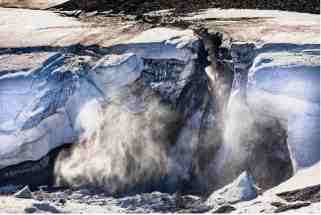
Over the past three decades, the rate of ice loss from Greenland has increased sevenfold. Photograph by Kerem Yücel / AFP / Getty

On yet another Earth Day, whatever those two words mean together in tandem these days, a message from a reliable source:

It’s Earth Day—and the News Isn’t Good

New reports show that ice sheets in Greenland and Antarctica are melting faster than anticipated, and other disasters loom.

The Greenland ice sheet is, quite literally, a relic of the last ice age. It consists of snow that fell year after year, century after century, and never melted; at the very bottom, there are flakes that fell more than a hundred thousand years ago. Continue reading

Messages From Greenland Ice

Greenland Ice.jpg

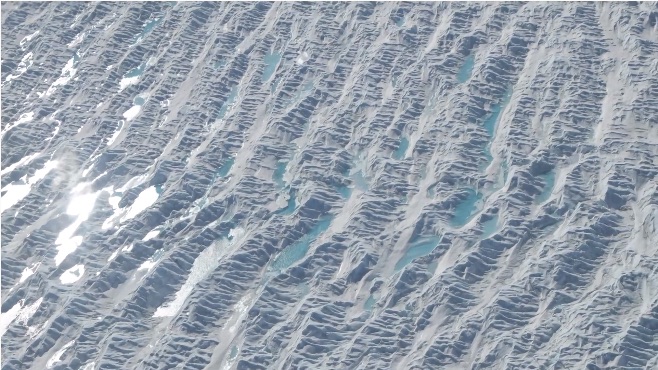
Surface meltwater ponds in Western Greenland in May 2019. NASA/JEFFERSON BECK

For his third appearance in our pages this year, illuminating a topic we all need to understand more fully, thanks to Jon Gertner for sharing this in Yale e360:

In Greenland’s Melting Ice, A Warning on Hard Climate Choices

Greenland is melting at an unprecedented rate, causing vast quantities of ice to disappear and global sea levels to rise. The fate of the ice sheet is not sealed, but unless CO2 emissions are sharply cut, the long-term existence of Greenland’s ice is in doubt.
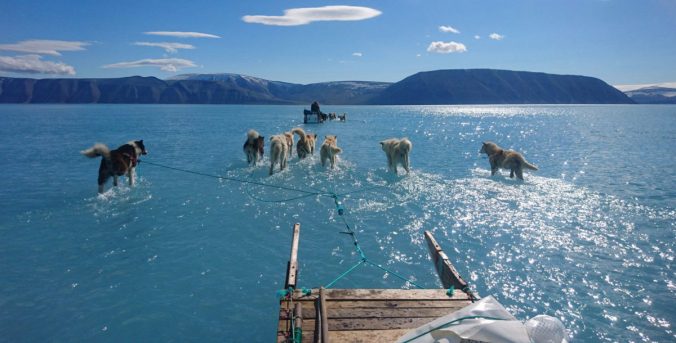
InglefieldBredning_June-13-2019_Steffen-M.-Olsen-Twitter_web2.jpg

A team from the Danish Meteorological Institute travels by dogsled across a pond of meltwater in northwest Greenland to retrieve equipment on June 13. STEFFEN M OLSEN/TWITTER

The heat wave arrived early this spring — a shroud of temperate air, sweeping in during early June, which enveloped the Northern Hemisphere’s biggest ice sheet in a stifling hug. At its peak, nearly 45 percent of Greenland’s frozen surface turned to meltwater, coloring the huge white expanse with sapphire lakes and lapis streams. During the warmest stretch, runoff from the ice sheet amounted to about 2 billion tons, which meant that at the same time Greenland was losing water, the North Atlantic was gaining it. Some areas on the island were 40 degrees Fahrenheit above normal for this time of year.

“We didn’t see anything like this prior to the late 1990s,” Thomas Mote, a University of Georgia scientist who monitors summer melting on the ice sheet, explained to CNN. “The melting is big and early,” Jason Box, a climatologist with the geological survey of Denmark and Greenland, informed the Washington Post.

Greenland’s ice sheet covers about 80 percent of the island, and measures about 660,000 square miles; in its center, it runs to a depth of about two miles. According to the most recent NASA studies, the ice sheet holds enough water to raise sea levels by about 24 feet, should it ever disappear completely. Continue reading

The Camera’s Gift To The Task Of Documenting Climate Change

main_900 (3).jpg

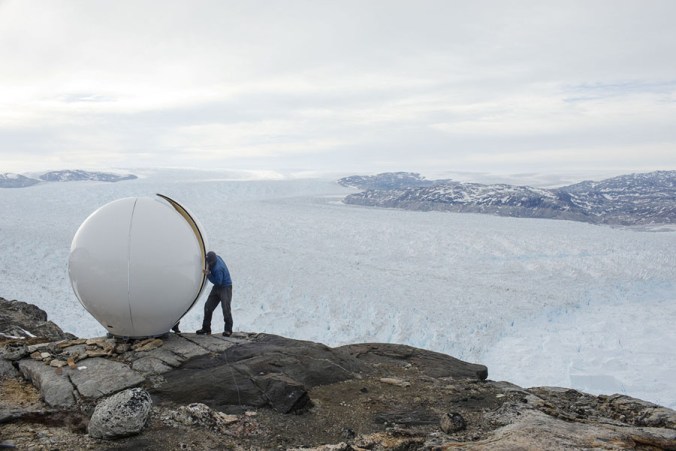
The safety officer Brian Rougeux assembles a radar dome while working at the research camp above Helheim Glacier near Tasiilaq, Greenland, on June 20, 2018. 
Lucas Jackson / Reuters

Alan Taylor, who  compiles and edits the news photo blog “In Focus” for the Atlantic, shares 21 spectacular images with captions that help even a lay person understand better the science of climate change:

Studying Greenland’s Ice to Understand Climate Change

main_900 (4).jpg

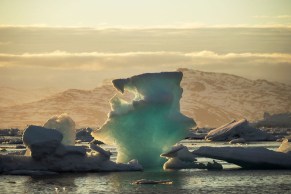
An iceberg floats in a fjord near Tasiilaq on June 16, 2018. # Lucas Jackson / Reuters

Earlier this year, Lucas Jackson, a photographer with Reuters, joined a team of scientists affiliated with a NASA project named Oceans Melting Greenland (OMG) and traveled with it to the Greenland ice sheet and fjords. Jackson photographed the researchers as they set up their scientific equipment and took readings to help understand the ongoing impact of the melting glaciers and map out what to expect in the future. Jackson says: “For both journalists and scientists, climate change is difficult to document. It most often happens imperceptibly—a tenth of a degree increase in temperature, a few less inches of rain, a slowly melting ice sheet.” Continue reading

“Watermelon Snow” = “Black and Bloom” = Melting Ice

Photo via blackandbloom.org

The last time we mentioned Greenland and melting ice sheets it wasn’t good news either; it rarely is. But any new research that can analyze how ice is melting faster than it could be is also helping figure out how we might reduce that rate of ice loss and ocean level rise. Alexandra Witze reports on algae and Arctic ice sheets:

Researchers are fanning out across the Greenland ice sheet this month to explore a crucial, but overlooked, influence on its future: red, green and brown-coloured algal blooms. These darken the snow and ice, causing it to absorb more sunlight and melt faster.

The £3-million (US$4-million) Black and Bloom project aims to measure how algae are changing how much sunlight Greenland’s ice sheet bounces back into space. “We want to get a handle on just how much of the darkness is due to microbes and how much to other physical factors”, such as soot or mineral dust, says Martyn Tranter, a biogeochemist at the University of Bristol, UK, and the project’s principal investigator.

Continue reading