Pythons & Captive Breeding Ethics

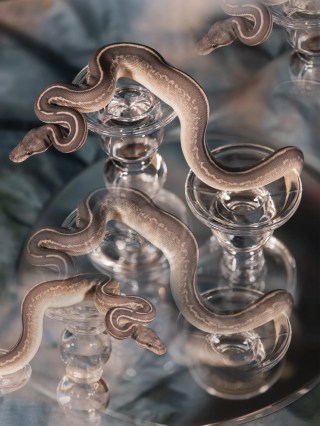
A “leopard blackhead Mojave hypo black axanthic” ball python: what sounds like an incantation is a catalogue of desirable mutations. Photograph by Delaney Allen for The New Yorker

Breeding animals in captivity is a topic we have pointed to in several posts. Sometimes the topic is ethics; other times it is about conservation of a species on the brink of extinction. Pythons somehow show up in our pages more frequently than captive breeding. Almost 15 years since Burkhard Bilger brought to our attention the topic of pythons and other animals invading new habitats that set off our python fascination, here is one at the intersection of captive breeding and ethics:

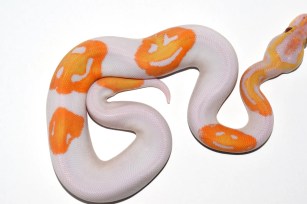
The Snake with the Emoji-Patterned Skin

In the wild, ball pythons are usually brown and tan. In America, breeding them to produce eye-catching offspring has become a lucrative, frenetic, and—for some—troubling enterprise.

“Sometimes your odds are one in two hundred and fifty-six, or one in five hundred and twelve, to make the snake you’re thinking about,” Justin Kobylka, a trendsetting breeder and the owner of Kinova Reptiles, said. Photograph by Delaney Allen for the New Yorker

On a fall day in Gainesville, Georgia, Justin Kobylka, the forty-two-year-old owner of Kinova Reptiles, was preparing to cut open two clutches of snake eggs. He was hoping to hit upon some valuable, beautiful reptiles. Kobylka is a breeder of designer ball pythons—one-of-a-kind, captive-bred snakes whose skin features colors and patterns not usually found in nature. “I think of myself as an explorer,” he told me. Nicking an egg with a pair of surgical scissors, he exposed a live hatchling in its goo. “Even when they haven’t yet touched air, you can sometimes see the tongue going,” he said, making a flicking gesture with his thumb and fingertip.

Kobylka had been trying to produce a “dreamsicle”—a white ball python with splotches of tangerine—but three of the circular markings on the snake looked like smiley faces. His video of the “emoji python” went viral. Photograph courtesy Kinova Reptiles

We were standing in a six-thousand-square-foot climate-controlled outbuilding that housed some two thousand pythons, which were kept in individual plastic trays slotted into tall metal racks. The space, which cost nearly a million dollars to build and outfit, was immaculate and well lit, with corner-mounted industrial fans and glossy floors. A vague odor of musk and Clorox was all that hinted at the daily chores of snake husbandry. Continue reading
Keeping It Green At Chan Chich Lodge

CCLSnake3.jpg

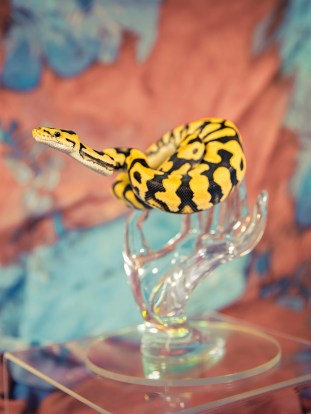
When I see a face like this I can only smile. I am not sure why, and I do not like to anthropomorphize animals, but this creature looks friendly, even a bit happy. Maybe because I am partial to the color green? Continue reading

Some Sea Snakes Lead Dehydrated Lives

Photo © NatGeo

Sea snakes are interesting creatures, and we’ve written about them before, both as heat-stealers in an article on kleptothermy and as victims of uncontrolled fishing for “medicinal” purposes in the Gulf of Thailand. Science writer Ed Yong discusses one particular species of sea snake that lives so permanently in the Pacific ocean that it barely gets to drink fresh water, apart from what it skims off the ocean surface during rains:

If someone asked you to think about a global animal that has spread over much of the earth, you’ll probably think of something like the brown rat, the rock pigeon, or us humans. You probably won’t think about the yellow-bellied sea snake.

It’s a striking animal—two to three feet in length, with a black back and yellow belly. And it is extraordinarily far-ranging for a snake. It lives throughout the Pacific Ocean, which is already more area than all the continents combined, and the Indian Ocean too. Of all the tetrapods—the animal group that includes mammals, birds, reptiles, and amphibians—this little-known snake is one of the most abundant and widespread.

Continue reading

New Snake Species Discovered in Mexican Mountains

A specimen of the new species, Geophis loranca, in life. Photo © Miguel Ángel de la Torre Loranca

Last time we mentioned a new species being discovered, it was also long, thin and reddish, but in the form of a toxic cave worm. The freshly-found reptile, which when translated from its scientific name would be called “Loranca’s earth snake,” is a red and black burrowing animal that is only found in a very localized region of east central Mexico, as the collaborative team of Mexican university researchers wrote in their academic journal article published in ZooKeys:

These burrowing reptiles are seldom encountered and, consequently, have been poorly studied. Furthermore, several species have restricted distribution, making them particularly vulnerable to extinction.

Continue reading

To Hunt a Newt

Dr. Grant holds a red-spotted newt from Beebe Pond in Sunderland, Vt., this month. Credit Jim Cole/Associated Press

Salamanders and newts have shown up on the blog before as an important environmental health indicator, an animal family that is fun to look at and look for, and a group of species at risk due to imported/exported diseases made possible by the pet trade. From the New York Times Science section this week, we’re learning even more about these slippery amphibians:

Warren Pond in southern Connecticut, bordered by shady oaks and maples, is a lovely place to fish for bass or sunfish. Or, if the mood strikes you, to hunt the Eastern red-spotted newt.

Why one would want to hunt newts is a valid question. But for Evan Grant, who was stalking the banks of Warren Pond this month, scanning the water through polarized sunglasses, the answer is that many species of salamander in the United States, including the newts he was seeking, may be on the brink of a deadly fungal assault, much like one that has devastated some frog and toad populations worldwide.

Continue reading

Map the Herps You Spot

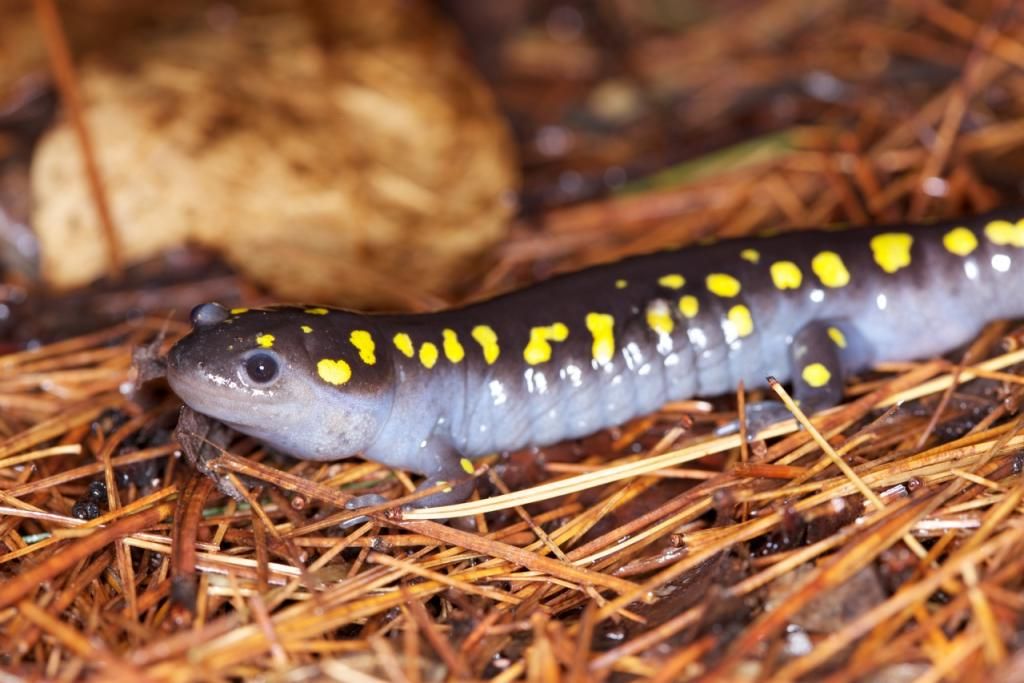
Spotted Salamander by Brian Magnier

In the spring of my penultimate year at Cornell, I took a Herpetology class that introduced me to the world of reptiles and amphibians, or “herps,” as they’re affectionately known. Thanks to that exposure, I was able to enjoy the spring migration of certain salamander species and learn the basics of the main families of frogs, lizards, snakes, and other herps like alligators, crocodiles, and all the other slimy or scaly animals in the classes Amphibia and Reptilia. If I had known of the existence of the citizen science project HerpMapper at the time (it wasn’t released until September of the same year as that salamander migration) I’d have certainly submitted some observations and photos to the organization! From their About page:

HerpMapper is a cooperative project, designed to gather and share information about reptile and amphibian observations across the planet. Using HerpMapper, you can create records of your herp observations and keep them all in one place. In turn, your data is made available to HerpMapper Partners – groups who use your recorded observations for research, conservation, and preservation purposes. Your observations can make valuable contributions on the behalf of amphibians and reptiles.

Continue reading

A Night Walk in the Osa Peninsula

I recently went on a night walk in the rainforest of Costa Rica’s Osa Peninsula, looking for frogs, snakes, and other nocturnal animals with a great wildlife guide who knew the area well. Although we didn’t see any mammals or the famous deadly Bothrops asper viper known as the “terciopelo” in Spanish (velvet) and “fer-de-lance” in French (spearhead). We did, however, see numerous frog species and at least two snake species, although we could only identify the six or seven Cat-eyed Snakes we saw.

There were also some basilisk lizards getting bit by mosquitoes, a large spider similar to a tarantula, a dragonfly larva in the water, and plenty of frog eggs. At one point we turned off all our flashlights to try to find a glass frog (pictured below) and noticed some bioluminescent mushrooms, which were impossible to photograph in the dark and look pretty dull in the light. Although I’ve forgotten the names of the various frog species featured in the slideshow of the photos I was able to take below, I hope you enjoy Continue reading

Uroplatus Geckos

Camouflage perfection in the Uroplatus. Photo Credit: en.wikipedia.org
 The Uroplatus Geckos are a magnificent species of gecko endemic to the island of Madagascar, and also my personal favorite gecko — truly one-of-a-kind, these geckos are also known as flat-leaf geckos. Effective camouflage coupled with their flattened body structure and almost completely flattened tails allow these geckos to literally become one with the trees.

Too many birds, not enough Herps!!!

We can’t let the birders have all the fun, so I’m going to start posting my favorite reptiles & amphibians!  (I’m clearly in good company on the subject, however!) These amazing creatures are often unjustly vilified, but if you take a closer look you will realize just how beautiful and unique they are.

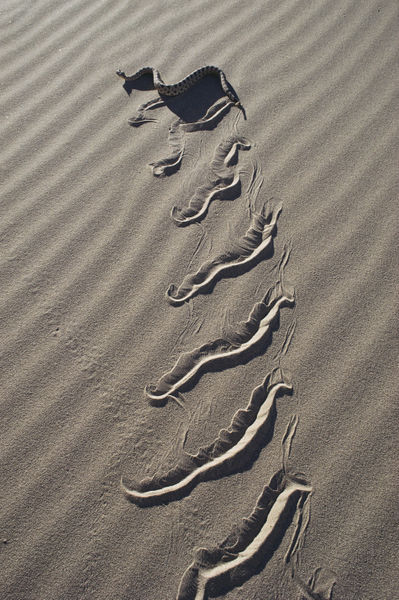
So I will start for now with Crotalus cerastes, the desert sidewinder (SW US/NW Mexico) — This small pit viper is specially adapted to live in the desert, most notably in its locomotive behavior of “sidewinding” which leaves a trademark imprint in sand.  Enjoy!

Image

Image