Stories from the Field: Spoon-billed Sandpiper

In my previous post I’d written about birding with Clement Francis and how educational he was in so many ways – sparking my interest in birding, my abilities as a bird photographer, and not least, my understanding of the challenges that birds and other wildlife suffer in the face of climate change and human related habit destruction. The story of the Spoon-billed Sandpiper impacted me in a huge way.

This tiny bird travels between the Arctic Tundra and the South Asiatic regions. While they breed in the tundra, they migrate southwards during winters in a migratory route of 8000 kilometres. Just 200 pairs of this birds existed back then. Now due to human intervention and the implementation of captive breeding programmes, the population are reaching to a decent number.

The International Union for Conservation of Nature (IUCN)  has listed the Spoon-billed Sandpiper under the “critically endangered” species. During one of our trips Clement showed me the picture of the bird in its breeding plumage that was shot in Siberia. From that moment on my mind was set on seeing the bird. It may appear like an exaggeration, but the bird appeared in my dreams quite often and the desire to see it for myself grew stronger every day. At the time of our trip the bird was in migration to a small patch in the Sunderbans of Bangladesh,  but the numbers there were decreasing, and their path seemed to be shifting toward stopovers in Thailand instead. 
Continue reading

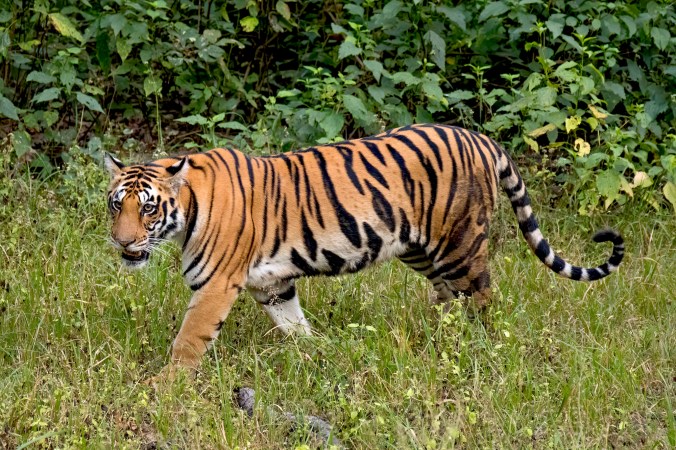
Tiger Conservation Progress

A Bengal tiger in India’s Kanha National Park. CHARLES JAMES SHARP VIA WIKIPEDIA

Tigers were an important part of our lives when this platform started, and for the following few years of our time in Kerala. We have retained an interest, so this news is welcome all these years later:

Wild Tiger Numbers 40 Percent Higher Than Previously Estimated

The number of endangered tigers around the world is 40 percent higher than previously thought, according to new data from the International Union for Conservation of Nature (IUCN). Continue reading

Pygmy Hogs In Assam

The pygmy hog is still endangered but a reintroduction programme in Assam, India, has given it a greater chance of survival

A highlight of seven years living and working in India was a brief visit to Assam to review the land holdings of an investor who was considering having us assist with the development of a conservation-focused lodge. I did not know about this endangered species at the time, but its current status brings a good vibe to my day for more than one reason:

Pig in clover: how the world’s smallest wild hog was saved from extinction

A pygmy hog enters the wild from the release enclosure in Manas reserve. Photograph: Goutam Narayan

The greyish brown pygmy hog (Porcula salvania), with its sparse hair and a streamlined body that is about the size of a cat’s, is the smallest wild pig in the world, and also one of its rarest, appearing on the International Union for Conservation of Nature (IUCN) red list as endangered. Continue reading

Fast Cats’ Feast

The cheetah is the fastest animal on land—a fact that is often repeated, but seldom truly appreciated. When documentary-makers film cheetas, they typically go for low-angle close-ups that capture the creature’s majesty, but that underplay its speed. The BBC’s The Hunt bucked the trend last year with aerial shots that reveal just how fast the cheetah is.

Ed Yong, writing on the Atlantic’s website, refers to the video clip above with his opening paragraph of Cheetahs Never Prosper. The cat lays the table for its feast, in full speed, and then Mr. Yong shares some plain truths: Continue reading