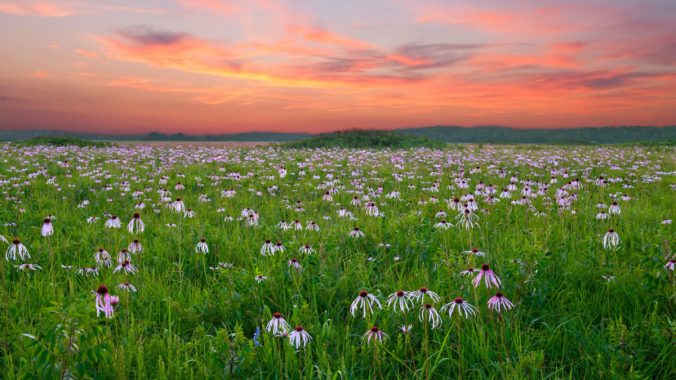
Cherokee Prairie Natural Area near Fort Smith, Arkansas. WILLIAM DARK PHOTOGRAPHY
Janet Marinelli, according to her author’s bio, is an award-winning independent journalist who was director of scientific and popular publications at Brooklyn Botanic Garden for 16 years; according to our read of her work over the last two years she is also a perfect fit with our mission to find at least one story every day that explains the natural world, illuminates the possibilities of entrepreneurial conservation or challenges us to be more careful with natural resources. She brightens our day:
Forgotten Landscapes: Bringing Back the Rich Grasslands of the Southeast
Native prairie and savanna once covered vast areas of the U.S. Southeast from Maryland to Texas, but agriculture and sprawl have left only small patches remaining. Now, a new initiative, driven by scientists and local communities, is pushing to restore these imperiled grassland habitats.
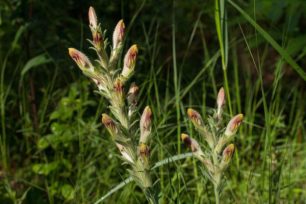
Southeastern grasslands have some of the highest plant richness in the world, home to rare species such as American chaffseed. COURTESY OF TIM MARTIN & USFWS
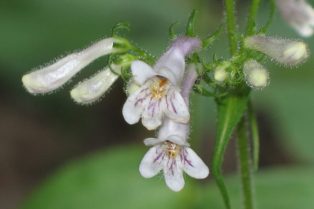
Dwayne Estes pulls over to the side of a rural road in Franklin County, Tennessee, about 20 miles from the Alabama border. He hops out of his truck and points out a small plant with dainty, trumpet-shaped white flowers with purple-streaked throats. “This is Penstemon kralii,” says Estes, a 40-year-old, 6-foot-3-inch-tall professor sporting a baseball cap and beard, the twin badges of honor for many field botanists. The plant is found almost exclusively at the base of the Cumberland Plateau escarpment, where it survives precariously in narrow, grassy roadside fringes with other rare and threatened species, including a sunflower and a blue-eyed grass yet to be named and described by scientists.
Kral’s penstemon. COURTESY OF TIM MARTIN & USFWS
We continue to the top of the steep, densely forested escarpment. Below, a checkerboard of croplands and pastures stretches as far as the eye can see. “Before 1840, those agricultural fields were prairies covering half a million, maybe 750,000 acres,” Estes says. “They were maintained by frequent fires and bison.” The wildfires probably swept up the base of the adjacent escarpment, he adds, keeping it open and sunny oak savanna where the penstemon and its companions could thrive. Like so many southern grassland denizens, they are vestiges of a lost botanical world that once covered as many as 120 million acres from Maryland to East Texas, caught in a vise between habitat loss to agriculture and urban sprawl on the one hand, and encroaching fire-suppressed forest on the other. Continue reading
 Organikos