Panthera’s Puma Program

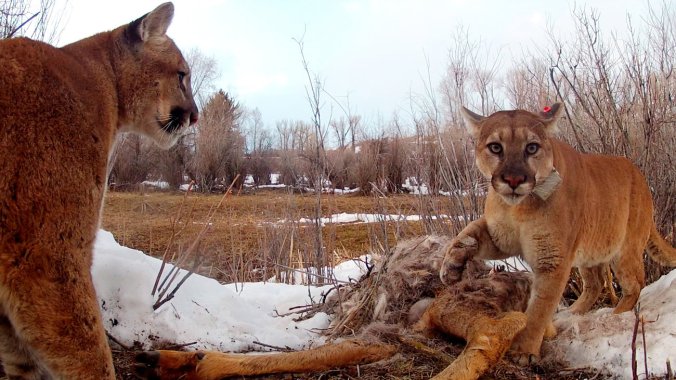
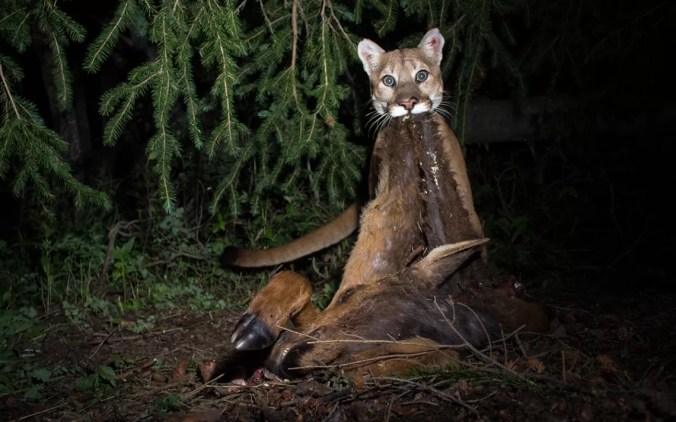
Puma in Wyoming. | Photo by Neal Wight, courtesy of Panthera

Thanks to Grace van Deelen for this article in the magazine of the Sierra Club:

Mountain Lions Are Murder Gardeners

By leaving carcasses, mountain lions create lush landscapes for future victims that could attract prey

If you’re hiking in Yellowstone and stumble upon an unusually lush landscape, you might have found a mountain lion’s garden. Continue reading

Pumas Are Not Such Loners After All

puma-1_wide-34b6cb9c5551bd1d1eab4ca1aaaeb7f7de9f3312-s1300-c85.jpg

Adult female with young male coming in (without collar) to her kill. Mark Elbroch/Panthera/Science

Thanks to National Public Radio (USA) for this latest news on one of our favorite species:

Supposedly solitary pumas actually hang out with their fellow big cats quite often, frequently coming together and hissing and snarling before settling down to share a delicious elk carcass.

That’s the startling discovery made by scientists who recently tracked 13 pumas — also called mountain lions or cougars — and set up cameras at kill sites. They recorded dozens of peaceful social interactions between these elusive felines. Continue reading

Conservation Tourism and Species Survival

A recent study found that the value of jaguars to tourism (US$6,827,392) was far in excess of the cost to ranchers from depredation of their cattle (US$121,500)

The intersection between jaguar territory and tourism has been part of our work for decades, in both the Paraguayan Pantanal, Costa Rica’s Osa Peninsula and more recently in northwestern Belize.

We’ve seen the efficacy of species protection via conservation tourism when the economic value of species survival is quantified. This is good news for one of our favorite animals.

Curiosity saves the cat: Tourism helps reinvent the jaguar

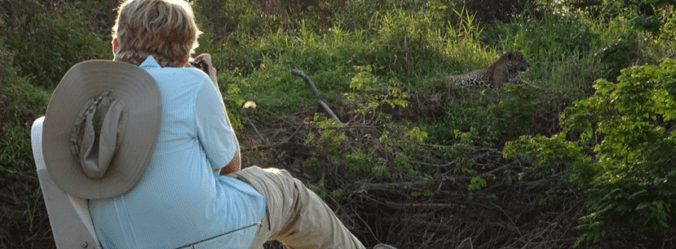
From villain to hero, the jaguar (Panthera onca) stands at the cusp of a radical overhaul in its public image. As the largest cat in the Americas, the species commands a dominant role in the food chain of its native Pantanal – a vast swathe of tropical wetland that encompasses parts of Brazil, Paraguay and Bolivia. Once hunted for its fur, the jaguar’s appetite for the abundant prey in the Pantanal has led it into deadly conflict with ranchers in recent decades, casting it as the stalking menace of livestock and livelihood in a region where much of the land is reserved for cattle rearing. However, in a hopeful development for conservationists, researchers have revealed in a new study published in Global Ecology and Conservation that jaguars are worth 60 times more to tourism than the cost the big cats inflict on ranchers.

“The study represents a regional reality in the Pantanal,” said Fernando Tortato, research fellow at Panthera, the global wild cat conservation group that helped lead the study. “Where the jaguar brings in far more revenue than the potential damage it can cause.”

Jaguars once abounded from the southwestern U.S. to Argentina, but their numbers have fallen due to hunting and habitat loss. In the Amazon rainforest, deforestation is an ongoing threat, even while the dense foliage often precludes human encounters with jaguars. In the absence of benign tourism opportunities there is demand for jaguar teeth, paws and claws as souvenirs.

But jaguar’s predilection for lush and low-lying forest makes the Pantanal a stronghold for the species. The wetland’s web-like tributaries also open the wild cat’s home to human exploration, allowing tourists to share in their company.

In the Pantanal, the biggest threat to their survival is conflict with ranchers. Continue reading

Conservation Via Valuation

When we consider that cat sightings play an important role in why our guests come to Chan Chich Lodge, this type of valuation is something we can get behind whole heartedly. Thanks again to the Anthropocene for this interesting piece of daily science. And thanks again to Panthera.org for their role in the research.

The lesson of the $300,000 bobcat

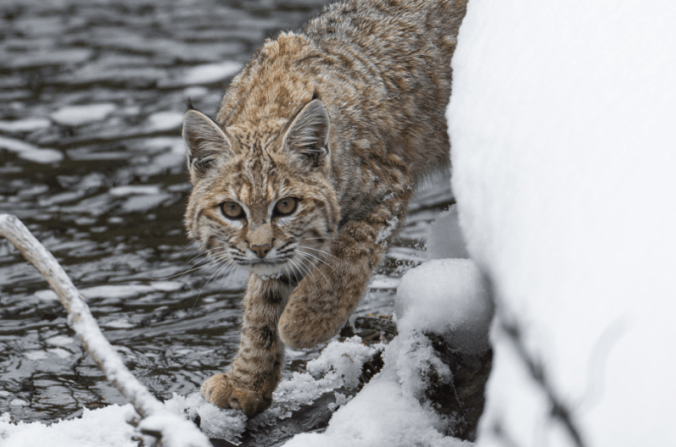
What is a bobcat worth? There’s a few ways of thinking about that question. One answer, of course, is that a bobcat’s value is intrinsic, their lives not something to signify with a price tag. Fair enough. But for the sake of discussion, and because there’s already a market for their hides, let’s run the math: in the state of Wyoming, a bobcat is worth roughly $300 dead and up to $308,000 alive. And in that vast difference is a tension — some would call it a flaw — in the way these marvelous cats, and many other species too, are presently managed in North America.

The calculations come from a study recently published in the journal Biodiversity and Conservation. Led by Mark Elbroch, a biologist with Panthera, the wild cat conservation organization, and also featuring researchers from wildlife advocacy group Wyoming Untrapped, the researchers totaled the revenues generated in 2015-2016 from selling trapping licenses in that state — $152,000 — and divided them by 1,160 bobcats killed, then added the average sale value of pelts. The final per-bobcat value came to $315.17.

Then Elbroch’s team turned to the example of a bobcat living along the Madison River in Yellowstone National Park, where his predilection for hunting waterfowl made him popular among wildlife lovers. They surveyed 46 photographers who traveled to Wyoming in winter 2015-2016 and the outfitters who guided them. Between outfitters’ fees, money spent on food, lodging and travel, and revenues from selling pictures, the bobcat generated $308,105, or a thousand-fold increase from his worth as a source of fur alone.

The researchers don’t argue that every living bobcat in Wyoming is worth more than $300,000.
Continue reading

Maternal Instinct vs Species Survival

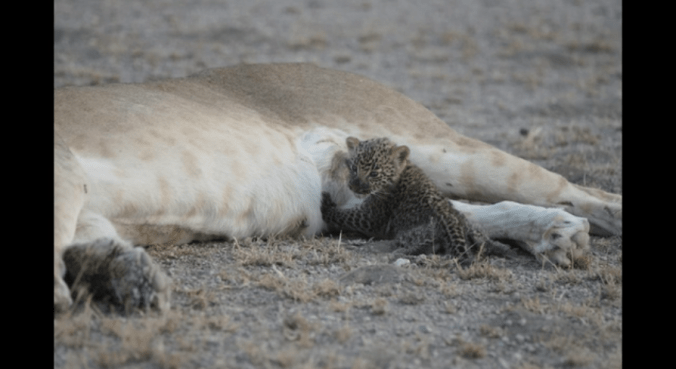
©JOOP VAN DER LINDE/NDUTU LODGE

The more time we spend at Chan Chich Lodge the more we see the seasonality of birth patterns in the wild. There clearly seems to be a “baby season”, that starts with the cats and moves down the food chain to their mammalian prey, as well as birds. Although no photo captures, several jaguar cubs were sighted earlier in the year, followed by dozens of fawns and baby collared peccary. Even the Gallon Jug Farm has welcomed 4 baby horses to the fold, with a fifth on the way…but we’ll talk about that another day.

This unusual news from Panthera.org, an important Big Cat Conservation NGO who uses our 30,000 acres as part of their Jaguar Corridor research, perhaps makes a little bit of sense within the context of those patterns.

We thank Susie Weller Sheppard for sharing these field notes.

Earlier this week, Panthera President and Chief Conservation Officer Dr. Luke Hunter received photos from our partners at KopeLion with some astonishing content: the first-ever evidence of a wild lioness nursing a leopard cub.

Taken on Tuesday by a Ndutu Lodge guest in Tanzania’s Ngorongoro Conservation Area, the images show a 5-year-old lioness, known locally as ‘Nosikitok,’ suckling a leopard cub estimated to be just 3 weeks old. Continue reading

Big Weather & Big Cats At Chan Chich Lodge

Cockscomb Basin Wildlife Sanctuary is of interest because it is a pioneer in conservation in Belize–as Chan Chich Lodge is in its own way. But in writing about it Vicky Croke, for The Wild Life at WBUR (National Public Radio, Boston, USA), reminds a few of us of our time in Belize during Earl, and the aftermath during which jaguar sitings have been, and continue to be, inexplicably spectacular:

Jaguars Interrupted: Counting Big Cats After A Hurricane

Two months after Earl hit Belize, researchers at the world’s first jaguar reserve are still taking stock.

By Vicki Croke

This past summer, within days of gathering spectacular camera-trap footage of a female jaguar and her two tiny cubs sauntering through the Cockscomb Basin Wildlife Sanctuary in Belize, field scientists with Panthera, the global wild cat conservation organization, got the news that a tropical storm was forming and might just come their way. Continue reading

Panthera onca

video taken by author on August 5th

Chan Chich is known for being pretty much the best place in Belize to spot a jaguar (scientific name, Panthera onca) in the wild, given the Lodge’s huge amount of protected land (30,000 acres) adjacent to hundreds of thousands of acres similarly preserved, or under government conservation that together form the international Jaguar Corridor Initiative.

The word Panthera comes from the ancient Greek pánthēr (πάνθηρ), which essentially means “predator of everything,” and is a scientific genus comprised of the five big cat species in the world: snow leopards, tigers, lions, jaguars, and leopards. The latter four of these are the only cats that can roar, given morphological differences in their bones and throat.

Continue reading