WasteShark

Our thanks to Robert Sullivan for this attention-getting article on a new device:

A Trash-Eating Sea Monster Appears in the Hudson!

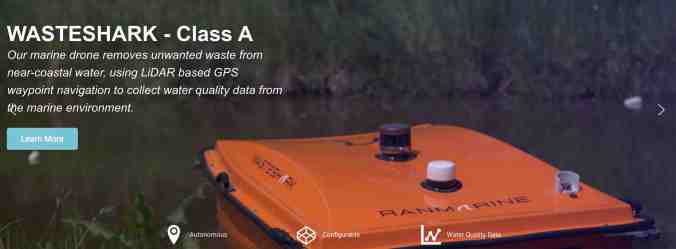
A team of scientists and environmentalists tests out the WasteShark, an unmanned watercraft that vacuums up soda cans and potato-chip bags.

WasteShark is not a shark. It is an unmanned watercraft that its creators named for a shark, owing to similarities between how WasteShark collects its prey and the feeding habits of the Rhincodon typus, or whale shark. Continue reading

Models Show Garbage Clean-up More Effective on Shoreline Than in Gyres

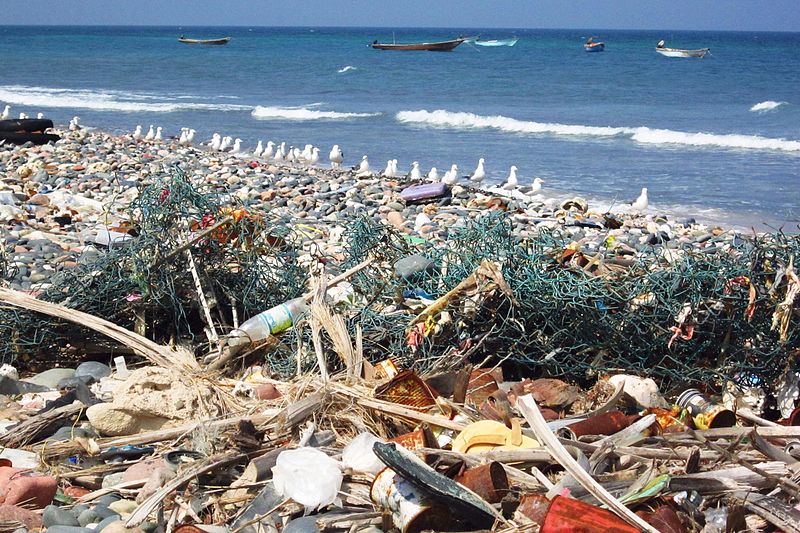
Image of trash on a beach by Flickr user Gerry & Bonni

The health of oceans in the face of massive pollution has been a topic of this blog on multiple occasions, and we’re always interested in learning more about the efforts to clean up the incredible amounts of waste, especially plastic, in one of the most–if not the most–important global ecosystems. New models by researchers at Imperial College London are hypothesizing that, rather than targeting sites like the great Pacific garbage patch, trash pick-up by floating microplastic collectors should be more effective near the coasts, where the rubbish originates. Sarah DeWeerdt reports for Conservation Magazine:

Cleanup efforts for ocean plastics should be concentrated close to shore, at the source of the problem, rather than in areas of open ocean where plastic tends to accumulate, according to a study recently published in the journal Environmental Research Letters. Ideally, if plastic collectors were placed offshore near coastal population centers, they could remove nearly one-third of plastic in the ocean over the next 10 years.

In the study, oceanographer Erik van Sebille and undergraduate physics student Peter Sherman, both at Imperial College London, used data on ocean currents and waste management practices in different countries to simulate the entry and circulation of plastic in the oceans from 2015 to 2025.

Continue reading

A Garden of Waste

Successful stories of upcycling, recycling and effective waste management are heartwarming to say the least. Because they speak of someone thinking about the future and taking the time and effort to act on a lay thought. That’s what the world (and the environment) needs – time. And, Nek Chand, who was born in Pakistan but made India his home, gave almost 60 years of his life to make trash beautiful, to give it meaning and purpose. He created a garden of sculptures and waterfalls out of trash over 40 acres and managed to hide it from everybody for 18 years. It was his secret to keep and is now Chandigarh’s pride. The nation’s, too.

In his spare time, Chand began collecting materials from demolition sites around the city. He recycled these materials into his own vision of the divine kingdom of Sukrani, choosing a gorge in a forest near Sukhna Lake for his work. The gorge had been designated as a land conservancy, a forest buffer established in 1902 and nothing could be built on it. Chand’s work was illegal, but he was able to hide it for eighteen years before it was discovered by the authorities in 1975. By this time, it had grown into a 12-acre (49,000 m2) complex of interlinked courtyards, each filled with hundreds of pottery-covered concrete sculptures of dancers, musicians, and animals.

Continue reading

Stubbing It Out

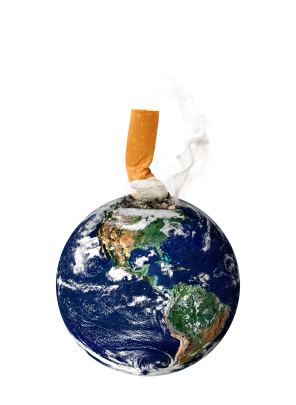
Cigarette ButtsI have seen countless cigarette butts littered on the street or on the beach, and it wouldn’t surprise me if many of the individuals who liter them are those who otherwise act in an environmentally responsible manner. So when I stumbled on this NYTimes article from a few years ago it made me wonder how people’s actions differ between perceived forms of trash.

“Littering is one of my pet peeves, and I always told my kids they’d be in big trouble if I catch them doing it,” said Ms. Scott, a 43-year-old financial executive, as she sat outside an office tower on Michigan Avenue in Chicago on a recent sunny afternoon. “I see people throw stuff out their car windows, and I cringe.”

Yet she confesses that she routinely discards cigarette butts on the sidewalk. For her and countless other American smokers, cigarette butts are an exception to the no-littering rule. “Aren’t cigarettes biodegradable?” Continue reading