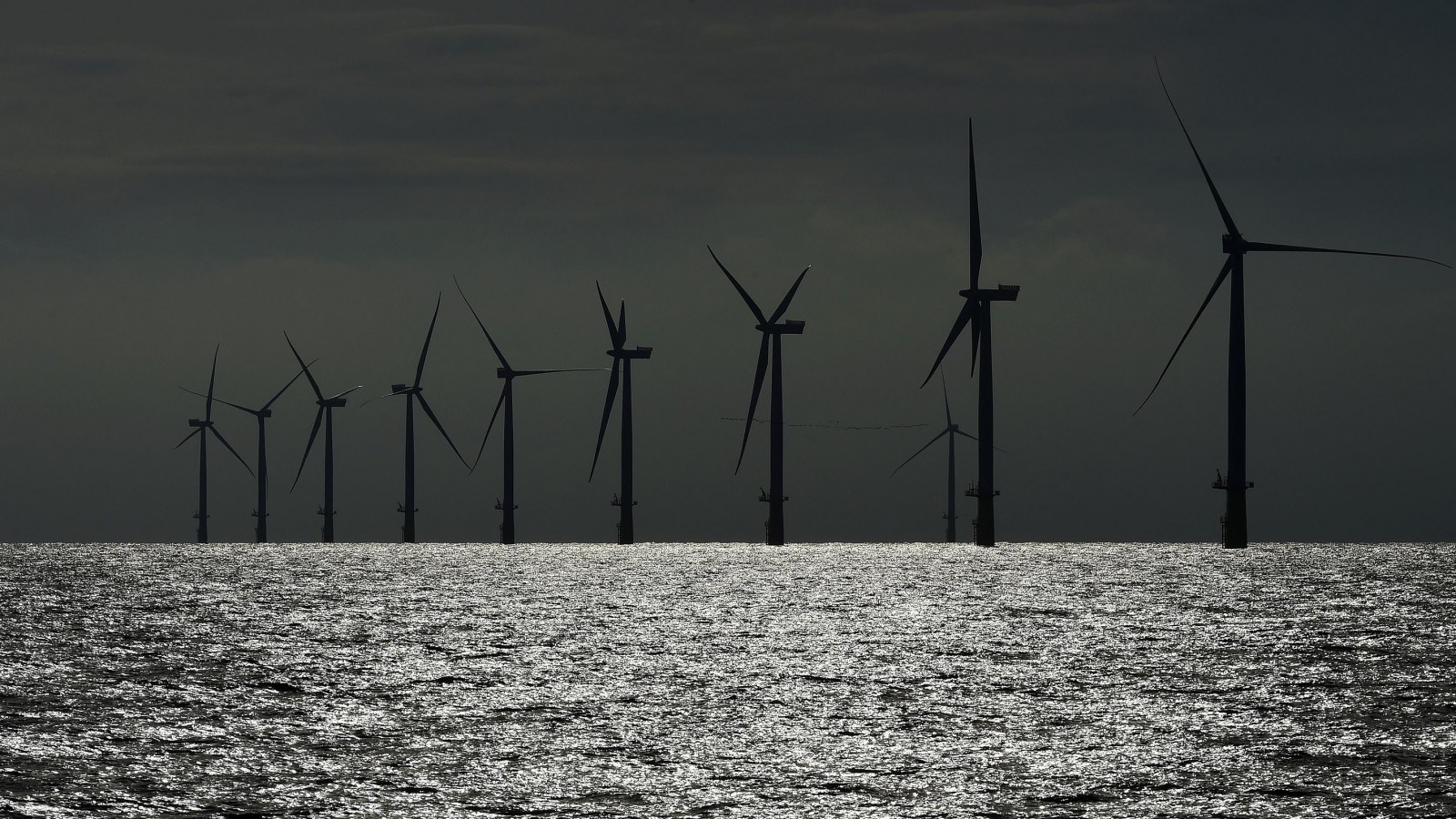
Big Turbines, Big Location, Big Wind Farm

Image via U.S. Bureau of Ocean Energy Management
A map shows the location of Dominion’s federal lease and where the company proposes to run associated infrastructure.

Thanks to National Public Radio (USA) station WHRO for this news.

It is a big deal:

Dominion can soon start building Virginia Beach offshore wind farm, feds say

Dominion Energy will soon have the green light to start building its long-awaited wind farm off the Virginia Beach coast.

Dominion Energy’s pilot turbines off Virginia Beach this summer. (Photo by Laura Philion)

The Biden administration announced Tuesday its approval of the $9.8 billion Coastal Virginia Offshore Wind project, which when constructed will be the largest in the country’s history.

Dominion can now start constructing infrastructure for the project on-shore, said spokesperson Jeremy Slayton. The company just needs the Bureau of Ocean Energy Management to OK its construction and operations plan for the offshore farm. Continue reading

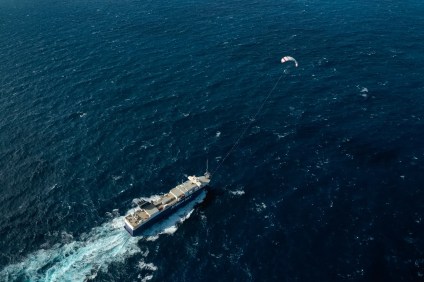
What’s New With Wind Propelled Ships

Thank you as always, Cara Buckley. The topic today is wind power, again, this time more on its use propelling ships:

More ships are running on wind power, as the global industry tries to fight climate change. One concept has backing from Abba, the Swedish pop stars.

The Pyxis Ocean began its first wind-assisted voyage in August. Cargill and BAR Technologies

One ship was pulled across the sea with the help of an enormous sail that looked as if it belonged to a kite-surfing giant. Another navigated the oceans between China and Brazil this summer with steel and composite-glass sails as high as three telephone poles. Continue reading

Wind Power & Backyard Progress

A turbine blade more than 300 feet long. The $4 billion Vineyard Wind project is expected to start generating electricity by year’s end. Bob O’Connor for The New York Times

On previous occasions when we linked to stories about windfarms‘ large turbines, we have noticed that aesthetics can get in the way of progress, so thanks to Stanley Reed and Ivan Penn for this reporting from the New England coast:

A Giant Wind Farm Is Taking Root Off Massachusetts

The offshore energy project will have turbines taller than any building in Boston, but they will be barely visible from Martha’s Vineyard.

On a chilly June day, with the Massachusetts island of Martha’s Vineyard just over the distant horizon, a low-riding, green-hulled vessel finished hammering a steel column nearly 100 feet into the bottom of the Atlantic Ocean. Continue reading

Turbines Replacing Rigs In Scotland’s Waters

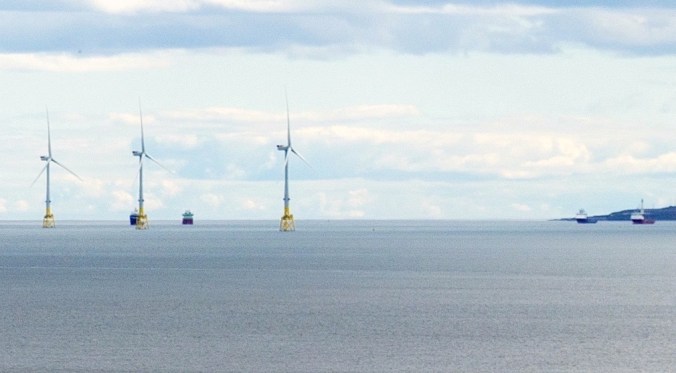
The Aberdeen Bay Wind Farm, an offshore wind demonstration facility off the coast of Aberdeenshire, in the North Sea, Scotland. ZANASZANAS VIA WIKIPEDIA

When big oil companies dismantle rigs and switch to building new turbines, it has the ring of something good. Our thanks to Yale E360 for this news brief:

North Sea Fossil Fuel Companies Plan to Invest More in Wind than Oil Drilling

Having won rights to develop wind farms off the coast of Scotland, Shell, Total, and BP are set to invest more in wind power than in oil and gas drilling in the North Sea in the years ahead, the latest evidence of oil majors changing tack on renewables to better navigate the energy transition. Continue reading

Wind Win

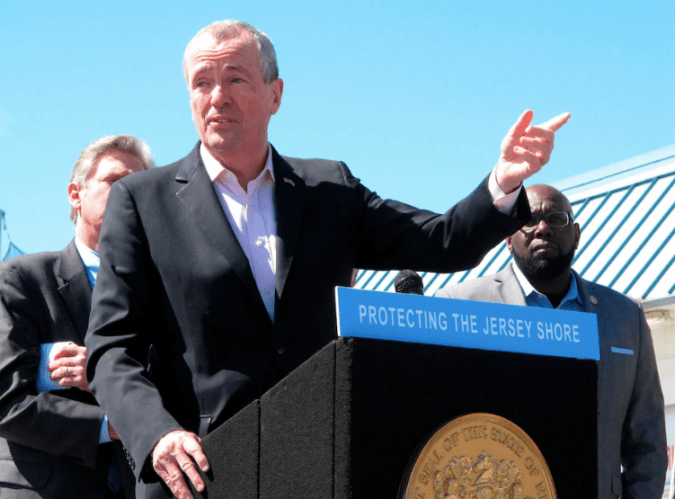
New Jersey Gov. Phil Murphy (D) speaks at a news conference on the boardwalk in Point Pleasant Beach, N.J., in 2018 before signing a bill banning offshore oil and gas drilling. (Wayne Parry/AP)

Alternative energy sources are the requirement for the future. We can only hope that positive leadership actions such as this aren’t vetoed by an administration that would like to keep progressive plans as a thing of the past.

New Jersey aims to lead nation in offshore wind. So it’s building the biggest turbine port in the country.

Gov. Phil Murphy (D) said his state will build the country’s first port dedicated to assembling the turbines that will go up not just in New Jersey but across the Eastern Seaboard.

New Jersey wants to be known for more than just its shores and casinos.

It aims to be the hub of the nation’s nascent offshore wind energy industry.

On Tuesday, Gov. Phil Murphy (D) is set to announce the construction of what he calls the country’s first port dedicated to constructing the colossal turbines that may one day dot the East Coast horizon as Northeastern and Mid-Atlantic states rush to build more renewable energy.

For New Jersey, it is about more than just tackling climate change. Just as Texas is the de facto capital of the U.S. oil and gas industry, New Jersey wants to be an economic engine for offshore wind.

“We have a huge opportunity,” said Tim Sullivan, chief executive of the New Jersey Economic Development Authority. “Somebody’s going to get to be the Houston of American offshore wind.”

To make sure New Jersey plays that role, the state government is planning to turn 30 acres along the Eastern Shore of the Delaware River 20 miles south of Wilmington, Del., into a staging area for assembling the massive turbines. Taller than 800 feet, the turbines will tower higher than the Washington Monument.

State leaders are also hoping to coax factories to the rural area, too, and have set aside 25 acres for potential turbine part manufacturers. They aim to start construction next year and launch operations by 2024. Another 160 acres will be available for future development.

“We’ll be able to be the focal point for the industry in this part of the country,” Murphy said in an interview.

The port is part of the state’s broader plan to get all of its electricity from clean energy by the middle of the century. New Jersey, already one of the nation’s fastest-warming places, wants to generate 7,500 megawatts from offshore wind by 2035 — enough to power half of New Jersey’s homes.

Continue reading

Wind Powering 590,000 Homes

WindFarm.jpg

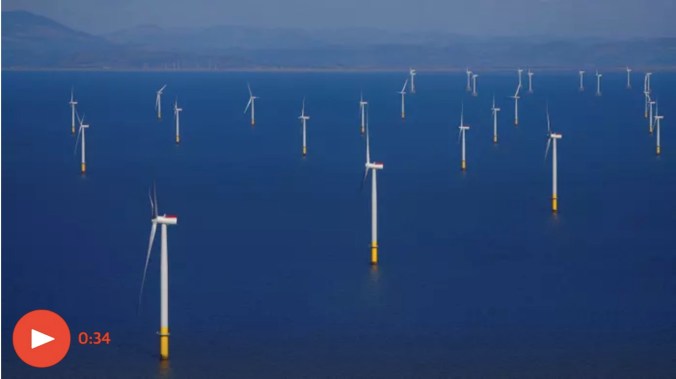
 Drone footage shows world’s largest offshore windfarm – video

Thanks to the Guardian for this news about harnessing wind at a record scale:

World’s largest offshore windfarm opens off Cumbrian coast

Walney Extension will power 590,000 homes amid fears Brexit could stifle growth

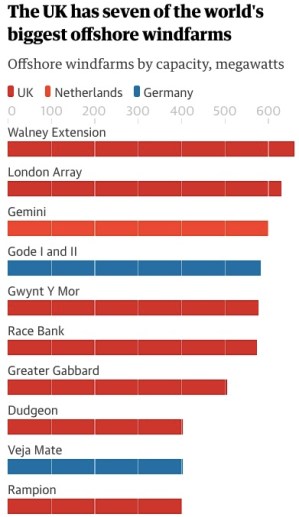
ChartWind.jpg

Guardian Graphic | Source: Renewable

The world’s biggest offshore windfarm has officially opened in the Irish Sea, amid warnings that Brexit could increase costs for future projects.

Walney Extension, off the Cumbrian coast, spans an area the size of 20,000 football pitches and has a capacity of 659 megawatts, enough to power the equivalent of 590,000 homes.

The project is a sign of how dramatically wind technology has progressed in the past five years since the previous biggest, the London Array, was finished.

The new windfarm uses less than half the number of turbines but is more powerful.

Matthew Wright, the UK managing director of Danish energy firm Ørsted, the project’s developer, said: “It’s another benchmark in terms of the scale. This – bigger turbines, with fewer positions and a bit further out – is really the shape of projects going forward.” Continue reading

Turbines, Bigger & Better

WindTurbs2

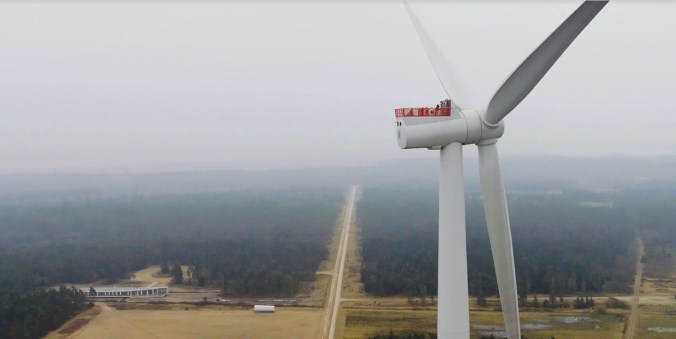
Prototype wind turbines whirl at a testing site in Osterild, near the northern end of Denmark’s Jutland peninsula. By Rasmus Degnbol

Thanks to the New York Times for this reminder that, in spite of what headlines often lead us to believe, progress is out there on as many fronts as we care to look to:

How Windmills as Wide as Jumbo Jets
Are Making Clean Energy Mainstream

WindTurbs.jpg

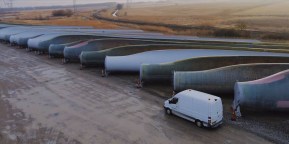
Blades for wind turbines lie outside a factory, waiting to be transported to wind farms.By Rasmus Degnbol

OSTERILD, Denmark — At the northern end of Denmark’s Jutland peninsula, the wind blows so hard that rows of trees grow in one direction, like gnarled flags.

WindTurbs3.jpg

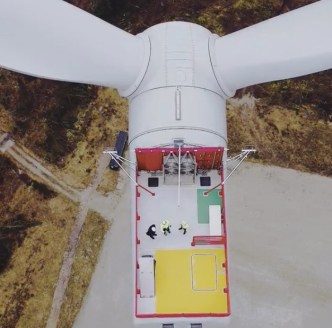
Technicians reach the roof of these enormous wind turbines either via an internal elevator or, if the turbine is installed offshore, by helicopters that lower them into the fenced-off area.By Rasmus Degnbol

The relentless weather over this long strip of farmland, bogs and mud flats — and the real-world laboratory it provides — has given the country a leading role in transforming wind power into a viable source of clean energy.

After energy prices spiked during the 1973 oil crisis, entrepreneurs began building small turbines to sell here. “It started out as an interest in providing power for my parents’ farm,” said Henrik Stiesdal, who designed and built early prototypes with a blacksmith partner. Continue reading

Kite Power

5911

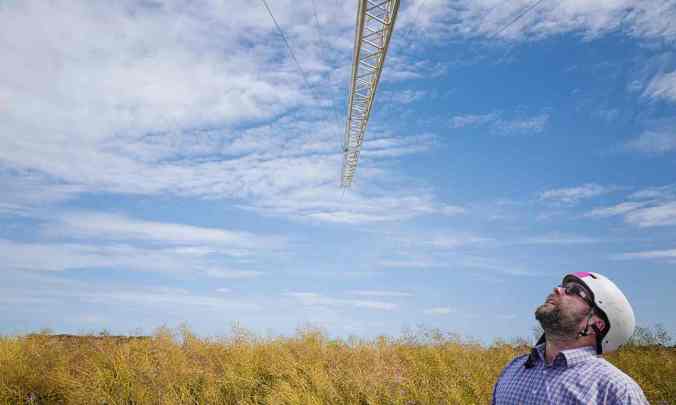
Bill Hampton, chief executive of Kite Power Solutions. Photograph: Sarah Lee for the Guardian


Kite power to take flight in Scotland next year

Kite Power Solutions plans to open UK’s first kite power plant and predicts the technology could global ease energy costs

Continue reading

Increasing China’s Wind Power Production

Dabancheng wind farm in China’s Xinjiang province (Source: Bob Sacha/Corbis, via Dailytech.com)

Wind power, as we’ve written before, has great potential as an alternative energy source, although there are certain issues to take into account. China is installing the most new wind turbines per year, but has yet to produce the most wind-generated electricity given barriers by the coal industry. Prachi Patel reports for Conservation Magazine:

China is the world’s top wind energy installer. The country’s wind installations have a capacity of generating 145 Gigawatts, twice that of the United States and about a third of the world’s total wind power. Yet the country produces less wind electricity than the US. Last month, researchers from Harvard University and Tsinghua University argued in the journal Nature Energy that this underperformance is due to deliberate favoring of coal over wind by grid operators, delays in connecting new wind farms to the grid, and sub-par equipment.

Continue reading

More (Offshore) Power to You, Germany

Germany is set to overtake the UK as the biggest installer of offshore wind globally, Denmark comes behind the UK by capacity, followed by Belgium and China PHOTO: Reuters/Fabian Bimmer

Germany is set to overtake the UK as the biggest installer of offshore wind globally. Denmark comes behind the UK by capacity, followed by Belgium and China. PHOTO: Reuters/Fabian Bimmer

We first discussed wind energy, as a viable resource to power the world’s needs, almost three years ago. Prior to that and in the time hence, Germany has done much about it. The country has chalked out a plan to replace nuclear power plants with offshore wind farms in a bid to use renewable energy round-the-clock. Importantly, the country is sticking to its plan. Above all, it is building on it.

Germany has hugely ambitious green goals. Five years ago it set a goal to produce 18% of its energy from renewables by 2020 (latest figures show it having reached 12.4%). The country also wants to reduce greenhouse gas emissions by 40% by 2020, compared with 1990 levels, and by 80% by 2050. The transformation is knows as the Energiewende—literally “energy turn.”

Continue reading