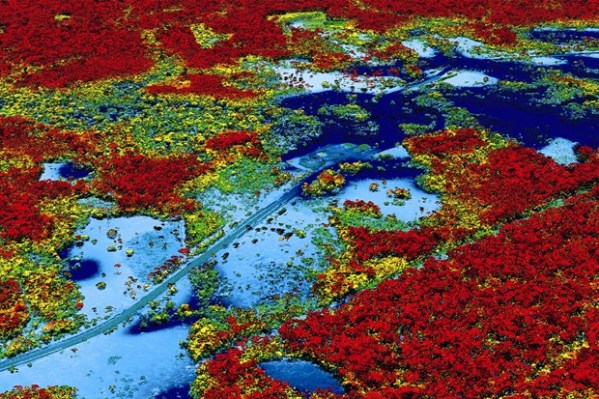
Click the image above to go to a story covered in Wired about a novel approach to mapping threatened rainforest, using existing technology in an innovative manner:
A small, twin-propeller plane flies over the Amazon rainforest in eastern Peru. The scale of the vegetation is extraordinary. The tree canopy stretches as far as the eye can see — an endless array of broccoli florets bounded only by haze and horizon. Greg Asner, 43, has seen the rainforest from this vantage point many times before, but he still stares out of the window in rapt fascination.
This patch of forest in the Tambopata National Reserve is rich with life, even by the Amazon’s standards. A 50-hectare patch of forest — the size of as many rugby pitches — contains more plant species than the whole of North America. “We might as well be exploring Mars,” says Asner. “These are areas where no human has ever been. There’s no access.”
Access isn’t a problem for Asner. Behind him are three state-of-the-art sensors of his own devising which, as the plane flies along, take the forest’s measure. “We’re trying to do something really new,” He says. “This world is changing and it requires science that isn’t incremental.” Using the technology he’s developed, Asner is mapping the shape and size of the trees, down to individual branches, from two kilometres above. He can measure the carbon stored in trunks, leaves and soil. He can even identify individual plant species based on the chemicals they contain. With wings and lasers, Asner is conducting one of the most ambitious ecology studies ever staged. He accumulates more data in a single hour than most ecologists glean in a lifetime. With this data, he aims to influence governments, steer the course of climate-change treaties and save the forests over which he soars.
 Organikos
Pingback: Cornell’s Nanoscale Carbon-scrubbing Sponges | Raxa Collective