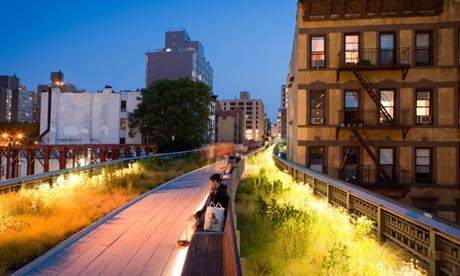
‘One of those once-in-a-decade projects’: the mile-long High Line linear park in Manhattan. Photograph: Andria Patino/ Alamy
We have written about it more than once, but here is an article quoting one of the architects of this public space on the relatively low expectations for success when it was first being designed and proposed:
The High Line, the mile-long park created on an old elevated railway in Manhattan, is one of those once-in-a-decade projects that, like the 1990s Guggenheim in Bilbao, both captures the imagination of the world and offers limitless inspiration to plagiarists. There are wannabe High Lines mooted for Calabria, Singapore, Jerusalem and Shenzhen, and in any number of American cities.
Any developer in possession of a meagre strip of green is apt to declare it a High Line. People changing planes at JFK airport have been known to nip over in taxis to get a glimpse before nipping back in time for their next flight, which somewhat negates the concept of a leisurely stroll in the park. One of the few people not completely mesmerised by it and ready to move on from it – who, indeed, believes it is not replicable – is one of its principal creators, Elizabeth Diller. Her practice, Diller Scofidio + Renfro, together with landscape architect James Corner and garden designer Piet Oudolf, designed the High Line. “On the joyous side,” she says, “I am still totally amazed by how many New Yorkers are really thankful and love to go; the part that gives thought is that it’s almost too popular for its own good. It could easily consume itself.”
She has other things on her mind, such as the ongoing, 10-year, billion-dollar project to make over New York‘s Lincoln Centre, about which a large book has just been published in America. A 1960s cultural complex, the Lincoln Centre is, like the South Bank and Barbican centres in London, based on the theory that it’s a good idea to group several venues in one place, and had similar problems of awkward circulation and hard-to-use public spaces. Here, Diller Scofidio + Renfro’s aim was to “open up the Lincoln Centre in a very democratic way” so that its “buzziness” could be enjoyed even by those not holding expensive tickets for opera or ballet…
Read the remainder of the story here.
 Organikos
Interesting, would love to visit this one day!
Pingback: Another Reason To Visit The High Line | Raxa Collective
Pingback: If You Happen To Be In New York City | Raxa Collective