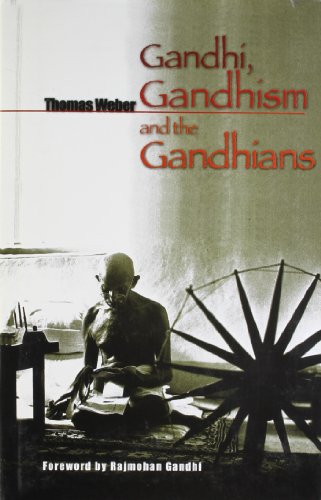
Among the many writings about Gandhi, Thomas Weber’s books seem to be held in esteem in India, with the book to the right being the most recent:
Mahatma Gandhi and his philosophy of truth and non-violence have intrigued the world for decades. Looking at the Western and Indian influences that had gone into making Gandhi the Mahatma, and the central importance of Gandhi to non-violent activism, these essays reclaim the power of truth and non-violence, which can still change the destinies of people and nations. In this collection, Weber discusses Gandhi, his ideology, and how India and the rest of the world is interpreting and reinterpreting the Mahatma. The doctrine of conflict resolution theory, new environmentalism, peace research, deep ecology, and Buddhist economics based on Gandhian principles renews the world`s belief in Mahatma and his teachings for our lives and our times.
One of the most visible and active Gandhi-focused websites posted an essay by Weber* about Gandhi’s influence on what eventually came to be known as deep ecology, and that seems a fitting reference on our site to commemorate this year’s birthday, which is also a national holiday in India. A few snippets:
…Many environmental activists who claim that ‘deep ecology’ is their guiding philosophy have barely heard the name of Arne Naess, who coined the term. While Naess readily admits his debt to Gandhi, works about him tend to gloss over this connection or ignore it…
…Schumacher’s ‘small is beautiful’ philosophy eventually came to be known as ‘Buddhist economics and gradually the links with Gandhi took a back seat. His concern for Third-World poverty led to the formation of the Technology Group to develop tools and work methods which are appropriate to the people using them. While this practical work can only be lauded, its philosophical under-pinning should also be remembered…
…for Arne Naess deep ecology is not fundamentally about the value of nature per se, it is about who we are in the larger scheme of things. He notes the identification of the ‘self’ with ‘Self’ in terms that it is used in the Bhagavad Gita (that is, as the unity which is one) as the source of deep ecological attitudes. In other words, he links the tenets of his approach to ecology with what may be termed self-realization. And here the influence of the Mahatma is most clearly discernible…
* originally published in Journal of Peace Research; Vol. 36, No. 3, May 1999
 Organikos
Reblogged this on disconnectedlandscapes.