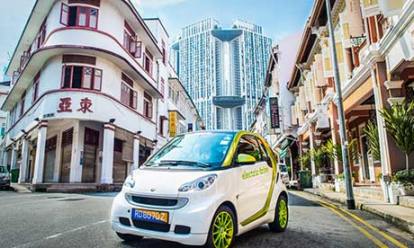
Bosch is testing the viability of electric cars in Singapore. Photograph: Samuel He/Bosch
Normally we avoid articles that look strictly like press releases promoting a PR firm’s client. However, in this case, a couple of exceptions were allowed. First, we like the storyline because of its relevance to three years’ worth of posts on our site. Second, there is not one iota of obnoxious flimflam, which is what normally forces us to avoid press releases.
But, an additional component to this one really made the difference. Nearly one year ago two of Raxa Collective’s contributors had the opportunity to visit Duke University and sit in the office of the founder and director of their Center for Energy, Development and the Global Environment. A conversation that was meant to last 15 minutes continued for hours that day, because of the credible commitment that Center and its leadership are making to ensure that future business leaders see sustainability as serious business. So, we gladly pass this newsworthy article on:
When it comes to sustainability ambitions, Singapore might take the prize. The island nation, which currently relies on neighboring Malaysia for its water, is aiming for water self-sufficiency by 2050, with 55% of its water needs met via recycled water and 25% from seawater desalination.
Moreover, its Sustainable Singapore Blueprint, which the government released in 2009, sets a target of certifying 80% of its buildings as green by 2030. And the sustainability push extends beyond buildings and civic services: Singapore’s Nanyang Technological University is shooting for greenest eco-campus in the world, with a 35% reduction in energy, water and waste by 2020.
Chee Kiong Goh, executive director for cleantech and infrastructure at the Singapore Economic Development Board, said Singapore’s national targets demonstrate its push towards environmental sustainability. “Overcrowding is a big problem here and throughout Asia – Asian cities are growing at a rate of 37 million (residents) a year. Singapore’s lack of land and natural resources also means the country must focus on sustainability,” Goh said.
He already sees progress. The Economist Intelligence Unit’s Asian Green City Index (pdf) ranks Singapore at the top of its list. Meanwhile, global corporations – including Panasonic, Bosch, EDF and Veolia – are investing in helping Singapore reach its goals with innovative tech solutions.
“We are ahead at demonstrating new, urban solutions, therefore we want to attract and work with the world’s best companies in the space,” Goh said.
Corporate partnerships
Singapore’s corporate-driven sustainability projects extend to almost every aspect of society. In 2010, GlaxoSmithKline and Singapore’s EDB formed a 10-year, $33m partnership for advancing green manufacturing in the pharmaceutical and fine chemical industries. Meanwhile, EDF and Veolia are helping Singapore’s Housing & Development Board, the country’s largest urban housing developer, to build out an urban modeling IT tool. Using 3-D visualization and simulation techniques, planners can simulate complex scenarios to determine which planning strategies to pursue. The tool, which is currently being used in the Jurong East residential district, assesses buildings’ energy efficiency, air-conditioning systems, domestic waste collection and solar panel integration.
On the transportation front, Bosch Software Innovations recently concluded the first phase of its investigation into the technical and commercial viability of electric vehicles in Singapore. The island already has 111 charging stations, and Bosch hopes to expand into car sharing and commercial fleets, said Thomas Jakob, Bosch’s managing director for the Asia Pacific region.
Singapore as a springboard
Singapore makes a sensible test bed for new products and ideas, many of which could be applied to other countries, experts say.
“The companies can move more quickly and try more radical approaches than they could in less resource-constrained markets, while also being ready when the market begins to demand these solutions,” said Daniel Vermeer, founder and director of Duke University’s Center for Energy, Development and the Global Environment.
Manoj Singh, global chief operating officer of Deloitte Touche Tohmatsu, added that the lessons corporations learn from sustainability initiatives in Singapore will be highly transferrable elsewhere in Asia: “The Singapore experience allows corporations to cut their teeth, test and actually implement the projects elsewhere, avoiding the same startup costs.”…
Read the whole article here.
 Organikos