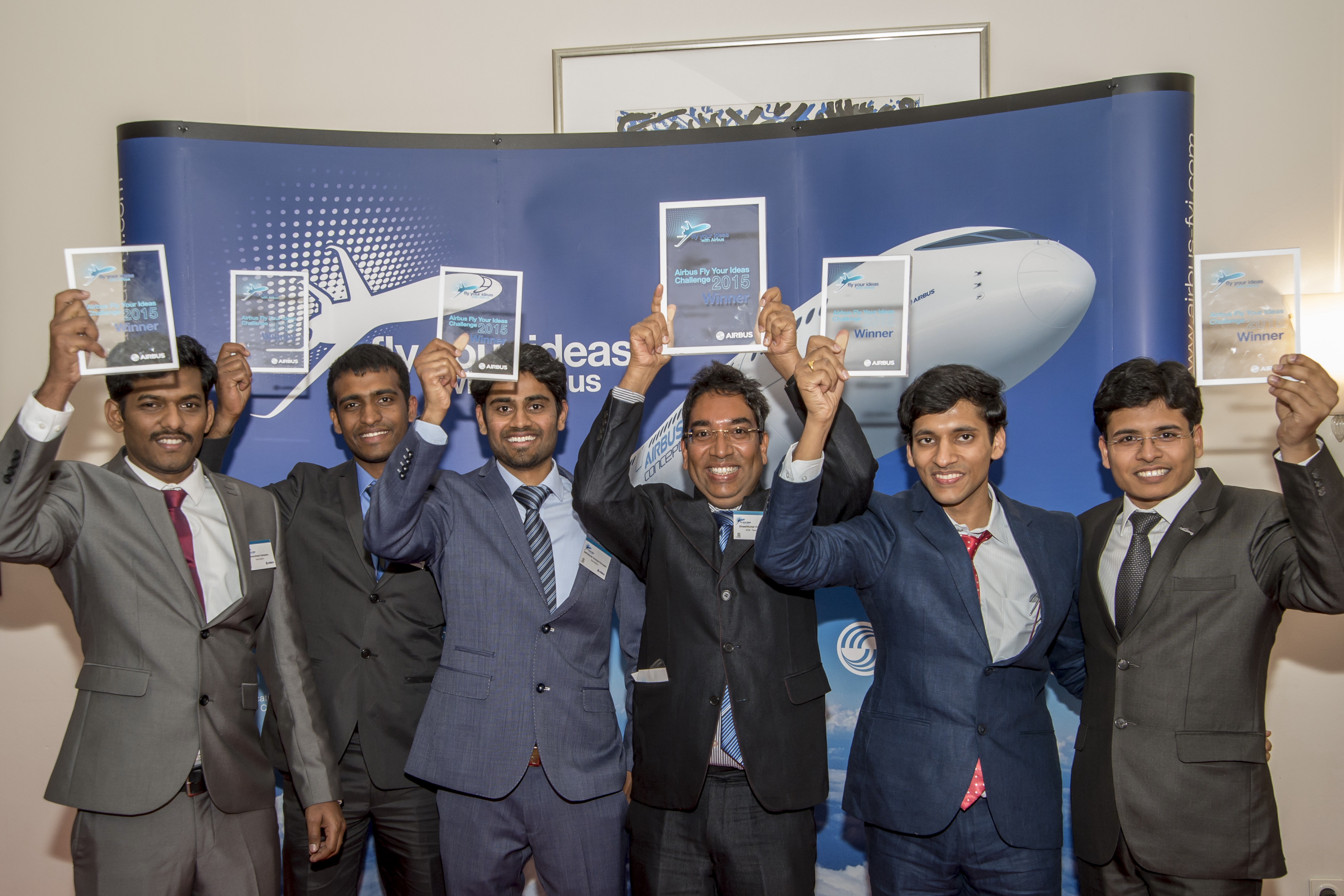
A team of Indian students won the fourth edition of the Airbus Fly Your Ideas global competition organised in partnership with UNESCO to encourage innovators . PHOTO: Airbus
A few weeks ago, Hamburg hosted the fourth edition of the Airbus Fly Your Ideas competition. The city is where the most popular single isle A320 family aircraft are finalised, where A380 cabin interiors are fitted and where the revolutionary A350XWB sections are manufactured. Organised in partnership with UNESCO to encourage the next generation of innovators, the competition saw 518 multi-disciplinary ideas, representing 3,700 students from over 100 countries – all to better the future of flight. And a team of four Indian students and their “good vibes” took home the top prize money of €30,000 (£21,500). And here’s the best bit: the winners physically met only on the day of the finals.
Currently spread across four continents, the winning team – Team Multifun – comprised of team leader Satishkumar Anasuya Ponnusami, (M.Sc Aerospace Engineering, IISc), currently pursuing his PhD at the Delft University of Technology, Netherlands; Damotharan Veerasamy (M.Sc Aerospace Engineering, IISc), currently pursuing his PhD at City University, London; Shashank Agarwal and Ajith Moses, currently pursuing their PhDs at the Nonlinear Multifunctional Composite Analysis and Design (NMCAD) laboratory, Aerospace Engineering Department at Indian Institute of Science.
They beat finalists from China, Japan, Brazil and the UK, whose ideas included using drones to guide birds away from airports and runways, recycling in-flight waste and greener ground operations. And this is the stuff the winners were made of:
Team Multifun’s winning idea is all about good vibrations. The team’s idea involved aircraft wings dressed in a composite skin that harvests energy from natural vibrations or flex in the wings. “Piezoelectric fibers gather electrical charges from even the smallest movements during flight, storing the energy generated in battery panels integrated in the fuselage and using it to power auxiliary in-flight systems, like lighting and entertainment systems. This reduces the energy footprint of aircraft during flight and could even replace the entire power source for ground operations,” Airbus said in a statement.
Read more here.
 Organikos