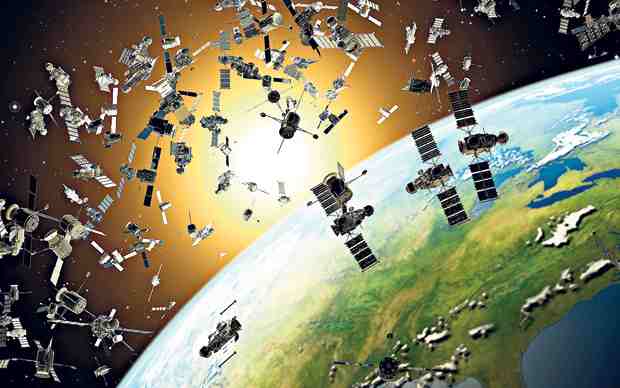
It’s not just here on earth that litter is a problem. In the last 40 years, there have been more than 5,000 launches into space, and they’ve ended up leaving a mark, and now scientists are worried about the litter they’ve left behind. ‘Space junk‘ are the small objects that we’ve left behind in space.They include things like old satellites, gloves, and toolkits accidentally dropped by astronauts. In 2014, the International Space Station had to move three times to avoid lethal chunks of space debris. The problem also threatens crucial and costly satellites in orbit. So what is the scale of the space junk problem, and what can we do about it?
Sadly, the space environment has borne the brunt of our increasing reliance on satellites and our long-lived belief that “space is big”.
More than 5,000 launches since the start of the space age, each carrying satellites for Earth observation, or communications, for example, have resulted in space becoming increasingly congested and contested. The issue has been examined for a BBC Horizon documentary on BBC Two.
Now, the US Space Surveillance Network is tracking tens of thousands of objects larger than a tennis ball orbiting above us, and we suspect that there are one hundred million objects larger than 1mm in the environment. Due to their enormous orbital speed (17,000 mph), each one of these objects carries with it the potential to damage or destroy the satellites that we now depend on.
Perhaps the most visible symptoms of the space junk problem are the regular collision avoidance manoeuvres being performed by the International Space Station (ISS), and the increasingly frequent and alarming need for its occupants to “shelter-in-place” when a piece of junk is detected too late for a manoeuvre.
Read more on NASA’s multi-pronged approach to space junk here while BBC brings you more data here.


Really nice post there! Best wishes for your blog, go check also what I’ve said about this Caos of Satellites! https://thebeautyofspace.wordpress.com/2015/08/08/the-magnificent-caos-of-2-million-pounds-of-satellites/ Cheers!
Hi Gonçalo – thanks so much, and best of luck with yours as well. We hope you get out to see the Perseids meteor shower tonight!
Hope too! Thanks to you! Cheers!