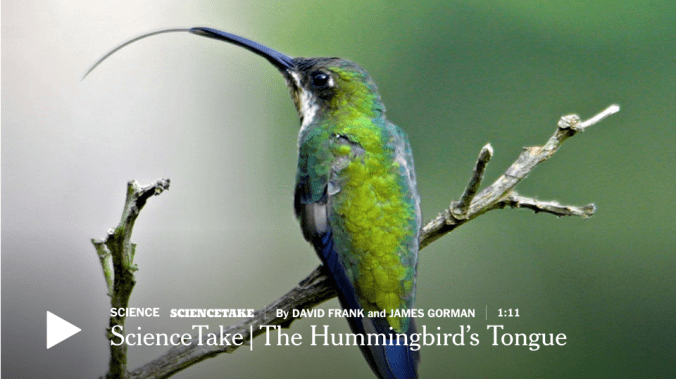
Thanks to the Science section of the New York Times for this recent “how” series, which you can see past examples of once this video stops playing (including how a boa constrictor “feeds,”) but especially for this video explaining one of our favorite birds. The related article The Hummingbird’s Tongue: How it Works is worth an additional few minutes:
Hummingbirds are great subjects for evolutionary biologists because they are so extreme. They live at a fast pace, wings a blur, tongue darting in and out of flowers at a frenetic pace, often 15 or 20 times a second.And, according to Alejandro Rico-Guevara at the University of Connecticut: “They’re just fascinating. They are so bold.”
Dr. Rico-Guevara, who just published in Proceedings of the Royal Society B a description of how the hummingbird’s tongue works to draw up nectar, said that when working in the middle of the forest, he has often had hummingbirds approach him. “They just come to hover right in front of your face.” He said it is as if they are asking, “Why are you here?”…
Read the whole article here.

