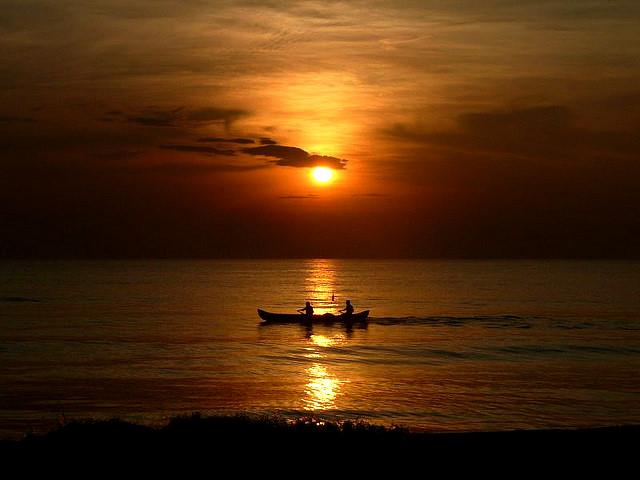
Many are the memories created on the banks of rivers, in the middle of the sea, and along ocean tides. PHOTO: Abrachan Pudussery
At Xandari Riverscapes, water is everything. Sharing the Kerala backwaters with all those who choose to travel with us has always been about sharing stories of the waters. Of the paddy fields that hug the river banks, canoes that transport groceries and construction material to the hinterlands, women and children fishing and splashing around near their waterfront homes, fishing boats, and more. And so this soulful piece on water’s incredible power to flow by memories resonates with us all through:
Water is great. We tune ourselves to it, to its murmured song of ebb and flow, of wave and ripple, in seas, rivers, streams, lakes, wetlands, ponds, snows. We drink it, we bathe in it, we stare at dark clouds praying for their sudden moment of release of it. “Take me somewhere magical,” my favorite cousin once said. So I did, to sail the sea. By the third day our ship was completely out of sight of land, nothing but water curving with the horizon.
“Oh,” she said. “Oh. That’s exactly what I needed.”
Below us, the swells rolled, allowing us to dance with them until our very steps were full of the lift of waves. In our own small way, our steps lifting with the waves, we were tuning the ocean as we sailed—and it, in turn, was tuning us.
Excerpts from the post on National Geographic:
I used to know a man who tuned rivers.
He would make camp on a willowy bank, then sit and listen. Listen to the chatter of water over rocks, the whirl of an eddy, the late evening splash of trout.
To truly hear the river required a few days. He’d have to learn to separate the trill of a tiny stepped waterfall, or the bass of a torrent over deadfall, from the rest of the landscape. If he was lucky, it would rain, and he’d get a chance to listen to the clouds building the river once again, drops spilling off trees like a water clock.
At last, he’d start to tune the stream. He would wade into the cool wet and move rocks to change the entire music of the flowing water, adding words to the language of a spill of river across moss.
This may be one of the most sensible things anyone has ever done. Because, really, aren’t we all dancing to the sound of water before we’re even born, in our mothers’ wombs?
Forget the poets who tell you we’re made of stardust. The human body is composed of up to 60 percent water, a coming together of those most common of elements, hydrogen and oxygen. Our bodies’ own rivers and streams are traced in blood, as susceptible to the forces of tides as Canada’s Bay of Fundy, where the seawater can rise and drop 50 feet in a matter of hours.
Water compels us, and water saves us. It hydrates us. It keeps our minds supple as we learn its patterns and splashes. It offers us many ways to move through the world.
And not just us: Consider whales. Look inside a whale flipper and you’ll see the bones of fully articulated fingers. Millennia ago, the precursors of whales came ashore, hung out on land awhile, then headed back to the sea, where they could sing water-carried whale song to each other across hundreds of miles.
Is it any wonder that we run for the water’s edge whenever we can, eager to feel that cut of sand pulling out from under our feet, reminding us where we came from?
Read the full post here.
 Organikos
Reblogged this on Bangkok Sarongs and commented:
miss sea fishing so much, hate city life