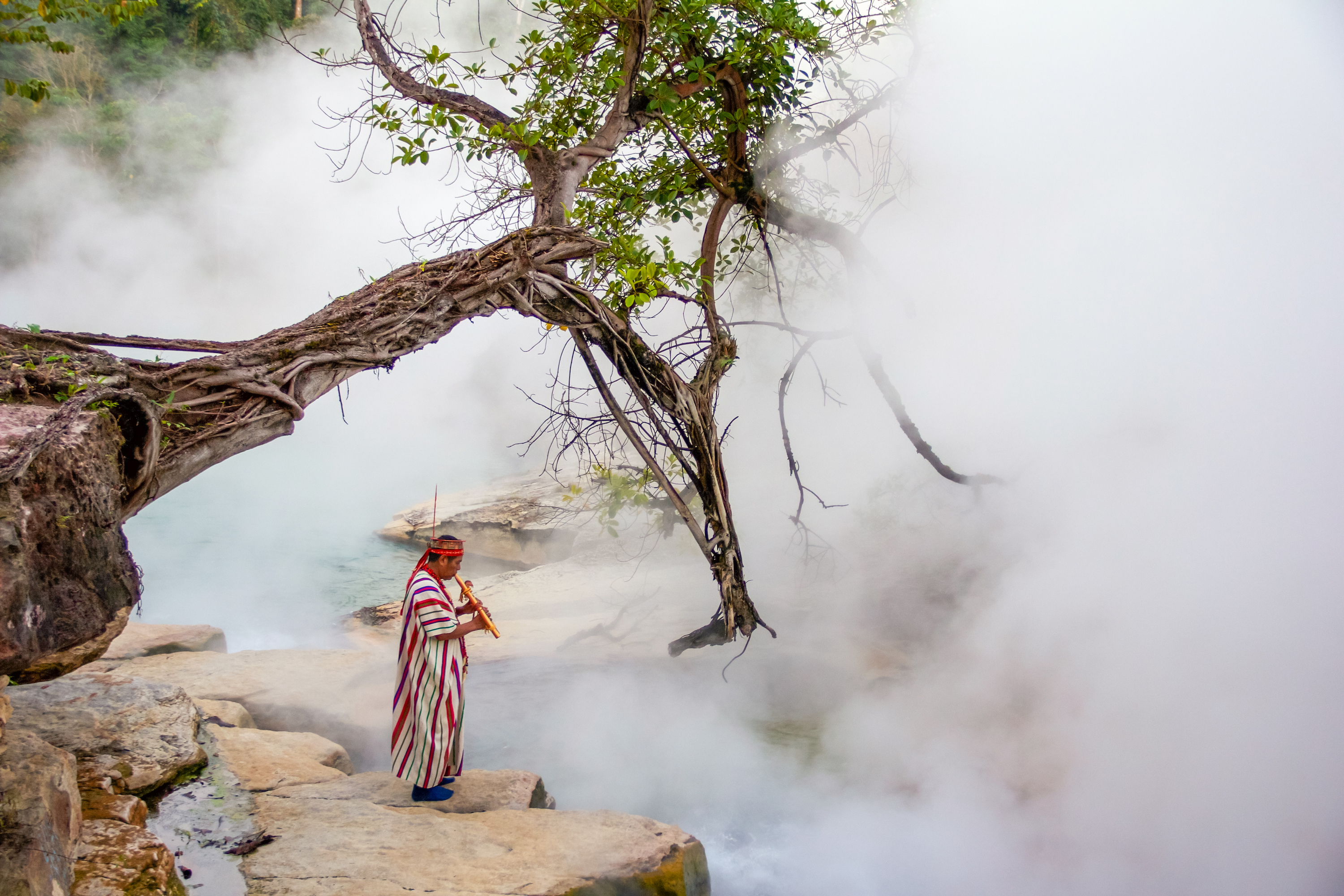
The Boiling River and an Amazonian shaman. Photo by Sofia Ruzo
Thanks once again to Chau Tu at Science Friday’s weekly written article, we’ve learned something new about the natural world, and it sounds like pretty much everyone except maybe a couple hundred people were unaware of its existence too: a steaming-hot river in the Amazon of Peru that isn’t volcanically heated. As Andrés Ruzo, the first geoscientist to study the water body, said in his TED Talk on the subject in 2014 (just released this February), “At a time when everything seems mapped, measured and understood, this river challenges what we think we know. It has forced me to question the line between known and unknown, ancient and modern, scientific and spiritual. It is a reminder that there are still great wonders to be discovered.” Here’s more from Chau Tu on the subject, and make sure to visit the Boiling River Foundation website.
Andrés Ruzo first heard about the Boiling River from his Peruvian grandfather, who shared a legend with him when he was a kid about the Lost City of Gold in Peru. “One of the details of the story was a ‘river that boils,’” Ruzo recalls.
Twelve years later, when Ruzo was studying at Southern Methodist University in Texas to become a geophysicist, he asked colleagues and other experts if they knew anything about a large river that boiled in the Peruvian Amazon. No one had; some scoffed at the inquiry. While thermal rivers do occur on earth, they’re generally tied to active volcanic or magmatic systems—neither of which were known to exist in the Amazon jungle, they said.
Ruzo gave up on the idea that the river was real. But then he happened to mention his frustration at a family dinner, when his aunt interrupted and said, “‘No, Andrés, I’ve been there,’” Ruzo recalls. “I didn’t believe her initially.”
But his aunt insisted. The river supposedly had healing powers, and shamans would make medicines from its scalding waters. But only those with the shaman’s permission could access the river.
Ruzo’s aunt tried to connect him with the shaman of a healing center she knew of. When they didn’t return his correspondence, she offered to personally take him, so they traveled to Peru in November 2011.
After they reached the healing center in the shamanic town of Mayantuyacu, the duo received permission to visit the river. Guided by the shaman’s apprentice, they embarked into the jungle, eventually arriving at their destination.
“The place itself is stunning,” Ruzo says. “Imagine a clear river, clear water that’s almost turquoise, bounded by these ivory-covered stones on either side. And along most of the river, you’ve got these 60-foot walls of green that are just shooting up from the jungle floor, with these huge beautiful trees.”
Most noticeable, though, was the steam rising from the river. Ruzo immediately took the temperature of the water. It averaged 86 degrees Celsius, or around 187 degrees Fahrenheit—not quite boiling, but still really hot.
Ruzo had three hypotheses that could potentially explain the hot water: The river was part of a volcanic or magmatic system; it was a non-volcanic hydrothermal system, in which water seeps into the earth, heats up, and then rises back up; or it was a result of oil or gas activity gone awry.
After that initial trip, Ruzo knew he had to launch a deeper investigation. He returned eight months later with the permission from the shaman, becoming the first geoscientist to study the river.
Over the course of several research trips, Ruzo narrowed down his hypotheses. He ruled out the first idea—geochemical testing of the water indicated that it wasn’t volcanic or magmatic.
The third hypothesis—an oil drilling accident—worried Ruzo. He learned that there was indeed an oil well more than a mile away, but the company that operated it was forthcoming with their activities, which didn’t affect the river. Stories told by the local shamans also suggested the river had been around for generations. And finally, Ruzo found mention of a thermal river in historical archives that documented the area before any oil development.
“The only remaining option is it’s just a ‘normal’ hydrothermal feature where waters are seeping deep into the earth, heating up, and then coming back up quickly,” Ruzo says.
Thermal springs often undergo the same sort of process (hot springs in Arkansas’ Hot Springs National Parkare examples), but the size of this boiling river in Peru is what sets it apart. (Ruzo estimates that the entire river system—which starts out as a small, cold stream—is about 5.5 miles long, and the river can get over 80 feet wide, though in those areas, the water is shallow).
You can finish the article at the original source, here.
 Organikos