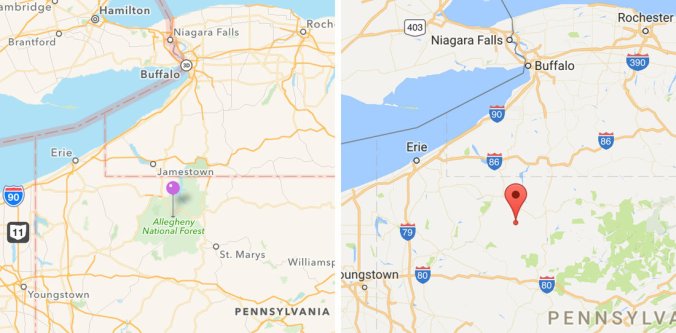
The Allegheny National Forest is absent from Google Maps (right) but displayed on Apple Maps (left). Apple & Google/Screenshots by NPR
We lose more than enough green in the real world, so when the cartographical world starts compounding the problem, we must shout in protest:
Where Did National Forests Go? Green Spaces Disappear From Google Maps
Erin Ross
If you looked at Google Maps this week, you might have noticed something strange: less green.
Typically, mint green highlights designate publicly owned wild spaces on Google’s maps. But as of this writing, some of those public lands have gone gray. The locations are still searchable, but if you don’t already know the park or forest exists, and where exactly, you might not be able to find it.
No green space is safe: Many of the missing parks are national forests, but some are state forests, Bureau of Land Management recreation areas, wildlife refuges and wilderness areas. Some, like the Blue Hills Reservation in Massachusetts, are just a few thousand acres. Others, like the Allegheny National Forest in Pennsylvania, are over 500,000.
The first clue to Google’s de-greening came Tuesday night, when your blogger was casually browsing maps of national forests (as one does). Sometime in the past few weeks, the 1.6 million acre Willamette National Forest in Oregon’s Cascade region had gone from green to gray.
“I was surprised to see we’d lost our government status!” said Karen Kanes, spokeswoman for the no-longer-mapped national forest. Google — which acknowledges its maps do have “occasional inaccuracies” —was displaying the forest in off-white like private lands, with its location marked at the headquarters in a nearby town…
Read the whole article here.
 Organikos