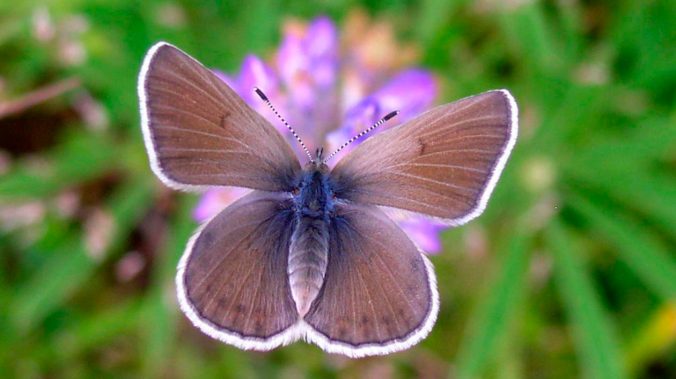
Fender’s Blue (Icaricia icarioides fenderi) is an endangered subspecies of butterfly found only in the Willamette Valley of northwestern Oregon. Fender’s Blue butterflies are completely dependent upon the threatened plant species, Kincaid’s lupine (Lupinus sulphureus kincaidii). Photo © Matthew Benotsch/TNC
Feed your inner biophilia with education to sharpen your senses:
Unlock a New Way of Seeing the World as a Master Naturalist
BY LISA FELDKAMP
Becoming a Master Naturalist is easier than you think. You don’t have to enroll in years of coursework or explore the world a la Darwin. In fact, there may well be a comprehensive naturalist class near you.
Working at The Nature Conservancy, I’m used to being around people with all kinds of nature knowledge. Many of my colleagues are hardcore birders, from those that are relatively new to the sport to those who have seen 5,000 bird species in a lifetime. And my editor, in addition to an interest in non-traditional angling, participates in the up-and-coming, but more daunting hobby of mammal watching.
All of these pursuits require a detailed knowledge of nature, often going beyond knowledge of birds, fish or mammals to knowledge of their habitat, prey and life history. Inspired by my coworkers’ fascinating knowledge of nature and natural history, I’ve learned there’s a word for them – they’re naturalists.
For many, the word “naturalist” evokes an earlier time: think Victorian-era explorers collecting species in the tropics. But the naturalist tradition is alive and well today. And I am about to embark on a class devoted to improving those skills.
How to Become a Naturalist
Many people become naturalists through rigorous self-study. Observing nature around them, taking field notes and reading field guides and natural history books. Many influential scientists, like Charles Darwin and John James Audubon were naturalists in this sense.
While improving my observational skills & talking to colleagues, I learned that there is another way to improve your knowledge of the natural world: Master Naturalist programs offer courses (usually through a university or state agency). These courses are open to adult learners with an interest in learning more about the environment.
Check to see if there is a Master Naturalist program in your state…
Read the whole article here.
 Organikos
Did you take this photo?? It’s amazing
Hi Dani, the photo is credited to Matthew Benotsch from The Nature Conservancy. It’s definitely an amazing photo though!
It is truly amazing!!! Could I ask you, what is your favourite animal? For my list of ideas for the fact files on my blog
Well – as a group, I’d say we’re quite partial to birds in general. But I’d say jaguars, sloths and tapirs are high on some of our personal lists, too! How about you?
Ooooh interesting animals. I think birds in general are at the top but I’m more of a margay/tiger/bear girl
Thumbs up to all of them!