Thanks to Anthropocene’s Brandon Keim for this story about a health care revolution for wildlife:
…Researchers led by University of Florida biologist David Duffy raise that possibility in a new Global Change Biology article about “precision wildlife medicine,” an approach that would draw upon innovations in human disease treatment.Combining modern medical techniques with traditional conservation efforts “will be essential to combat species decline,” they write…
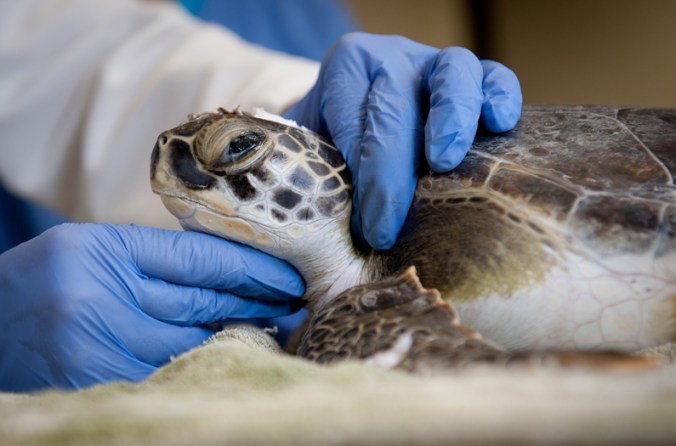
…“Species conservation could be improved by using precision medicine techniques,” write Duffy’s team. As examples they give fibropapillomatosis, now treated by treated by time- and labor-intensive surgery; by profiling tumors, the researchers have found drugs that might attack them. Cancer is also a problem in beluga whales in Canada’s St. Laurence estuary and also Tasmanian devils in Australia, and might be approached in a similar way. Western gorillas vulnerable to ebola could be given vaccines. Amphibians threatened by chytridiomycosis, a disease caused by a pathogenic skin fungus, may benefit from bacterial treatments that enhance their resistance.
Scientific questions still remain, of course. Once those are answered, ethical questions come next. Some people may worry that, in a larger sense, precision wildlife medicine might amount to treating symptoms while avoiding the fundamental problems giving rise to disease. Fibropapillomatosis, for example, occurs naturally but seems to have been exacerbated by pollution and rising ocean temperatures. No drug will fix that, and if our responsibility to stop polluting is expiated by treating a few turtles, any so-called cure would be a conservation placebo.
In a similar vein, those beluga whale cancers are caused by human-spread toxins. Duffy’s team acknowledges that while “it would be preferable” to prevent toxins “from entering the environment at all, the fact remains that the onus is on humans either to enact relevant environmental protection legislation or to develop treatments for species affected by such pollution.” While waiting for root causes to be addressed, we might as well treat what disease we can.
This might still seem frivolous to some people. After all, there are plenty of humans who lack basic health care, much less access to the fruits of a revolution in precision medicine. But that doesn’t eliminate our responsibilities, and compassion is rarely a zero-sum game. It’s also quite likely, write Duffy’s team, that lessons learned from studying and treating disease in wildlife can eventually be applied to human health. Taking care of Mother Nature might also be good for us.
Source: Whilde et al. “Precision wildlife medicine: applications of the human-centred precision medicine revolution to species conservation.” Global Change Biology, 2016.
Read the whole story here.
 Organikos