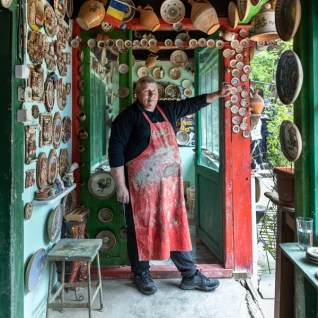
Mr. Biscu makes pieces using clay that comes from earth extracted from a hill in Horezu.
Chantel Tattoli reported this story from Horezu, Romania for the New York Times. Accompanied by photographs and video by Marko Risovic, her story is based on speaking to a dozen local potters using a translator:
Can Old-World Ceramics Survive Modern Tastes?
A style of pottery made for centuries in a small Romanian town has recently become a hot commodity.
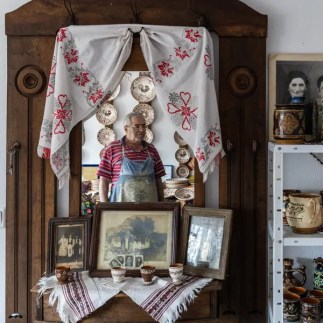
Sorin Giubega at his home, which is filled with ceramics made by him and his ancestors.
Sorin Giubega’s grandfather was a potter. So was his father. And at 8 years old, Mr. Giubega said, he started to play on a pottery wheel, too.
Mr. Giubega, now 63, and his wife, Marieta Giubega, 48, are potters in Horezu, Romania, a town in the foothills of the Capatanii Mountains about three hours by car from Bucharest.
Horezu is home to a community of about 50 artisans who make a traditional style of ceramics with methods that have been practiced for more than 300 years. In 2012, Horezu pottery was recognized as an Intangible Cultural Heritage of Humanity by UNESCO, the United Nations Educational, Scientific and Cultural Organization.
Most potters in Horezu, including the Giubegas, live on Olari Street (“olari” means potters in Romanian), where they work in home studios. The artisans advertise their craft by hanging ceramic plates outside their houses, some of which have yards where they keep roosters and pigs.
On a Monday afternoon in early May, Mr. Giubega, who was wearing a clay-caked apron, showed off a shelf of ceramic honey pots and jam jars that his grandfather had made in the 1920s.
“This is the story of my life!” said Mr. Giubega, who was named a Living Human Treasure by Romania’s Ministry of Culture in 2021.
Traditional Techniques
Artisans in Horezu work year-round, and the ceramics are made by two potters with distinct roles. Modelers, who are typically men, shape clay into pieces. Decorators, who are typically women, paint the pieces using ancestral motifs that include spirals, waves, spider webs, roosters, serpents, fish and an arboreal design known as the tree of life, which is dotted with apples…
Read the whole story here.
 Organikos