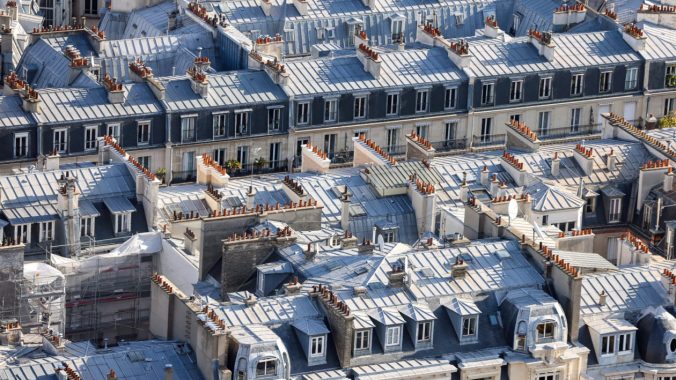
Paris’ iconic zinc roofs can heat up to 194 degrees F on a hot summer day. JAN WOITAS / PICTURE-ALLIANCE VIA GETTY IMAGES
We have celebrated the many greening efforts made in Paris over the last decade, and today is a small but important addition to our knowledge of those commitments. Our thanks to Jeff Goodell in Yale e360:
A rendering of a rooftop terrace installed by the Parisian startup Roofscapes. ROOFSCAPES
Paris When It Sizzles: The City of Light Aims to Get Smart on Heat
With its zinc roofs and minimal tree cover, Paris was not built to handle the new era of extreme heat. Now, like other cities worldwide, it is looking at ways to adapt to rising temperatures — planting rooftop terraces, rethinking its pavements, and greening its boulevards.
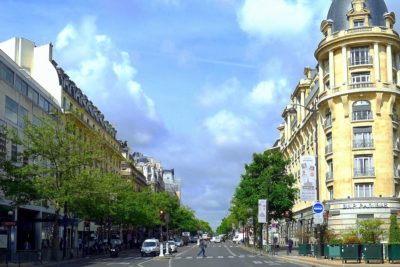
The tree-lined Boulevard des Italiens is much cooler than nearby streets that lack trees. MBZT VIA WIKIPEDIA
There’s a long tradition in France of taking August off for holiday. Paris virtually shuts down as the temperature drifts around in the seventies, and people go to the beach or the mountains to cool off and relax. Think of it as an old‑fashioned adaptation to heat. People who stick around during August are often older or have jobs that require them to stay and keep the city functioning.
In the summer of 2003, Parisians who remained in the city were hit with something they were not accustomed to: a heat wave. For nine days in August, the daytime temperature was above 95 degrees Fahrenheit, sometimes spiking up to 104 degrees. It didn’t cool off much at night either. It took a few days for the full scope of the tragedy to reveal itself. Hospital emergency rooms started to fill up. A week or so into the heat wave, city officials began running out of places to store bodies.
In less than two weeks, 15,000 people in France died as a direct result of the heat wave. Nearly a thousand lived in central Paris. Many of the victims lived alone, in top‑floor garrets or attic apartments, where the heat built up beneath zinc roofs and literally cooked people as if they were in an oven.
Like every other city in the world, Paris was built by people who believed that the Earth’s climate was stable. Yes, there were hot and cold days, ebbs and flows of rivers, storms, and droughts, but the basic idea that there was a certain steady state and that the world would always return to it was never questioned. Just as no one built a city on the coast with the assumption that the polar ice sheets could melt and raise the water five or six feet in a few decades, no one built a city with the assumption that the temperature would jump five or 10 degrees or that extreme heat waves would zap us. We built and lived in the Goldilocks Zone, and our cities are a part of that. They are Goldilocks cities.
But now, like everything else, these cities have to change. That is being brought home this month, as Earth has seen its hottest days on record, and deadly heat waves have hit the U.S. Southwest, Southern Europe, China, India, and elsewhere. Making a city that was not designed for extreme heat into a city that is livable during extreme heat is the great urban engineering project of our time. Or, if that is too much, at least making it a city that is not a death trap for its citizens.
For cities, the challenge of thriving on a superheated planet is twofold. First, as cities grow, how do you ensure that they grow in a heat‑smart way? Another 50 years of suburban sprawl is not the answer. Cities need to be denser. Cars need to be replaced with bikes and public transit. New buildings need to be not only efficient and built of sustainable materials, but also safe for people during increasingly intense heat waves. That means more green space, more trees, more water, more shade, more thermally intelligent urban design…

Read the whole article here.
 Organikos