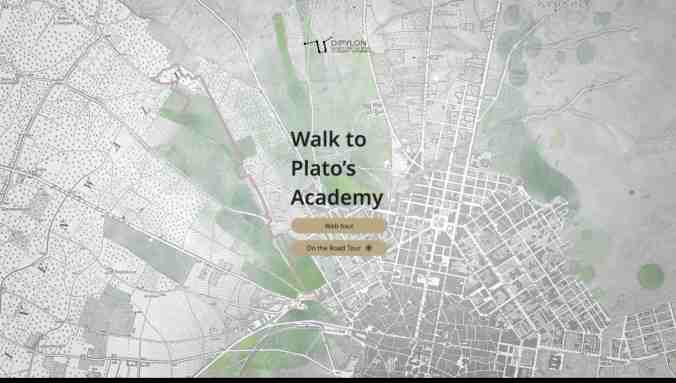
If you click on the image above you will experience through a short video what can happen when technically skilled map-makers, using GIS, combine forces with scholars of antiquity. Better yet, go straight to the software they have created. In advance of travel commemorating 40 years since two of us met, my daily omnivorous media diet brought me to Dipylon, via a profile by Nick Romeo, which I highly recommend (to better understand the origins and workings of Dipylon) whether or not you are planning to visit Athens:
Illustration by Eleni Kalorkoti
The Hidden Archeologists of Athens
By collecting long-forgotten archeological data, a new project reveals the researchers who toiled unrecognized.
In Don DeLillo’s 1982 novel “The Names,” an American businessman living in Athens can’t quite bring himself to visit its most iconic monument. “For a long time I stayed away from the Acropolis,” he says. “It daunted me, that somber rock.” He prefers “to wander in the modern city, imperfect, blaring”; when he catches sight of the Acropolis from odd angles, he finds its exalted reputation forbidding. “The ruins stood above the hissing traffic like some monument to doomed expectations,” he observes.
Today, most tourists have no such hesitancy: in the summer, as many as twenty thousand visit the Acropolis each day. And yet, after millennia of human habitation, Athenian history isn’t confined to a few famous spots. Over the last two centuries, as the city has grown from a sleepy village to a sprawling capital, new ruins have been continually discovered. Greek national law requires so-called rescue excavations before the construction of new houses, buildings, subway lines, sewer systems, or almost anything else; although these are faster and less comprehensive than the research excavations conducted for purely archeological reasons, they can still reveal the locations of shrines, wells, walls, roads, and cemeteries, as well as smaller artifacts, such as oil lamps, toys, and loom weights. Collectively, all of this material constitutes a kind of secret history of the city.
Until recently, information from rescue excavations was sequestered in a vast gray literature of reports published in Greek by the state archeological service. But, in 2014, a group of Greek archeologists and a cartographer launched an organization called the Dipylon Society, which aims to share these discoveries more widely. Dipylon has undertaken a series of fascinating, high-tech projects, including digital maps, searchable databases, and free mobile apps with guided walking tours. Its first app, Walk the Wall Athens, appeared in 2018. It leads users through a twisting six-kilometre course, past thirty-five locations where parts of the ancient city’s walls survive. The route snakes through the basements of hotels and apartment buildings, beneath shops and through parking garages, connecting points where the twenty-five-hundred-year-old monumental walls are still accessible. At these hidden spots, the app allows you to see historical photos, read key findings from the rescue excavations, and hear an audio narration in Greek or English.
Dipylon’s projects reflect years spent gathering, digitizing, and synthesizing data from almost fifteen hundred rescue excavations conducted in Athens over the past hundred and sixty years; it has changed our understanding of the archeology of the city. But, by recovering one sort of lost history, Dipylon has revealed another. During Athens’s most explosive decades of growth, the archeologists who ran excavations for the state archeological service were predominantly female; their work was often unheralded and unacknowledged. Now, in digital form, it’s coming to light.
On a sunny morning last fall, I joined a wall walk led by Annita Theocharaki, a founding member of Dipylon. A tall, curly-haired woman in her early sixties, Theocharaki runs a family business by day; Dipylon, which now has a full-time staff of six, is a lasting passion project that she helps run on nights and weekends. We met at Kotzia Square, a pedestrian plaza fringed with leafy trees and charming neoclassical buildings. A dozen students had gathered outside a gated enclosure, inside which stone embankments lined a stretch of old road that was barely the width of a bike path. “Imagine a road continuing directly beneath us toward the walls,” she said, sweeping her arms in a diagonal from where we stood to the edge of Kotzia Square. The students shifted their gaze to follow her hands.
“You can see the burials on either side of the road,” she continued, gesturing to bits of pale stone beside the path—actually parts of weathered burial shafts and stone sarcophagi from a cemetery dating back to the eighth century B.C. “It’s common to find cemeteries just outside the city walls, but placing graves right beside the road was also about display,” she said. “Anyone walking in or out of the city would see all of the funerary monuments.” As she spoke, the sun moved across the site, bathing the pale stone and red dirt in early morning light.
We followed Theocharaki across the square, tracing the path of the old road that ran invisibly beneath us. At the corner, tucked underneath the looming façade of the National Bank of Greece, an open-air site plunged some twenty feet below the modern city; inside this pit was a huge section of the ancient wall from the fourth century B.C. More of the wall was visible under glass panels in the sidewalk. Although it is now far below the level of the modern city, it was likely around ten metres high in the fourth century B.C. and still stands to half that height. “Fortification was just as important as the acropolis or the agora,” Theocharaki said as we looked down. “It was not only a matter of protection—the walls were also beautiful, monumental structures. Something citizens could admire.”
From there, our path grew stranger. In the underground parking lot of a bank, a massive section of wall rose beside us in the shadows as we walked down a sloping concrete ramp. (According to one of Plato’s dialogues, Socrates once walked past this spot on an ancient ring road.) A few blocks away, we descended into a subterranean warren of busy printers’ shops. Theocharaki told some workmen that we wanted to see the wall, and one began to clear aside piles of posters and paint-splattered buckets cluttering the corridor. Once he finished, we peered through a steel grate and saw the pale chiselled blocks winding away into the darkness. “I can’t believe it’s here,” a student said…

Read the whole article here.
 Organikos