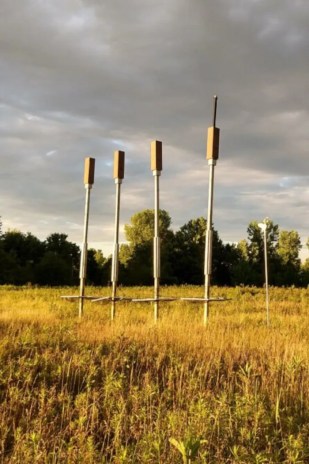
O’Keefe’s team designed bat boxes that offer a wide range of interior temperatures. Joy O’Keefe
We have pointed to stories about activism and entrepreneurship in the interest of protecting animal habitat plenty of times, but not so much on the science of the field work. As part of its Climate Desk collaboration Mother Jones shares this article originally published by Undark, written by Marta Zaraska, that addresses some of the science of species-specific safe spaces:
Inside Scientists’ Race to Create Safe Refuges for Animals
Climate crisis is destroying habitats. Can technology help create new ones?
Conservation ecologist Ox Lennon simulated stacks of rocks that would create crevices big enough for skinks, but too small for mice. Courtesy Ox Lennon
In 2016, Ox Lennon was trying to peek in the crevices inside a pile of rocks. They considered everything from injecting builders’ foam into the tiny spaces to create a mold to dumping a heap of stones into a CT scanner. Still, they couldn’t get the data they were after: how to stack rocks so that a mouse wouldn’t squeeze through, but a small lizard could hide safely inside.
Lennon, then a PhD student at Victoria University of Wellington in New Zealand, aimed to protect skinks, snake-like lizards on which non-native mice prey. When road construction near Wellington displaced a local population of the reptiles, they were moved to a different site. But the new location lacked the rock piles that skinks use as shelter.
So, Lennon and their colleagues set out to create a mice-proof pile of rocks. It proved harder than they thought.
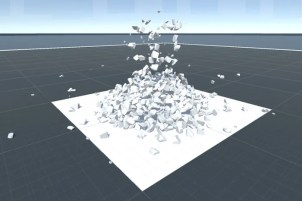
The solution finally came out of Lennon’s love for video games, specifically one called The Elder Scrolls, which featured a scene in which watermelons tumble from the sky to form a pile. Inspired, Lennon programmed a simulation to stack virtual stones, creating crevices big enough for lizards, yet too small for mice. That simulation, generated with the same design program used to build The Elder Scrolls,
showed the scientists what sizes of stones to choose and how to assemble them.As climate change, agriculture, and urban development fuel the destruction of natural habitats, many conservationists have emphasized the need to protect endangered animals left without shelter. But recreating natural habitats isn’t easy: For instance, tree hollows, where owls or bats nest, can take more than 100 years to develop. And while human-made options, from nest boxes to fake dens, have been a common conservation tool for decades, researchers have found that many older designs can actually be harmful—leaving animals vulnerable to predation, overheating, and parasites.
Read the whole article here.
 Organikos