
The Royal Caribbean Icon of the Seas cruise ship docked in Miami on Jan. 11. Photographer: Eva Marie Uzcategui/Bloomberg
The “floating hotel” that many people consider the best way to vacation–cruise ships—are not the best environmentally.
 We knew that. Now we know this in addition, thanks to Kendra Pierre-Louis at Bloomberg:
The World’s Largest Cruise Ship Is a Climate Liability
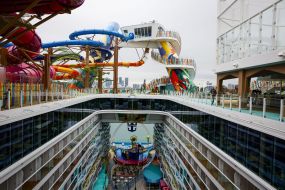
Water slides at the Thrill Island waterpark onboard the Icon of the Seas.Photographer: Eva Marie Uzcategui/Bloomberg
As massive ships like Royal Caribbean’s Icon of the Seas tack on more energy-intensive amenities, emissions from the cruise industry are climbing.
When Royal Caribbean’s Icon of the Seas embarks on its first official voyage on Jan. 27, the journey is sure to make waves. The world’s largest cruise ship, the Icon is over 1,000 feet long (360 meters) and weighs in around 250,000 gross registered tons. It boasts 20 different decks; 40 restaurants, bars and lounges; seven pools; six waterslides and a 55-foot waterfall. Royal Caribbean says its boat will usher in “a new era of vacations.”
Maybe so. But the Icon is also a doubling down on a negative aspect of cruising’s current era: greenhouse gas emissions.
In 2022, Bryan Comer, director of the Marine Program at the International Council on Clean Transportation examined the carbon footprint of cruising as compared to a hotel stay plus air travel — since cruises are effectively floating hotels. His analysis found that a person taking a US cruise for 1,200 miles (2,000 kilometers) on the most efficient cruise line would be responsible for roughly 1,100 pounds (500 kilograms) of CO2, compared with 518 pounds (235 kilograms) for a round-trip flight and a stay in a four-star hotel. In other words: Taking a cruise generates “about double the amount of total greenhouse gas emissions” as flying, Comer says.
Not to mention, “usually people fly to take a cruise,” notes Stella Bartolini Cavicchi, marine policy advisor at OceanMind, a nonprofit that uses satellite and other technologies to understand humans’ impact on the sea. Flying to a cruising port means you “end up with quite a carbon-intensive holiday,” she says.
A Royal Caribbean spokesperson says the Icon is designed to operate 24% more efficiently than the international standard for new ships, which per International Maritime Organization (IMO) regulations must already be 30% more energy-efficient than those built in 2014. The company will also monitor the Icon “over the next six to 12 months to ensure that we’re getting what we were designing the ship to be,” the spokesperson said.
In 2022, the most recent year for which data is available, Royal Caribbean direct (or Scope 1) emissions totaled 5.5 million tons of CO2 equivalent, up from 5.3 million tons in 2019…
Read the whole story here.
 Organikos