Kalichka / Getty
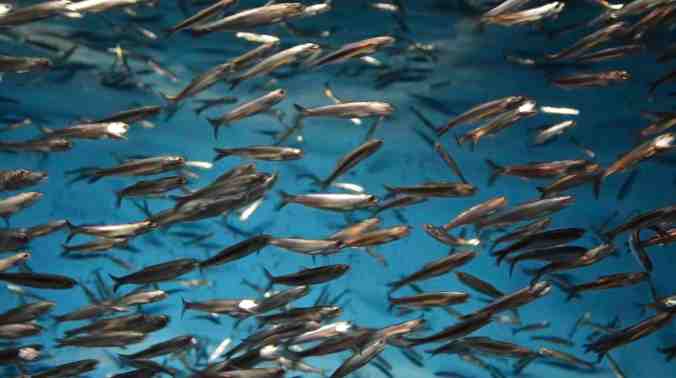
Anchovies are not exactly a staple in our pages, but they make their presence known. They are important. Thanks to The Atlantic, and their collaboration with Hakai Magazine for this article by Christina Couch that illustrates another remarkable feature of these small creatures:
The little fish’s mating rocks the ocean as much as a major storm.
Bieito Fernández Castro wasn’t expecting to find a turbulent hotbed of anchovy sex.
Commissioned by the Spanish government to investigate the conditions behind algae blooms, which kill mussels, Castro and his team were studying a peaceful spot in a bay in northwestern Spain. In the absence of strong winds or waves, toxic algae blooms occur more frequently here compared with surrounding areas, to the detriment of the resident mussels—and mussel farmers. But after two weeks of monitoring the apparently tranquil water with sensors that measure small shifts in temperature and velocity, Castro and his colleagues found that the bay’s calm surface belied what was happening below.
“Every night and without any apparent reason, we were seeing very, very high levels of turbulence,” says Castro, a physical oceanographer at England’s University of Southampton. Castro and his colleagues eventually traced the source of all this mixing: the frothing free-for-all of an anchovy orgy. These fish churn the water as much as a major storm does.
Anchovies are among the ocean’s more amorous residents. The fish move in large aggregations of sometimes millions or more, and a female anchovy can release 20,000 to 30,000 eggs each year, which males promptly fertilize like aquatic crop dusters…
Read the whole article here.
 Organikos