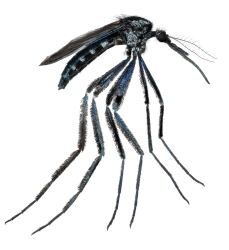
A macro image of a Costa Rican mosquito, Psorophora cilipes.
Living in, or even just visiting Costa Rica, inspires appreciation, and respect, for nature. But one creature defies this spirit:
A blood-sucking nuisance, mosquitoes are responsible for spreading diseases to hundreds of millions of people every year. True?
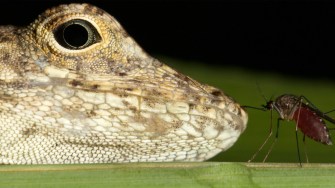
A Culex mosquito feeding from an invasive brown anole lizard in Florida. Photos courtesy of Lawrence Reeves
Yes, says entomologist Lawrence Reeves, but it’s also true that mosquitoes primarily feed on plant sugars, not blood. Only female mosquitoes consume blood, and only when they need it to complete their reproductive cycle. Also, it is possible some may serve as pollinators like bees, allowing plants to produce fruit, seeds, and more young plants.
The bottom line is that while mosquitoes have a bad rap, the truth is probably much more complex given how diverse they are and how much we don’t know about them.
“[Mosquitoes are] this rather indescript, dark insect that’s biting you and making you itch,” said Reeves, an assistant professor at the Florida Medical Entomology Lab at the University of Florida, who spoke last week as part of the OEB Seminar Series, hosted by the graduate students at the Department of Organismic and Evolutionary Biology. “In my lab, we’re trying to visualize mosquitoes, both their morphology and interactions with other organisms.”
Reeves makes the case that while mosquitoes may be one of the most immediately recognized insects, there’s plenty scientists don’t understand about their bodies, habitats, habits, and impacts on their surroundings. A lot of his lab’s work involves photographing and documenting many of the more than 3,700 species of mosquitoes that exist globally.
“We try to create these images that help us to visualize what mosquitoes look like. They are, of course, very small insects so we have a lot of trouble,” Reeves explained, while showing high-resolution, detailed images of the insects throughout the presentation. When someone asked his photography strategy, he said, “I’m often following them around with my hand trying to get them to land,” eliciting laughter from the audience.
One of the reasons photography and videography are so important is that they help Reeves communicate the diversity of mosquitoes, particularly in how they look and act.
Some estimates suggest that mosquitoes have been around for 217 million years; the U.S. and Canada have about 200 species, with Florida alone being home to about 90 species…
Read the whole article here.
 Organikos