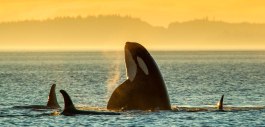
Although all the planet’s killer whales are currently considered a single species (Orcinus orca), some of the world’s leading experts are proposing to split them into three species. Photo by imagebroker.com/Alamy Stock Photo
Hakai is the go-to magazine for marine stories, and we hope to see more work of Craig Welch, the science journalist who wrote the article below, in the future:
Meet the Killer Whales You Thought You Knew
The iconic marine mammals may not belong to one species but several. Surprise!
Transient, or Bigg’s, killer whales, not only look, sound, and act differently than their resident killer whale neighbors, they might be an entirely different species. Danita Delimont Creative/Alamy Stock Photo
John Ford still recalls the first time he heard them. He’d been puttering around the Deserters Group archipelago, a smattering of spruce- and cedar-choked islands in Queen Charlotte Strait, between Vancouver Island and mainland British Columbia. He was piloting a small skiff and trailing a squad of six killer whales. Ford, then a graduate student, had been enamored with cetacean sounds since listening to belugas chirp while he worked part-time at the Vancouver Aquarium as a teenager. Now here he was, on August 12, 1980, tracking the underwater conversations of wild killer whales through a borrowed hydrophone.
Ford had spent the previous two summers painstakingly recording the sounds made by other groups of these iconic black-and-white marine mammals, known as resident killer whales. In summer and fall, the residents traveled in noisy, tight-knit pods that often hugged the shorelines of British Columbia and Washington State, breaching in spectacular aerial displays that delighted tourists, scientists, and other bystanders. They emitted rapid overlapping clicks and thumps, along with squeals, honks, and bleats that could resemble seal barks or, occasionally, human flatulence.
Yet to Ford, the vocalizations he captured on his reel-to-reel that August day sounded nothing like the resident killer whales he’d recorded in previous years. They were coming from a gang of whales researchers had taken to calling “the oddballs,” because they appeared to scientists to be social outcasts who had left or been driven out of the resident group. Their calls were tonal, more alien, and far louder, sometimes sounding like a rusty hinge on a closing gate. Clicks were infrequent when they came at all. “I was amazed,” Ford says now.
While Ford spent the rest of his career studying whales, eventually leading the cetacean research program for Fisheries and Oceans Canada’s Pacific Biological Station before retiring in 2017, he never forgot his reaction that day: these must be different creatures.

Read the whole article here.
 Organikos