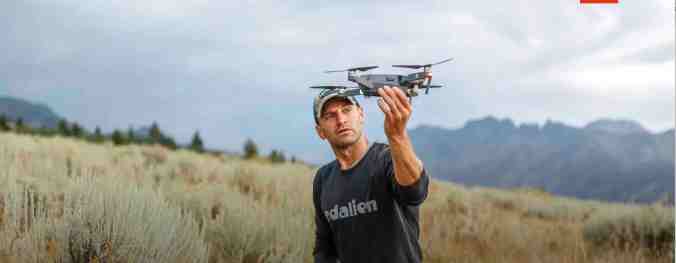
Daniel Anderson holds a drone on his family’s ranch in Montana’s Paradise Valley. Louise Johns/High Country News
High Country News is where a story like this gets assigned, and since they are a hyper-niche publication we thank The Atlantic for broadcasting it. If drones can unite these two constituencies, they are worth a moment of your time:
Illustration by Matteo Giuseppe Pani. Source: Getty.
Drones Could Unite Ranchers and Conservationists
Flying robots could offer a nonlethal way to keep wolves away from cattle.
In the summer of 2022, several researchers with USDA Wildlife Services held their breath as a drone pilot flew a large drone, equipped with a camera, toward a wolf standing in a pasture in southwestern Oregon. The team members, watching from a distance, expected the wolf to freeze or run away the minute the whirring rotors approached it. But to their disbelief, it did neither.
Instead, the wolf wagged its tail, stretched out its front legs, lowered its head, and lifted its butt—a classic canine invitation to play and precisely the opposite of the response researchers were hoping for. The project, led by Paul Wolf, the southwest Oregon district supervisor for Wildlife Services, was designed to find ways to use drones to scare wolves away from livestock, not give the animals a new toy.
Later that night, the researchers tried again, this time outfitting the drone with a speaker that broadcast human voices. The wolf took off running. For the rest of the summer and fall, the field staff focused on using drones to discourage wolves from approaching cattle, in one case using a speaker-equipped drone to halt an ongoing attack. The three wolves fled, and the wounded steer survived. “We know for sure that we saved at least one (animal) doing this,” says Dustin Ranglack, the Predator Ecology and Behavior Project leader for Wildlife Services’ National Wildlife Research Center and a collaborator on the Oregon project. (An arm of the Department of Agriculture, Wildlife Services sometimes kills predators, such as wolves, in addition to implementing nonlethal livestock-protection measures.)
Ranglack and other researchers hope drones will help keep the peace between predators and livestock. “Early detection is your best means of mitigating conflict before something negative occurs,” says Jared Beaver, an assistant professor and a wildlife-management specialist at Montana State University. “Before livestock gets killed or before a wildlife species gets in trouble and has to be killed as well.”
Drones are already used for population surveys and even health assessments of hard-to-reach species, such as orcas. This can reduce the need for going up in small aircraft, one of the riskiest parts of a wildlife biologist’s job…

Read the whole article here.
 Organikos