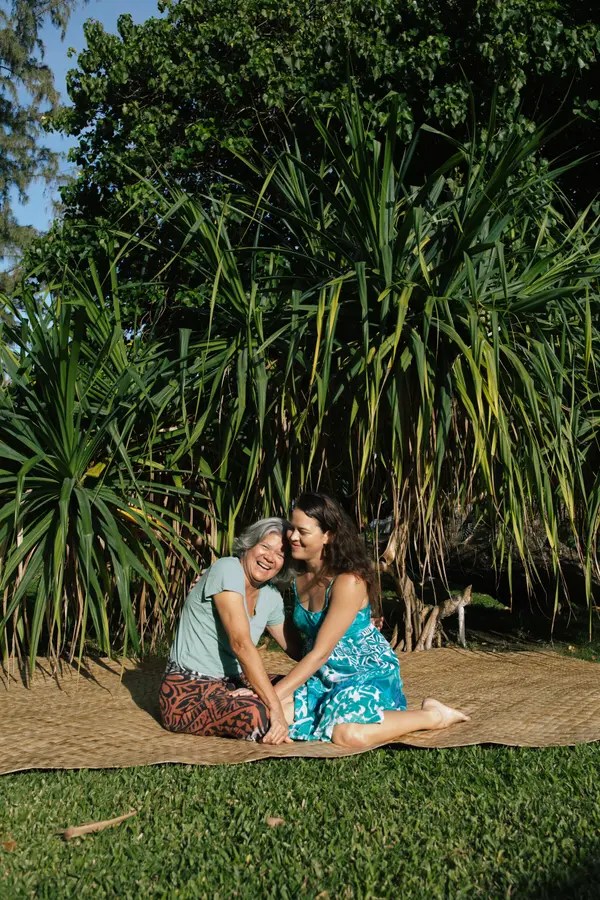
Emma Broderick, right, and her mother, Maile Meyer, under a pu hala tree on Oahu, a touchstone of Hawaiian culture. Its leaves are used to weave mats like the one they are sitting on. “To be a weaver is to be a healer,” said Broderick, whose group passes on ancestral knowledge about weaving and other practices. Daeja Fallas for The New York Times
Traditional weaving was a means to achieve our goal of strengthening biodiversity in our final work in Kerala. It is heartening to see handicraft coming back to life in Hawaii for other reasons:
In Hawaii, Weaving New Life Into a Nearly Vanished Art Form
The age-old practice of turning tree leaves into mats has been revived on the islands. “It teaches you how to weave relationships, past and present,” one master artisan says.
Just past daybreak, before they began to weave, Emma Broderick and her mother, Maile Meyer, gathered beneath a canopy of sinuous leaves to greet the pū hala tree, a touchstone of Hawaiian culture that for generations has provided the raw materials for weaving moena, the traditional floor mats that were once ubiquitous in Hawaiian homes.
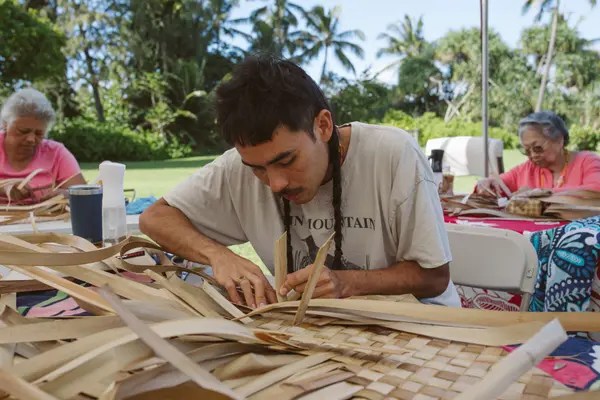
Kainoa Gruspe, one of the young weavers who joined the group. Preparing the lau is laborious and begins by ridding the leaves of ants and centipedes before cutting, smoothing and drying. Daeja Fallas for The New York Times
Broderick introduced herself to the tree, with its lattice of stilt-like roots, addressing it as she might a loved one. “Of course, flattery never hurts,” she said. She had a pink plumeria blossom with an intoxicating aroma tucked behind her ear.
“You want to come with me?” she asked the tree, seductively. “Would you like to live in a house and be in a mat?”
Broderick, 33, is the executive director of the Pu‘uhonua Society, a group dedicated to reviving age-old Hawaiian practices, like weaving and coconut growing, that were on the verge of vanishing. (The word “pu‘uhonua” means refuge.) Along with a growing number of weavers on other islands, it is collectively energizing a tradition brought by the first Oceania settlers who arrived in Hawaii on canoes powered by woven sails.
Broderick is third generation, inheriting the leadership role from her mother, who in turn inherited it from her mother, Emma Aluli Meyer, who founded the group in 1972.
The pū hala — scientific name, Pandanus tectorius — was growing in a landscape lush with lipstick-red heliconia flowers, orchids on lichen-covered branches and myna birds flitting overhead. Only thick brown leaves, or lau, on the verge of dropping, are harvested for mats, the longer the better. The leaves are also used to plait hats, bracelets, fans, place mats, ceremonial baskets and other items…
Read the whole article here.
 Organikos