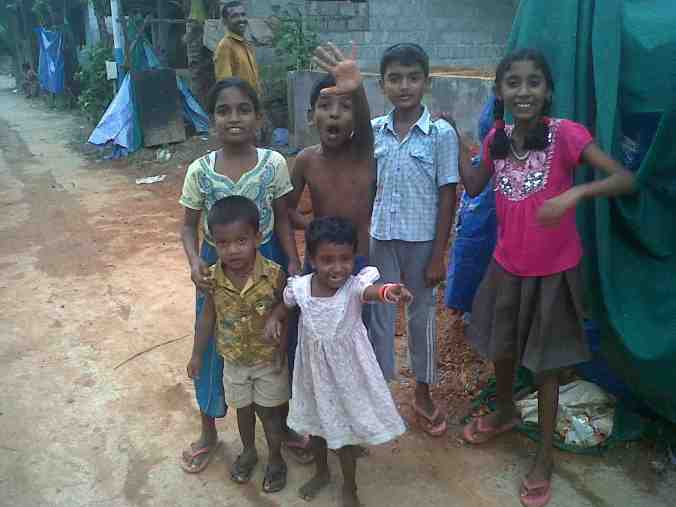
Our Gang, Thevara (Wait!)

Since our last such update on our smaller neighbors six months ago, the photo opportunities have not diminished.  Our strolls through Thevara, rather, have become impromptu portraiture composition parties.  The call rings out in one small but loud voice: “PHOTO!” and it would be impossible not to oblige with a snapshot because they are already assembling themselves.  Here, they are assembled and the photo is snapping but they see more smalls across the way. Continue reading

Dear Pretenders, Best In Category Is Here

Commencement speech season is long over, and I barely remember this last batch, though from time to time I have an opportunity to watch those of people I admire. Thanks to the internet for that, among all its wonders. This one above does credit to the genre, and to the school, not to mention the speaker himself. I believe he is as good as any commencement speaker I have ever heard. The video of his talk has not gone viral, nor is it likely to.  But Robert Krulwich, hitherto known to us mainly by his froggy nasal tones on Radio Lab and elsewhere, has arrived. At least, he is in our pantheon.

It is rare to find a half hour so well spent as this, whether or not you have university-aged kids, are a recent or soon to graduate university student yourself, or just plain curious how the man of wonders might mete advice given the opportunity.  And thanks not least to him for introducing us to this amazing-sounding college.  We will be interviewing for interns there soon, no doubt.

p.s. Jad, our feelings about you remain the same, but your buddy is now playing leap-frog.

Note To Maggie

August 14, 2012

Dear Maggie,

We got so busy that we neglected to notice your work and its wonderful home until just now.  I may have heard someone say boingboing before, but I did not know what it meant.  Now I have one data point to help me understand it.  It looks in spirit and even in content much akin to our own style and interests on this site.

If work brings you to India, or any of the other locations where you see contributors on this site, please let us know.

Regards from Kerala,

Crist

p.s. we like your other site too. Continue reading

Communitarian Is As Communitarian Does

Thanks to one of most thoughtful, witty writers at The Atlantic or any other similar publication, a glimpse of an unsung hero who has community and collaboration written all over his accomplishments (toward the end of the linked item, click further onward to a profile of this amazing fellow from a few years back):

The profile also reminded me what a thoroughly decent and public-spirited guy Tim Berners-Lee is. Sometimes people who do great things turn out to be jerks, but he definitely isn’t such a case. One other thing Tim Berners-Lee isn’t is fabulously wealthy–and finding out why he hadn’t taken the road to riches (and that he almost had) was for me one of the more interesting outcomes of this reporting project.

Go, Marcus!

In case you missed my earlier post on the topic, you may want to listen to that podcast before reading this more straightforward “business wunderkind” story in today’s Sunday New York Times.  Still, the closing paragraphs of the story circle around to why this fellow has our attention.  Great food interests us, yes; entrepreneurship, yes; but even more so this sense of community:

He often seeks interaction with the broader community, whether at his restaurants, through the Internet, or on his daily subway ride. In Harlem, he has held free cooking classes for children and has helped expand the farmer’s market in the area. More than 70 percent of Red Rooster employees are local residents, many of whom had little experience with fine dining. The restaurant hired additional managers to get the employees up to speed.
“When you look at strategy, it’s not set up to be a pure moneymaking machine,” says Derek Evans, the media adviser for the Marcus Samuelsson Group. “It’s a passion machine.”

113 Hemingway

Screen shot from my subscriber’s access to old New Yorker articles–the text is cut off at the bottom of the image but you can still savor the journalistic description in the sampling.

Lillian Ross, today among the last living chroniclers, along with A. E. Hotchner, of Hemingway in living technicolor, wrote this profile of him when he was a 50-year old superstar and she was a 24-year old who had been a New Yorker staff writer since she was 19.  How’s that?

Who cares how?  I care that.  And thank her for it on this, his 113th birthday.  She has always had a distinctively invisible presence in her writing, which makes Hemingway pop on her page.  Of course he never popped. He banged. Exploded.  Her profile makes a trip to your local public library worthwhile to find a 62-year old hard copy of the magazine.

Or, if the library near you is no longer, subscribe to the magazine and gain access to all content in past issues.  I care that she, and Hotchner, and others, have shared small sketches not designed to titillate as gossip, but yes to amuse.  As in amuse-bouche.  Small tastes for those who aspire to greatness and are not embarrassed from time to time to wonder how the great think, how they feel, what they do:
Happy Centenary Birthday, Woody

I am a week late, but I do not think he would mind.  There is plenty to read and listen to with Woody in mind, but my first realization that I had missed his birthday was while listening to a podcast a few days ago.  If you are interested in Woody’s life and the context of his music, it is worth a listen.  I also do not think Woody would mind sharing the celebration a bit, so after the jump have another go at this song.

Continue reading

Yes, Marcus

I am known among friends, colleagues and family for being a slave to hyperbole.  I like to think I am master, but it always gets the better of me. When I love something you will have no doubt about it; and the inverse is true. I will use the strongest words to convey my admiration or displeasure, or whatever.  Guilty as charged.  Here goes: in just under 40 minutes of listening to the author of this book speak in an interview, I am compelled to say that I have never heard a better interview in my life.  It is not merely the superb vocabulary he uses to describe how he became a chef; it is not merely the amazing story line; it is the man’s values, which drip from every word he utters.  Click the image to the left to go to the podcast of that interview:

“Being born in Ethiopia, where there was a lack of food, and then really cooking with my grandmother Helga in Sweden. And my grandmother Helga was a cook’s cook.”

Helga’s roasted chicken, pan-fried herring and black bread captivated Samuelsson, who spent many afternoons watching and helping his grandmother cook.

“We were jarring, pickling, there was always a bowl of chicken soup ready to be served, there was always sausage ready to be made,” he says. “She was incessant all year round with cooking. … It was really in those rituals that my love for food was built.”

Happy Birthday Henry David Thoreau

lead_960_540 (1)

Lisel Ashlock

After coming across the Emerson item, and linking it to my own experience as a lapsed researcher, now entrepreneur, I went back and looked at some of the posts Seth wrote while taking coursework last autumn. The courses were remarkable for their relevance to what we do at La Paz Group: Environmental History; Environmental Archaeology; Ecology and the Environment; and Environmental Governance.  The history course, in particular, had a syllabus that I appreciated for acquainting or re-acquainting me with some of the roots of thought underlying my chosen occupation (whatever that is).

Now a few days later I have discovered that on today’s date in 1817 Henry David Thoreau was born.  A little more digging, and I see he serialized some of his writings in a magazine that still publishes today. He apparantly wanted his ideas spread as far and wide as technology would enable.  Surprisingly modern for a man who embodies “back to nature” more than most.  Would he have blogged in today’s world?

No need to speculate on silly questions: his writing speaks for itself. On June 1, 1858 he published his first of three tracts in The Atlantic Monthly.  It is a lovely meditation on the true nature of pine trees, poetic insight, and moose meat, among other things nineteenth-century.  Four years later to the day the same magazine posthumously (he had just died weeks earlier) published his second tract, called Walking, which has about as fine a statement as I can find anywhere: Continue reading

Defining Moments

This slideshow requires JavaScript.

“At the end of the world,” the photographer Brigitte Grignet writes, “lies one of the most remote and undisturbed areas of Patagonia.” This sparsely populated region in southern Chile, called Aysén, is also one of the most endangered, threatened by plans to dam two of the region’s rivers in order to send hydro power north along thousands of miles of power lines.

Reading about and seeing the images of Aysen above brings back fresh memories of the two years prior to our move to India.  In October 2009 I was invited by the local community of Aysen to represent their commercial interest in wilderness conservation at a forum sponsored by Hydro Aysen.  I had been working in Patagonia since early 2008 and established relationships that led to their entrusting this task to me.  I did not let them down. Continue reading

Consequential Incidents

We have all had defining moments.  An event–small, medium or large–that seems to change the course of everything.  For me, it was the rather random choice of topic (more on which after the jump) for a research project with a friend in graduate school, leading to my doctoral dissertation and then onward to nearly two decades in entrepreneurial conservation.  Not my expected career path in my teens, my twenties or even my early thirties. When I saw this opening line in a “culture” piece on The New Yorker‘s website, I was hooked:

In 1833, Ralph Waldo Emerson, a New England pastor who’d recently given up the ministry, delivered his first public lecture in America. The talk was held in Boston, and its nebulous-sounding subject (“The Uses of Natural History,” a title that conceals its greatness well) helped lay the groundwork for the nineteenth-century philosophy of transcendentalism. It also changed Emerson’s life.

With no illusions or delusions about the significance of Emerson’s random epiphany, versus my own, I can still relate. Emerson’s ideas and their impact had consequence during his lifetime for the place that became my research focus a century later.  As it happens, Emerson visited that place just before his 60th birthday, and was deeply amused (it inspired his writing for another two decades) and amazed.  That place, which I was interested in for historical reasons related to collective action (thus the occasional posts on this site with that topic as centerpiece), had consequence for late twentieth-century notions of how to develop tourism under a new model.

Continue reading

Guardian Contributors

This slideshow requires JavaScript.

I have mentioned at least once why we like the publication, not least for our sharing some etymological roots with it, name-wise. Its journalism is among the best for helping us keep things in perspective. Sometimes we find entomological common ground as well. Milo, our in-house odonatographer, might have easily found a place for his work in the reader-contributed collection above, but we are just as happy to be the outlet of record for his work.

Post-Poned

Funny: I was just about to follow up on yesterday’s news about UNESCO’s declaration, with some further explanation for those less familiar with the various definitions/forms of patrimony and heritage considered worthy of protecting.  Then Tim’s post popped up when I refreshed this page.  Then my other tab opened, eerily on its own, to The New Yorker‘s website.  Although it is a site of frequent visitation for my browser, the eery thing was that it chose to open on its own, at that particular moment, and in the most visible spot on the page was this particular blog post:

Rounding out the weekend reading was a piece in Le Monde about the California ban on foie gras—another death notice of sorts. As Dana Goodyear has written, the Californians see the ban as a life-extending measure for ducks and, potentially, for humans who relish their fatty livers, whereas the French fear the demise of their patrimony before its time. “The French producers are furious,” Le Monde wrote, quoting a diplomatic source who reasoned, somewhat shakily, “It’s a subject that can seem anecdotal, but it’s necessary to take it seriously … Foie gras is an important part of our gastronomic heritage, recognized by Unesco.”

I no longer need to write the post I had intended, so I will just link to a post that partially explains my love of heritage, culinary patrimony in particular.  Truth be told, Tim’s compelling post notwithstanding, the above in extra-particular is among my culinary favorites.

Infusion Of Meaning

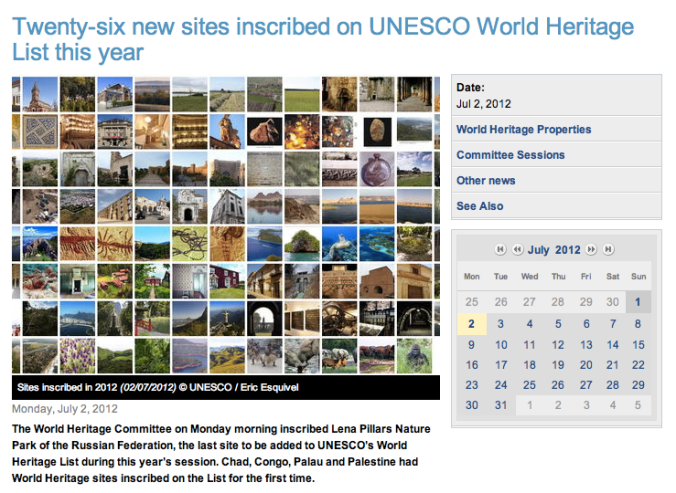
Today it was announced to the world that the Western Ghats have been designated as a World Heritage Site.  How does that happen?  How does a place, a practice, or a thing, get inscribed?  What infuses meaning in a place?  We spend a lot of time thinking about that, especially with regard to lodging properties that are devoted to the conservation of patrimony.  And especially in the Western Ghats, where Cardamom County is our learning laboratory for entrepreneurial conservation. Continue reading

Evolution’s Malcontents

Click the image to the right for an accessible discussion of one strain of debate within the field of evolutionary biology:

The best way to distinguish between Professor Dawkins’ waking and sleeping states is probably on the basis of how contentious he is at a given time. Nevertheless, I’m compelled to say something for two reasons. First, this particular fight happens to be taking place right in my proverbial (and professional) wheelhouse; second, I’ve just finished my annual re-reading of Michael Crichton’s Jurassic Park duology.

Whether You Met Him Or Not, Say Goodbye to George

Lonesome George: alone until the end. Photograph: Thomas H Fritts/EPA

Some of our contributors, like Reyna and Roberto, are permanent residents of the Galapagos Islands; some like Seth, are currently stationed there; others among us have been there and had a brief encounter with George.  The news of his demise is not merely sad, for all of them, all of us; it sends a bit of a chill, for reasons evident when you read the history of his species.  Yet, George made an enormous contribution to awareness of the need for conservation and habitat renewal.  He was a celebrity, of sorts, working (whether he liked the gig or not, we shall never know) on behalf of endangered species around the world.  Thank you, George.  Click the image above for the notice in The Guardian:

The last known representative of the giant Galápagos tortoise subspecies Chelonoidis nigra abingdoni had every reason to shun humanity, however. His relatives were exterminated for food or oil by whalers and seal hunters in the 19th century, and his habitat on Pinta was devastated by escaped goats. George possibly has relations on neighbouring Isabela Island, but it is more likely his whole subspecies is now extinct – the end of what is probably a 10m-year-old line.

Story’s It

I can trace it back to the beginning for you, trace my Moth addiction to its start. For the uninitiated, the Moth is an organization devoted to the craft of storytelling. It’s real people telling true stories, “live and without notes.”

So can I.  Click the image above to read Nathan Englander’s engaging account of telling stories in front of a live audience.  Reading it I am reminded of my recently untended year-old efforts to further articulate Why La Paz Group?

Continue reading

Gold’s Glitter Guarded

From The New Yorker‘s website, a slide show on the recent article about last year’s discovery of gold buried in a temple in south Kerala, and a remarkable set of observations from the photographer assigned to that story:

In India, deities can own property, and this temple, dedicated to Vishnu, has been accumulating gold for centuries. “I was asked to photograph it from the outside; it is strictly forbidden to take photos inside,” Goia said. “Jake and I found ourselves jumping from office to office calling whatever number possible to try to get permission to access the security area.”

This slideshow requires JavaScript.

Report To Greco

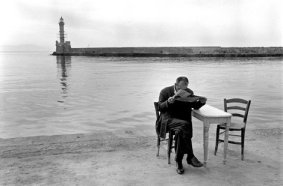
Man reading, Chania, Crete, 1962 (Costa Manos/Magnum Photos)

Click the photo to go to the recent post titled “Do We Need Stories?” in the blog site of the New York Review of Books.  It starts out:

Let’s tackle one of the literary set’s favorite orthodoxies head on: that the world “needs stories.” There is an enormous need,” Jonathan Franzen declares in an interview with Corriere della Sera (there’s no escape these days), “for long, elaborate, complex stories, such as can only be written by an author concentrating alone, free from the deafening chatter of Twitter.”

Continue reading