Fighting Big Oil and Big Banks to Save Sacred Lands, Precious Water and Unraveling Climate
Bill McKibben
Most Americans live far from the path of the Dakota Access Pipeline—they won’t be able to visit the encampments on the Standing Rock Sioux reservation where representatives of more than 200 tribes have come together in the most dramatic show of force of this environmental moment. They won’t be able to participate in the daily nonviolent battle along the Missouri River against a $3.7 billion infrastructure project that threatens precious water and myriad sacred sites, not to mention the planet’s unraveling climate. Continue reading
Author: Organikos
Veggies Punching Above Their Weight

PHOTOGRAPH BY ERIC HELGAS FOR THE NEW YORKER
When scanning the hard news, feature stories, reviews and profiles we are on the lookout for stories that address any of a group of themes, generally related to better treatment of the planet we live on. We are interested in creative approaches to making better human treatment of the natural world more likely, more palatable, so to speak. After reading this article about magnificent results from modest parcels of land cared for by relatively common folk, we see a parallel theme in this restaurant review; it qualifies:
DINING FOR THE MODERN HERBIVORE
“Vegan” evokes two images: judgment for abstemious virtue or scarcity on meat-centric menus. Neither happens at Ladybird.
By Jiayang Fan
…Of some two dozen tapas, the most successful were the least expected and the most unassuming. The olives and cornichons—perfectly pert, coated in seasoned rice flour and gently fried in chili oil—proved to be the kind of addictive nibblers that make you forget the etiquette of communal dining. Continue reading
If You Happen To Be In New York City
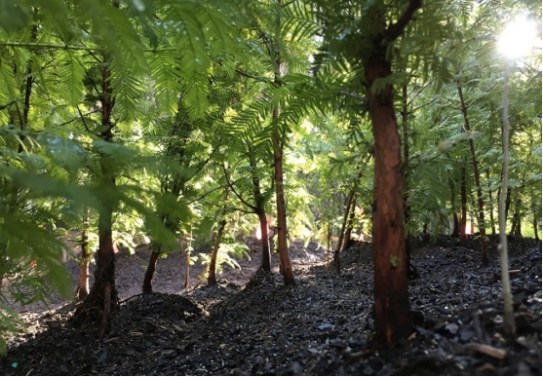
SPENCER FINCH LOST MAN CREEK
October 1, 2016 – March 11, 2018
SPENCER FINCH TO CREATE A MINIATURE REDWOOD FOREST IN THE HEART OF DOWNTOWN BROOKLYN
See the website of the exhibit at Public Art Fund for this description and more:
Lost Man Creek is a miniature forest. But rather than growing naturally and of its own accord, this undulating landscape populated by some 4,000 Dawn Redwoods is a recreation. Artist Spencer Finch partnered with the Save the Redwoods League to identify a 790-acre section of the protected Redwood National Park in California. Significantly scaling down the topography and tree canopy heights, he reimagined this corner of the California forest for MetroTech at a 1:100 scale. While the original trees range from 98 to 380 feet – taller than the buildings that surround the plaza – the trees in the installation are just one to four feet in height. Continue reading
Magnificent Ecological Services From Modest Parcels Of Trees

Eve Lonnquist examining trees on her property with Logan Sander, a consulting forester. Credit Leah Nash for The New York Times
An excellent article, whose title says it all, in the Science section of the New York Times this week:
How Small Forests Can Help Save the Planet
By
BIRKENFELD, Ore. — Eve Lonnquist’s family has owned a forest in the mountains of northwest Oregon since her grandmother bought the land in 1919. Her 95-year-old father still lives on the 157-acre property. And she and her wife often drive up from their home just outside Portland.
But lately, Ms. Lonnquist, 59 and recently retired, has been thinking about the future of her family’s land. Like many small-forest owners, they draw some income from logging and would like to keep doing so. But they would also like to see the forest, with its stands of Douglas fir, alder and cherry, protected from clear-cutting or being sold off to developers. Continue reading
Bird of the Day: Yellow-crowned Night Heron
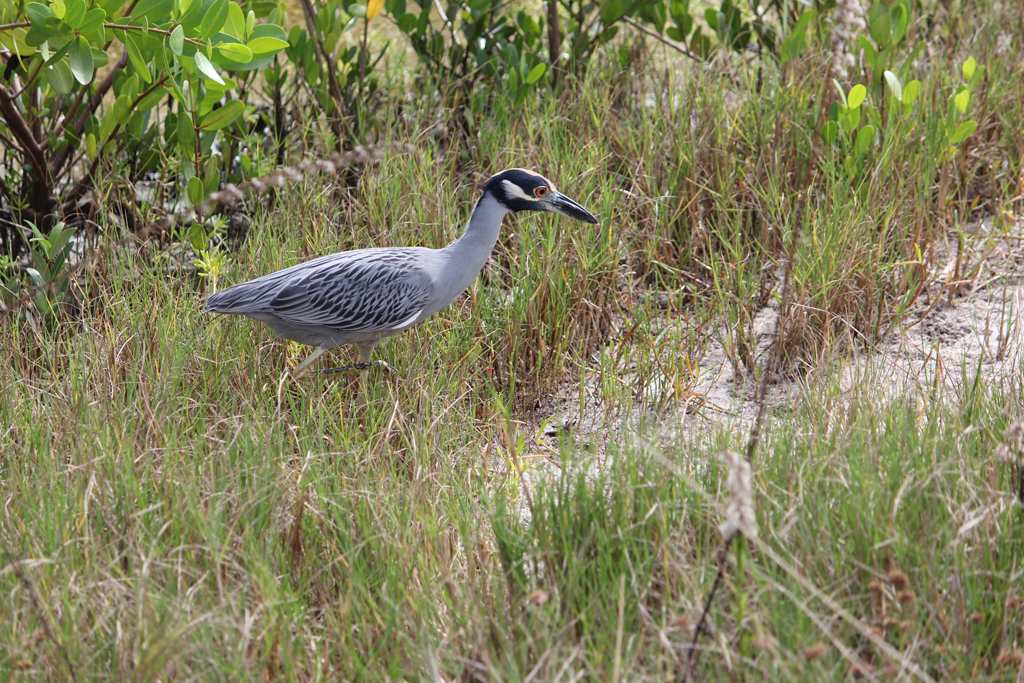
photo credit: Stephen Crafts
Ding Darling National Wildlife Refuge, Sanibel Island, Florida
Fly-Fishing In The Rockies
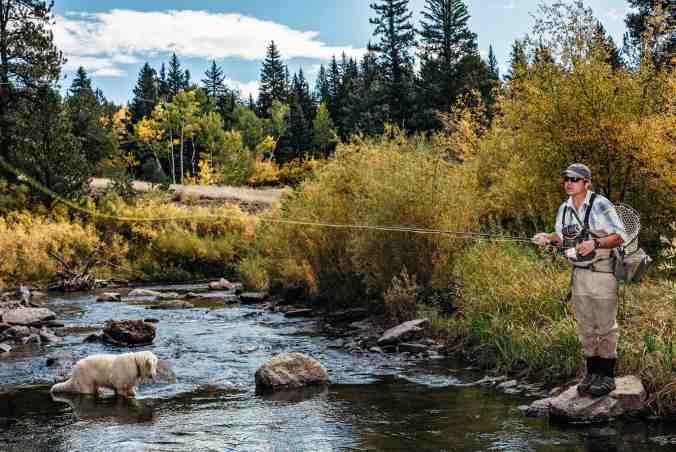
Scott Tarrant is the fly-fishing manager at the Broadmoor resort and hotel in Colorado Springs. Credit Ryan David Brown for The New York Times
We always think we have the best occupations, but occasionally we see what someone else is doing and start having second thoughts. But, as we know, there is a reason why it is called work:
The Curative Power of Water, Waders and a Fly Rod
Vocations As told to
Scott Tarrant, 46, is manager of fly-fishing at the Broadmoor, a resort and hotel in Colorado Springs. Continue reading
Down An Amazing Rabbithole
Yesterday’s post got us looking through the MacArthur Foundation’s website, and lots of worthy material there to investigate, including this news we missed a couple months back. In some ways the findings are intuitive, and maybe seem not surprising; but the scientific evidence of the challenges facing biodiversity on the planet are certainly useful for policy planning, not to mention strengthening our resolved commitment to entrepreneurial conservation:
Most Biodiverse Countries Spending the Least on Conservation, Study Finds
Countries that contain most of the world’s species biodiversity are also spending the least on a per-person basis to protect these natural assets, according to a MacArthur-supported study by theWildlife Conservation Society and the University of Queensland. Countries near or in the tropics, where most of the world’s diversity is located, spent the least on biodiversity conservation. The report recommends engaging leadership of these countries and promoting conservation through existing social traits within cultures that do not currently prioritize conservation. Continue reading
Beadwork Worthy Of A Genius

Political beadwork.
We enjoy this time of year when the John D. and Catherine T. MacArthur Foundation “Genius” grants are awarded, since they invariably make for great reading, and usually great viewing or listening as well. Here is another one, thanks to Quartz for this summary and short profile to accompany the images of this recipient’s work:
Photos: The jewelry and sculptures about racism and sexism that earned Joyce J. Scott a MacArthur “genius” award
Lila MacLellan
A beaded necklace is an unlikely place to find a narrative about race, history, and slavery, says Lowery Sims, curator emerita at the Museum of Arts and Design (MAD) in New York. But that surprise factor is part of the allure of Joyce J. Scott’s art. “Technically it’s breathtaking, it’s intimate, it’s intricate—but it’s also a very powerful statement about the world and some of the issues we face as human beings,” Sims says. Continue reading
Birding By The River
Friends and followers of this site already know of our fondness for birds, and we were happy to come across Will Rose‘s charming educational animation illustrating bird identification. Continue reading
Beauty Is A Beast

Culling could undermine the viability of the entire Norwegian wolf population, say conservationists. Photograph: Roger Strandli Berghagen
We love sheep, and sheep farmers, and shepherds, and wool, and so on. But we cannot read this without feeling more sympathy for the wolves, at this moment:
Norway’s wolf cull pits sheep farmers against conservationists
Norway’s recent decision to destroy 70% of its tiny endangered population of wolves shocked conservationists worldwide and saw 35,000 sign a local petition. But in a region dominated by sheep farming support for the cull runs deep
Elisabeth Ulven and Tone Sutterud in Oslo
Conservation groups worldwide were astonished to hear of the recent, unprecedented decision to destroy 70% of the Norway’s tiny and endangered population of 68 wolves, the biggest cull for almost a century. Continue reading
Bring Back The Green!
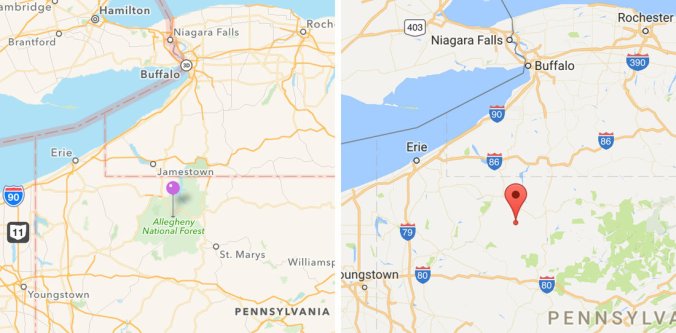
The Allegheny National Forest is absent from Google Maps (right) but displayed on Apple Maps (left). Apple & Google/Screenshots by NPR
We lose more than enough green in the real world, so when the cartographical world starts compounding the problem, we must shout in protest:
Where Did National Forests Go? Green Spaces Disappear From Google Maps
Erin Ross
If you looked at Google Maps this week, you might have noticed something strange: less green. Continue reading
Bees, Status, Survival Of The Fitted
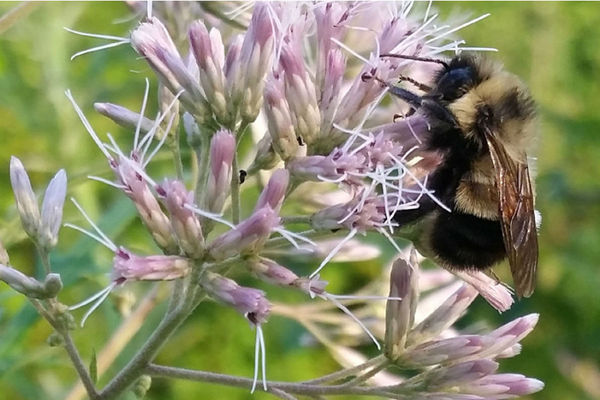
A rusty patched bumble bee, under consideration for listing as an endangered species by the US Fish and Wildlife Service, pollinates a flower in Madison, Wis. Rich Hatfield/Reuters/File
The CS Monitor has an article today that raises an interesting question, whether the same rules that have worked well for eagles, owls, fish, wolves and bears (among other animal species) would be effective for the humble bumble bee and other similar creatures. We see a very good fit between the problem, which we have noted here frequently, and the solution, whose track record is not perfect but it is clearly the best mechanism we’ve got:
Could putting a bumble bee on the endangered list save it?
The rusty patched bumble bee, which has seen a 91 percent decline since the late 1990s, would be the first in the continental US to receive protection under the Endangered Species Act.
The past several years have not been kind to the humble bee.
But perhaps none suffer more than the rusty patched bumble bee, orBombus affinis, a fuzzy insect with a rust-colored patch on its abdomen. The bee used to be a common sight across the Midwestern United States, but now, the bee struggles to survive in a habitat broken apart by increased farming and commercial development.
The US Fish and Wildlife Service (FWS) is proposing to list the bee as endangered, which would grant it significant protections and hopefully save the bee from extinction. Continue reading
Bird of the Day: White Ibis

photo credit: Stephen Crafts
Ding Darling National Wildlife Refuge, Sanibel Island, Florida
Food Memories & History, Coastal Mesoamerican Edition

Hudutu Credit Davide Luciano for The New York Times. Food stylist: Maggie Ruggiero. Prop stylist: Gozde Eker.
Belize is a close neighbor to the culture described here, so this story, and especially the colors on the tables in the photos, have an air of familiarity:
A History Lesson, Served as Coconut-Seafood Soup
By
When Sulma Arzu-Brown’s father traveled from his village in Honduras into the city, people pointed at him, at his black skin. When he spoke his language, people laughed. “They said, ‘Look at that monkey, goo goo gaga,’ ” Arzu-Brown told me. Continue reading
Forest Protection By Any Other Name, For Any Other Purpose, Through Any Other Means, Is Just As Sweet
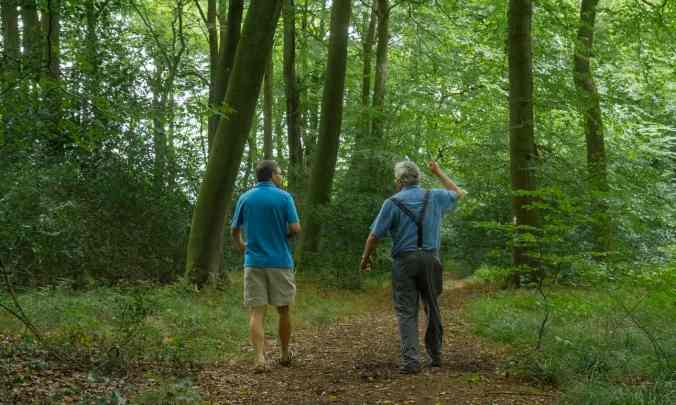
Richard Fortey and Derek Niemann among the beeches in Grim’s Dyke Wood. Photograph: Sarah Niemann
We do not favor private sector conservation efforts over all other options; we favor them over the option of no conservation at all. Governments around the world have rightly done the heaviest lifting on preserving nature, considering their resources, eminent domain, and other factors including the most salient; public lands effectively belong to an entire nation’s citizens. Philanthropies have also done enormous good. We have written plenty on both public and philanthropic conservation schemes. Today, a more modest story, but no less lovely:
A walk in the woods with Richard Fortey
Henley, Oxfordshire The palaeontologist and author offers a tour of Grim’s Dyke Wood, which he bought in 2011
Derek Niemann
Five years after the palaeontologist Richard Fortey bought Grim’s Dyke Wood, a small Chiltern beech wood, he shows no diminution in enthusiasm for his “nature reserve”. He gives me a tour, though in truth we delight in each other’s discoveries. I find him a ring of bright feathers on a pile of rotting pine logs, a raptor’s kill, the buffs and browns speaking of a song thrush forever silenced. He finds bracket fungi that have insinuated themselves into the thin, horizontal lesions on a cherry tree’s trunk. Continue reading
Save Your Screen Time, Kochi!

The Kochi-Muziris Biennale 2016 “main stage” doesn’t start until December, but Kochi is already throbbing with activity – from the Piramal Art Residency at Pepper House to introductions to this year’s participating artists on the KMB Facebook page.
Interested in film and video? The Signs Festival 2016 begins in less than a week at the Kochi Town Hall on September 28th.
SiGNS, the pioneering festival in India for digital videos featuring national level competition for documentaries and short fiction for the prestigious John Abraham National Awards. John Abraham Awards was instituted in 1999 by the Kerala Region of Federation of Film Societies of India Continue reading
Being Human, Sharing Relevant Information, Building Community

In the first few years of our building this wordpress platform to communicate about things that concern us and especially about things that inspire us, we occasionally found something that Andrew Sullivan had posted that was relevant here (only rarely since his site was mainly dedicated to politics and other topics that do not belong on our platform).
So we know a bit about him and always admired his relentless pursuit of what he believed in. We also know he is an excellent writer, so almost always worth a read. The same relentlessness we admire is also one we vigilantly guard against in these pages, where we have tried to limit our daily contribution to just a few essentials. We want only to have some shared space with a community of readers who care about some of the issues that interest us the most. This article Mr. Sullivan just published is definitely worth a read:
Lionfish Tales
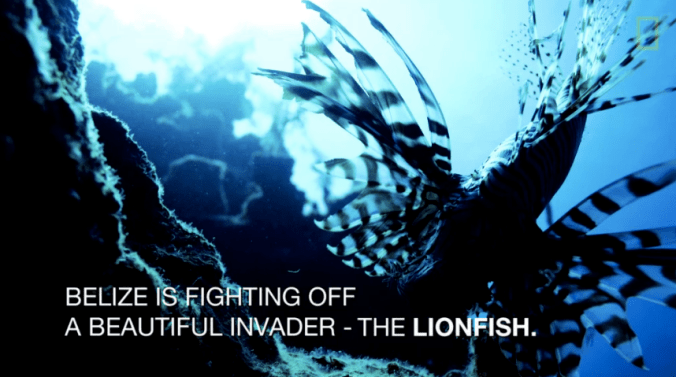
This is issue has been on our radar for some time, in most part due to contributor Phil Karp‘s posts on his work with groups in Belize and other parts of the Caribbean focused on this goal. The concept of “If You Can’t Beat ’em, Wear ’em” carries a powerful message of innovative practices to manage the invasive species that’s causing havoc in the southern Atlantic and Caribbean waters. Continue reading
No Kitten Videos Here, But Plenty Of Cats
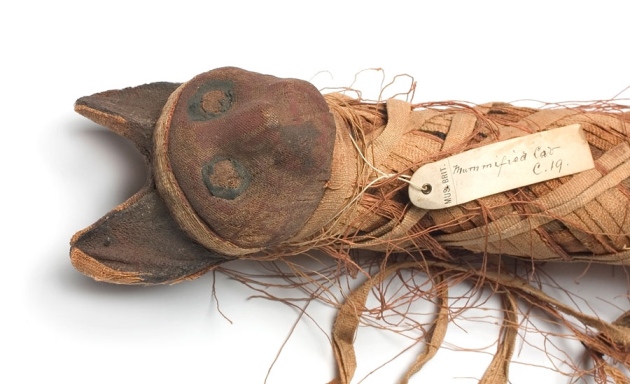
We are human, therefore we love cute kitten videos just like the next person. We just do not need to share them here. That is not our purpose. Ditto for puppy dog videos, though we have a soft spot for scientific explanation for how dog became man’s best friend. Especially when creatively oriented to non-scientists. Back to cats. We have been featuring them as often as possible here, when considered relevant. And then some links for good measure. Our thanks now to Nature, which brings scientific studies within reach of a motivated lay audience, for this story on one path by which cats came to their current prominent state of domestication in our lives:
How cats conquered the world (and a few Viking ships)
First large-scale study of ancient feline DNA charts domestication in Near East and Egypt and the global spread of house cats. Continue reading
If You Happen To Be In The Boston Area

Saint Barbara, attributed to the “Ghent Associates” of the Master of Mary of Burgundy, from a book of hours-missal, c. 1485-1490. Courtesy of Houghton Library/Harvard University
We check in from time to time at magazines published by universities where we have recruited. This article, which we appreciate topically because of the conservation of cultural heritage described, makes us wish we could visit the venues described in “Illuminations.” Lily Scherlis provides a good example of why we keep coming back to this magazine–crisp, clear writing and a compelling argument in favor of looking back into history for an enriching perspective on crowdsourcing versus individual authorship (read to the end of the quoted section):
…These works were born into a world where literacy was scarce and almost universally affiliated with religion: the exhibition description refers to monasticism as, at its heart, a “cult of the book.” I imagine how compelling written religious text would have been to early readers: the words echo off the page, as if read by an invisible voice heard only by you, but are available to other readers as well. Continue reading
 Organikos