Bee Friendlier

Screen Shot 2014-10-13 at 12.46.44 PM

Our otherwise impenetrable fortress, resisting commercial interests everywhere, sometimes lets one over the wall.  For worthy causes only. Good stuff here, we think, especially learning about The Xerces Society through this company’s initiative:

Our Commitment

At Cascadian Farm, we’ve been farming organically since 1972, and we know how essential bees are to the environment and food supply. In fact, almost all of the food that we make depends on bees. That’s why we’re spearheading Bee Friendlier, an education and support program to help bees thrive. It’s also why we’re donating $0.50, up to $150,000, for every code redeemed online before December 31, 2014, to help support bee research and habitat creation… Continue reading
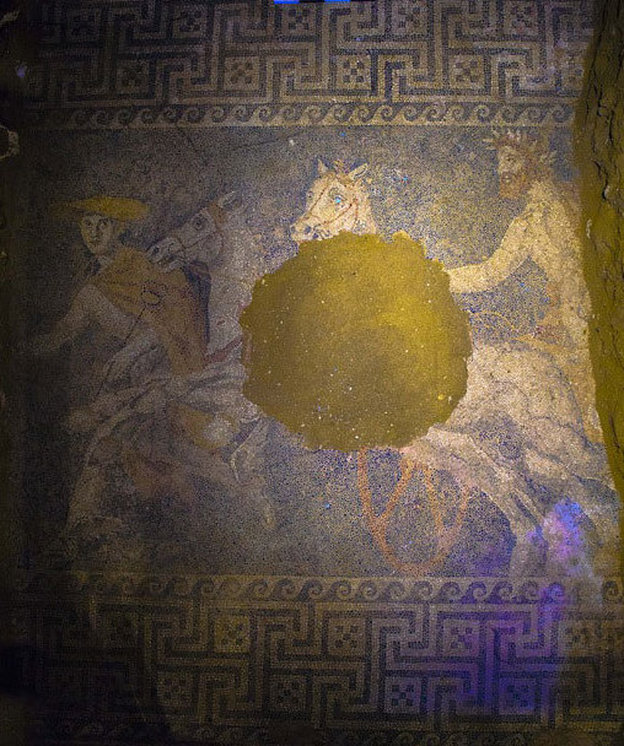
Hermes Appears, Again

Striking Mosaic Found In Greek Tomb Dates From 4th Century B.C. by BILL CHAPPELL

Striking Mosaic Found In Greek Tomb Dates From 4th Century B.C. by BILL CHAPPELL

We are now in our second month without the classicist among our ranks, but we amateurs can still do our part to share stories of interest from the world of classics. Hermes was there all along of course, for about 2,400 years since the image above was created, but amazingly we are still finding new hiding places for a character mentioned in these pages more than once:

Archaeologists have uncovered an intricate and beautiful floor mosaic in a large tomb in northern Greece. Dating from the last quarter of the 4th century B.C., the mosaic covers a space of nearly 15 feet by 10 feet. It features two horses, a man and the god Hermes; it was found in a tomb that was discovered in August. Continue reading

If You Happen To Be In New York City

website-header1

It is the sort of conference we are happy to see hosted by an MBA program:

MILLENNIALS RISING: WHAT’S NEXT FOR SUSTAINABILITY?

Friday, October 31, 2014

We are living in promising but turbulent times. Never before has there been such interest in harnessing innovation to find sustainable solutions for communities and the environment, but never have the problems been more urgent, complex or challenging.

While more business leaders are pursuing sustainable strategies, what can be done to accelerate this change and harness the talents of millennials as future sustainable leaders to ensure they realize this potential? What can be done to sustain interest in solving social and environmental issues, sustain funding for these efforts, and sustain the pipeline of social entrepreneurs leading these changes?

Join us at the 2014 Social Enterprise Conference by Columbia Business School and help spark the conversation on driving sustainable change beyond the new millennium:

Continue reading

Mind Over Matter, Consumption, And Findings From Behavioral Economics

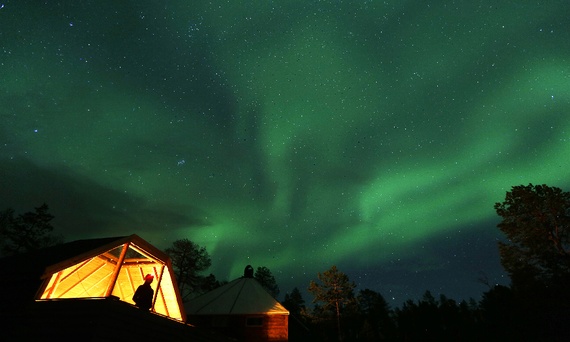
Northern lights over a camp north of the Arctic Circle, October 2014 (Yannis Behrakis/Reuters)

Northern lights over a camp north of the Arctic Circle, October 2014 (Yannis Behrakis/Reuters)

We may be a bit self-interested in declaring so, but this research matches what we believe from daily experience–not to say it is obvious–and so it is good to know science is helping us understand why:

Buy Experiences, Not Things

Live in anticipation, gathering stories and memories. New research builds on the vogue mantra of behavioral economics.

Forty-seven percent of the time, the average mind is wandering. It wanders about a third of the time while a person is reading, talking with other people, or taking care of children. It wanders 10 percent of the time, even, during sex. And that wandering, according to psychologist Matthew Killingsworth, is not good for well-being. A mind belongs in one place. During his training at Harvard, Killingsworth compiled those numbers and built a scientific case for every cliché about living in the moment. In a 2010 Science paper co-authored with psychology professor Daniel Gilbert, the two wrote that “a wandering mind is an unhappy mind.”

Continue reading

Watch Your Pump Jockey

shutterstock.com

shutterstock.com

Conservation‘s daily summary of an intriguing scientific finding captures our attention at least one time per week. Which is about how often, on average, some of us fill the gas tank of our vehicles. And we learn that the fuel lost during those visits can add up to massive waste. Which means, this should interest you:

First, you pull into the gas station. You open the cover to the fuel tank, unscrew the cap, insert the nozzle, and pump away. Once you’ve filled up your tank, you dislodge the nozzle and return it to its starting position. But in between – perhaps without even noticing – you spilled a few drops of gasoline onto the concrete. You were as careful as possible, and it was just a tiny bit wasted…right? A few drops here and there aren’t a big deal, are they?

Well, it might be. That’s according to new research published this week in the Journal of Contaminant Hydrology. Continue reading

A Norwegian Sense Of Obligation

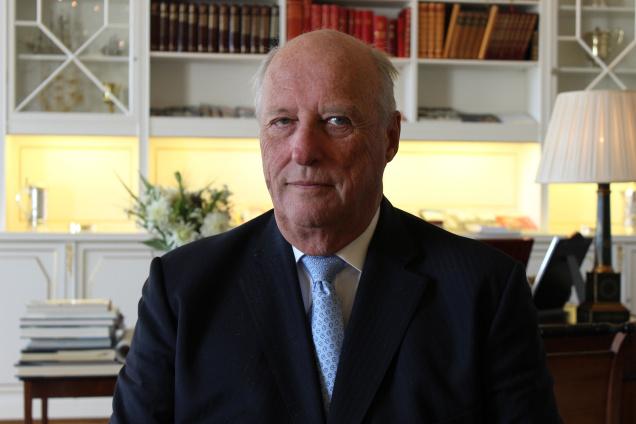
Norwegian King Harald V.  Photo: P. J. George

Norwegian King Harald V. Photo: P. J. George

From today’s Hindu, an interview with the King of Norway. It may be an example of noblesse oblige, but it is an interesting story at a time when some other developed economies have determinedly charged hard right, away from state-sponsored welfare:

‘We had a problem — too much money’

Interview with Norwegian King, Harald V, on the country’s successful welfare model, its oil and gas reserves and the threat of climate change

The Norwegian society is at present debating several issues, including its economy, climate change, immigration and the changing cultural milieu. In all these, the country often looks to its King, Harald V, for a decisive voice… A renowned sailor, he carries out royal duties with aplomb even at the age of 77. He spoke to The Hindu recently in Oslo on the triumphs and concerns of his country. Excerpts: Continue reading

If You Use Amazon, Read This

Screen Shot 2014-10-11 at 10.58.33 AM

As the article below suggests, whether we shop with them or not we are all complicit. It is the best article yet on the growing concern over not only Amazon’s market power but its cultural influence. And in true liberal spirit of the great publication that offers it, both sides of the argument are presented starting at the first sentence:

Before we speak ill of Amazon, let us kneel down before it. Twenty years ago, the company began with the stated goal of creating a bookstore as comprehensive as the great Library of Alexandria, and then quickly managed to make even that grandiloquent ambition look puny. Amazon could soon conjure the full text of almost any volume onto a phone in less time than a yawn. Its warehouses are filled with an unabridged catalogue of items that comes damn close to serving every human need, both basic and esoterica mere click away, speedily delivered, and as cheap as capitalism permits. Continue reading

Entrepreneurial Conservation, Macro Version

ILLUSTRATION BY CHRISTOPH NIEMANN

ILLUSTRATION BY CHRISTOPH NIEMANN

In the current issue of the New Yorker, the excellent “explainer in brief” of economic phenomena provides a macro equivalent example of what we have referred to as entrepreneurial conservation. Instead of just a sampling of the text we provide the full story here, per an occasional exception we make for important environment-related stories, but please click through to the source to give proper attribution:

During the recent U.N. Climate Summit, it was hard not to think of the quip, attributed to Charles Dudley Warner, “Everyone complains about the weather, but no one does anything about it.” A parade of global leaders (including Barack Obama) made all the right noises, but there was little action. So it was notable when Norway announced a deal with Liberia: Norway will give Liberia up to a hundred and fifty million dollars in aid, in exchange for which Liberia will work to stop the rapid destruction of its trees.

Continue reading

Flowering Plants Of The Western Ghats

05tv_western_ghat__2140103e

For flower lovers, ecologists, and concerned citizens everywhere, important news in today’s Hindu:

As a global biodiversity hotspot and a world heritage site, the Western Ghats is a magnet for conservationists, nature lovers, scientists and researchers hoping to delve into the secrets of its abundant flora and fauna. But despite decades of study by individuals and groups, an essential reference work cataloguing the rich biodiversity of the region has remained a dream.

In a bid to address this need, scientists at the Jawaharlal Nehru Tropical Botanic Garden and Research Institute (JNTBGRI) at Palode near here have come out with a comprehensive work on the flowering plants of the Western Ghats.

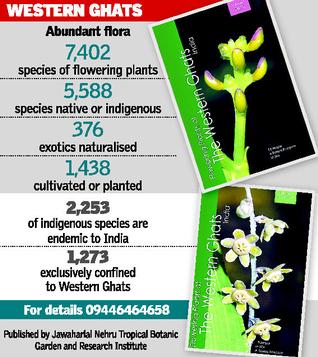
Published in two volumes, the 1,700-page book reveals the occurrence of a total of 7,402 species of flowering plants in the region, out of which 5,588 species are native or indigenous. Of the rest, 376 are exotics naturalised and 1,438 species are cultivated or planted as ornamentals. Continue reading

Those Who Make Chinese Restaurants In The USA What They Are

141013_r25586-690

Chinatown employment agencies can get immigrants kitchen jobs in a few hours. CREDIT PHOTOGRAPH BY ANNIE LING

When our interest in long form journalism intersects with our wide and deep interest in foodways, we could not be happier than to pass it along. Have a taste of this deeply reported story on cooks in the Chinese restaurant trade in the USA, as offered in this week’s New Yorker:

In a strip mall on a rural stretch of Maryland’s Indian Head Highway, a gaudy red façade shaped like a pagoda distinguishes a Chinese restaurant from a line of bland storefronts: a nail salon, a liquor store, and a laundromat. On a mild Friday morning this July, two customers walked into the dimly lit dining room. It was half an hour before the lunch service began, and, aside from a few fish swimming listlessly in a tank, the room was deserted.

In the back, steam was just starting to rise from pots of soup; two cooks were chopping ginger at a frenzied pace. Most of the lunch crowd comes in for the buffet, and it was nowhere near ready. “Customers are here already!” the restaurant’s owner, a wiry Chinese man in his fifties, barked. He dropped a heavy container onto the metal counter with a crash. “How can you possibly be moving this slowly?” Continue reading

Walter Isaacson On Geniuses Of The Digital Revolution

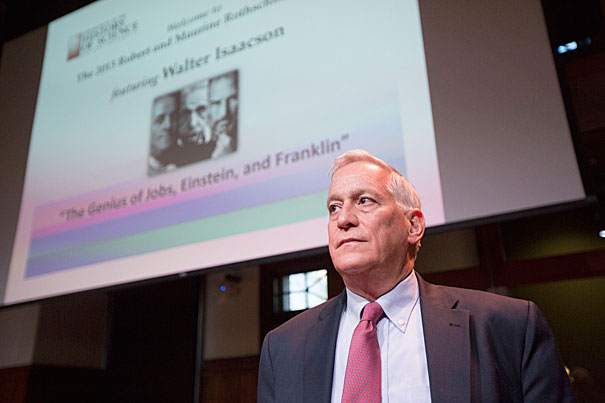
File photo by Kris Snibbe/Harvard Staff Photographer.  "We’re now in a phase in which the connection of creativity to technology is going to drive innovation," said Walter Isaacson ’74, a Harvard Overseer, biographer, and CEO of the Aspen Institute. "I do believe that it’s important for people to have an appreciation for the arts and humanities."

File photo by Kris Snibbe/Harvard Staff Photographer. “We’re now in a phase in which the connection of creativity to technology is going to drive innovation,” said Walter Isaacson ’74, a Harvard Overseer, biographer, and CEO of the Aspen Institute. “I do believe that it’s important for people to have an appreciation for the arts and humanities.”

Thanks to Christina Pazzanese and Harvard Gazette for this conversation with one of the more interesting biographers writing today:

Ghosts in the machines

The history of the Digital Revolution touches our hearts and heads, Isaacson says

In many ways, the entire Digital Era can rightly be laid at the courtly foot of Lord Byron’s rebellious daughter, Ada. Lady Lovelace was the poet’s only child born in wedlock, inheriting both her father’s headstrong, Romantic spirit and her mother’s practical respect for mathematics.

As the Industrial Revolution bloomed, her appreciation for the beauty of numbers and invention, an analytical approach she called “poetical science,” led her to write what is now regarded as the first algorithm and to help refine a machine that could be programmed to perform many different tasks, an idea that anticipated the modern computer by a century.

That’s where Walter Isaacson’s latest book, “The Innovators: How a Group of Hackers, Geniuses, and Geeks Created the Digital Revolution,” steps off.

Continue reading

Pre-Colonization Food

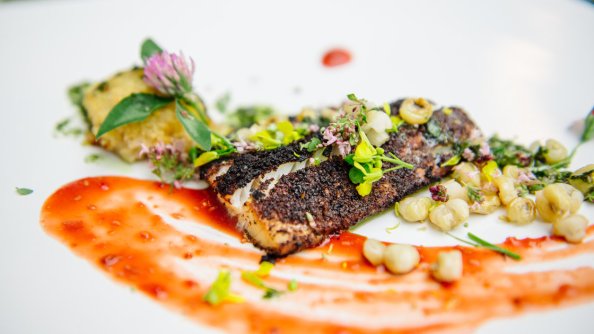
Sean Sherman’s Walleye filet with sumac and maple sugar, a white bean and smoked walleye croquette and toasted hominy; Becca Dilley/Courtesy of Heavytable.com

As we fine tune the concept of Malabar Soul Food at 51 we’re always on the lookout for other stories of cultural culinary crossovers. This is especially relevant with chefs who are pushing culinary limits by reaching back to early foodways like Sean Sherman, a member of the Oglala Lakota tribe. Mr. Sherman’s life is in the kitchen, but a great deal of his energies go into discovering the pre-colonization foods of his Great Plains ancestors. Thanks once again to NPR and the Salt for sharing this story.

Sherman, who calls himself the Sioux Chef, grew up on the Pine Ridge Indian Reservation in South Dakota. It’s where he first started to learn about the traditional foods of the Plains, whether it was hunting animals like pronghorn antelope and grouse, or picking chokecherries for wojapi, a berry soup.

“We were close to the Badlands and its sand hills, which is not the best growing area by far,” says Sherman, who’s now 40. “But we would also spend weeks in the Black Hills, crawling around and learning stuff.”

Sherman’s grandfather was among the first Native American children to go to mission schools on the reservation, and he was one of Sherman’s first teachers. Continue reading

Pots Calling Kettles Black

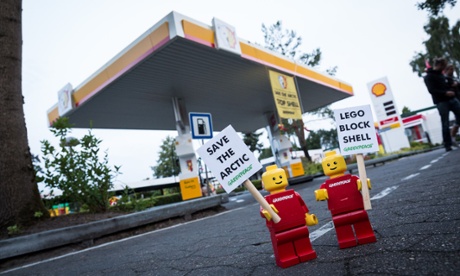
Mini activist figures at a Shell gas station in Legoland in Billund, Denmark, part of a global campaign targeting Lego and highlighting Shell’s plans for Arctic oil exploration. Photograph: Uffe Weng/Greenpeace

Mini activist figures at a Shell gas station in Legoland in Billund, Denmark, part of a global campaign targeting Lego and highlighting Shell’s plans for Arctic oil exploration. Photograph: Uffe Weng/Greenpeace

Lego is easy to love. Anyone who had these toys as a child, or who has children who have these toys, can testify to the joy they bring.

Shell is easy not to love, for reasons that do not really need to be explained here.

And yet, Lego is a product made up primarily of petroleum, so what we learn in this story in today’s Guardian seems odd as much as it seems good:

Lego will not renew its marketing contract with Shell after coming under sustained pressure from Greenpeace to end a partnership that dates to the 1960s.

The environmental campaign group, protesting about the oil giant’s plans to drill in the Arctic, had targeted the world’s biggest toy maker with a YouTube video that attracted nearly 6m views for its depiction of a pristine Arctic, built from 120kg of Lego, being covered in oil. Continue reading

Reasons Not To Eat Certain Things

PHOTOGRAPH FROM PIEPENBURG / LAIF / REDUX

PHOTOGRAPH FROM PIEPENBURG / LAIF / REDUX

For those of us on a recent reconnaissance mission in Greece, this post from the Elements section of the New Yorker‘s website seems just a bit late, but nonetheless an excellent thought exercise:

Ben Lerner’s new novel, “10:04,” opens with a meditation on a decadent and expensive lunch in Chelsea, prominently featuring baby octopus. The narrator is supposed to be celebrating the six-figure sale of his book, but instead he focusses on the absurdity of the meal: “the impossibly tender things” had been “literally massaged to death.” He wonders about eating “an animal that decorates its lair, has been observed at complicated play.” Afterward, he and his agent walk out onto the High Line to watch the traffic on Tenth Avenue, and he experiences an empathic response to the once sentient octopuses now curdling within him:

I intuited an alien intelligence, felt subject to a succession of images, sensations, memories, and affects that did not, properly speaking, belong to me: the ability to perceive polarized light; a conflation of taste and touch as salt was rubbed into the suction cups; a terror localized in my extremities, bypassing the brain completely. Continue reading

Giraffes Deserve Science As Much We Need Good Science Writers

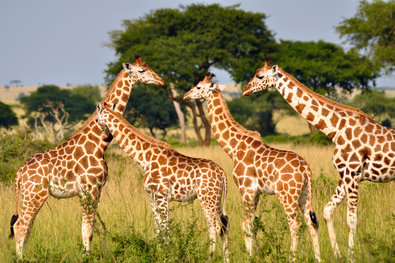
Julian Fennessy. Giraffes are the “forgotten megafauna,” said the  executive director of the Giraffe Conservation Foundation.

Julian Fennessy. Giraffes are the “forgotten megafauna,” said the executive director of the Giraffe Conservation Foundation.

We have been highlighting science writers since our outset as a blog, following a longstanding respect from our contributors for their particular talent, which has made us richer by reaching fruit that is sometimes too high on a tree to reach and bringing it where we can reach it.

From the current New York Times weekly section highlighting and explaining scientific matters of interest to us with one of the greatest writers in the genre, we now turn our attention to giraffes for the first time in our several years sharing (and as pointed out in the article we can only wonder why we have not paid more attention to such a creature prior to now):

SCIENCE TIMES: OCT. 7, 2014

Our Understanding of Giraffes Does Not Measure Up

By NATALIE ANGIER

Giraffes may be popular — a staple of zoos, corporate logos and the plush toy industry — but until recently almost nobody studied giraffes in the field so there is much we don’t know about them.

If You Have No Problems

Mother and kids at Kayal Villa

Goats have been on our radar recently for various reasons, mainly dairy. Kayal Villa got its first family of goats a few months ago and the herd has expanded organically, so to speak. And we have expanded it by bringing in new individuals from various locations to expand the gene pool.

We do so with some awareness of the challenges ahead, all in the interest of better dairy for our kitchens. We have heard it said that “if you don’t have any problems, get a goat” — the humorous meaning of which is related to goats being notoriously troublesome in their eating habits, devouring everything in sight and very cleverly finding their way to go where they should not go and do things they should not do (i.e. if you have no problems, you will if you get a goat).

But this briefing in Conservation gives us more reason to appreciate these hooved creatures:

Where herbicides and mowers have failed, goats might succeed. In a new study, scientists have found that these humble herbivores can devour 12-foot-high invasive plants, allowing native species to regain a foothold in wetlands.

Continue reading

Don’t Just Sit There!

The WeBike cycling desk can be found at airports and train stations across in Western Europe. WeWatt

The WeBike cycling desk can be found at airports and train stations across in Western Europe. WeWatt

Do something! That is a call to action everyone has heard at some moment in their life, from a drill sergeant, a coach, a parent…and it turns out there is good reason to heed the call for the sake of longevity. And entrepreneurs are doing something about it to give you options in unexpected ways and places, as we learn in this story from National Public Radio (USA):

Amsterdam is famous for its laissez-faire attitude about extracurricular activities, its beautiful canals and of course, its bicycles. Now, even if you only have a layover at Amsterdam’s Schiphol Airport, you can get in some pedaling, and power your phone and other devices at the same time. Continue reading

Reversing Extinction Risk

extinctiontimes

Thanks to Conservation for this note on the relationship between the proper identification of a species’ extinction risk and the amount of time practically required to do something about it:

Congratulations, you’ve made the IUCN Red List of Threatened Species! Now what? Is that enough to promise your salvation? Or will the increasing press of climate change on your vulnerable/endangered/critically endangered back spell your doom anyway?

A new study aimed to answer this question, of just how long placement on the Red List gives conservationists to try and save a species on its way to oblivion thanks to climate change. Continue reading

Popcorn Patrimony

01-JP-POPCORN2-sfSpan

Dennis Chamberlin for The New York Times. Ears of heirloom popcorn are smaller than with other types of corn but deliver more flavor.

We link to stories about entrepreneurial conservation, most often involving wilderness, whose tangible value is straightforward. Other times it is about art, or language; these forms of cultural patrimony are more intangible in value–not less obviously of value, but less tangibly so.

It should not diminish the concept of patrimony, nor the tangible/intangible divide, to talk about heritage popcorn, as trivial as that might at first sound. In the interest of tangible patrimony that has intangible value embedded into it, we appreciate this New York Times Dining & Wine section offering, an unexpected small pleasure:

Heirloom Popcorn Helps a Snack Reinvent Itself

Heirloom varieties you pop yourself deliver more flavor than those store-bought bags.

Continue reading