Whether you’re a “hat person” or no, we’d be surprised if news of this exhibition didn’t bring a smile to the lips of anyone familiar with Theodor Seuss Geisel‘s books. For the first time in history “Dr. Seuss’s” personal hat collection is on tour in an exhibit called Hats Off to Dr. Seuss!, which debuted at the New York Public Library in January and will stop in six states over the next seven months.
Author: Organikos
Yes, I Should Be Vegetarian

Unloading vegetables from a boat on a foggy January morning in Bangladesh (A.M. Ahad/AP)
If you have thought about dropping animal protein from your diet, or at least thought about it and decided not to do so, this blog post at the Atlantic‘s website is worth a read:
“Let me be clear about this. A low carbohydrate diet is quackery,” Dr. Neal Barnard told me over the phone. “It is popular, bad science, it’s a mistake, it’s a fad. At some point we have to stand back and look at evidence.”
Note to self: Don’t ask Dr. Neal Barnard about limiting your carb intake.
“You look at the people across the world who are the thinnest, the healthiest, and live the longest; they are not following anything remotely like a low-carb diet,” he said. “Look at Japan. Japan has the longest-lived people. What is the dietary staple in Japan? They’re eating huge amounts of rice.” Continue reading
Getting To Inspiration, Unhindered
 There is a new book on our reading list, thanks to this interview with its author, Amy Wallace (if your reading list includes publications we regularly link to, especially those that offer long form journalism, this podcast is an incredible resource). After listening to the interview, we found her website, and this book looks worth waiting for:
From Ed Catmull, co-founder (with Steve Jobs and John Lasseter) of Pixar Animation Studios, comes an incisive book about creativity in business—sure to appeal to readers of Daniel Pink, Tom Peters, and Chip and Dan Heath.
Creativity, Inc. is a book for managers who want to lead their employees to new heights, a manual for anyone who strives for originality, and the first-ever, all-access trip into the nerve center of Pixar Animation—into the meetings, postmortems, and “Braintrust” sessions where some of the most successful films in history are made. It is, at heart, a book about how to build a creative culture—but it is also, as Pixar co-founder and president Ed Catmull writes, “an expression of the ideas that I believe make the best in us possible.” Continue reading
Malayalam Mother Tongue, Second Language

For those of us non-Indians living in Kerala, the following story sounds familiar because most of our friends and colleagues of the same age, and younger, as the writer share some similar story about their relationship to their mother tongue:
I’m at one of my favourite restaurants in Chicago, nearing the end of a long week which has been both more and less productive than I’d hoped for. I dragged myself here in an effort to finish a piece I’ve been working on forever.
The rain has kept most customers away, I’ve had the privilege of a large dining room to myself, and the television set directly above my head has been mercifully silent. Every now and then, people will come in and leave when they’re done. I’ve stayed on, nibbling at my chicken biryani and downing endless cups of tea as I lie hunched over in my corner. Continue reading
Microchipping Rhinos In Kenya

Click above to go to the video, on the Guardian‘s website courtesy of WWF:
In a dawn operation, rhinos in the Mara region of Kenya are tranquilised by rangers. A multidisciplinary team of researchers, vets and technicians take over to drill a tiny hole in the horn to insert a microchip. Another is implanted in the body and a unique pattern is put on the rhino’s ears. Microchipping, conservationists say, is essential to protect the endangered black rhinos. ‘If Kenya loses its rhinos, it will lose its heritage,’ says Robert Nedeti, species manager at WWF Kenya.
Saving Rainforest One Pop-Tart At A Time
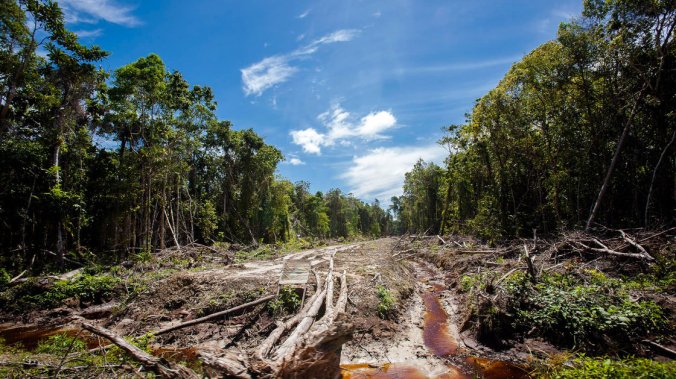
An access road is constructed in a peatland forest being cleared for a palm oil plantation on Indonesia’s Sumatra island in 2013. Chaideer. Mahyuddin/AFP/Getty Images
Thanks to National Public Radio in the USA for this story of palm oil, Pop-Tarts and ethics, wrapped up in the clothing of an entrepreneurial conservation case study among multinational corporations:
If you think a small shareholder can’t get the attention of the multibillion-dollar palm oil industry, think again.
Lucia von Reusner lives half a world away from the palm oil plantations in Southeast Asia that have become notorious for environmental, labor and human rights abuses.
So, how did she nudge for change? She couldn’t tell palm oil plantations in Indonesia to clean up their act. But, as a Kellogg shareholder, she figured out how to put pressure on the company to use its leverage to push for change.
Palm oil, of course, is the fat that lubricates so many of our packaged snacks today, from Pop-Tarts and Eggo waffles to soaps and other personal products. And global demand for palm oil has grown quickly.
The clear-cutting of precious forests in countries like Indonesia and Malaysia to grow the oil palm trees has been well-documented. More recently, an investigation by Bloomberg Businessweek into human rights abuses on Indonesian palm oil plantations and an Accenture analysis that described the use of child labor have raised more awareness about other unsavory realities in the industry. Continue reading
A Master Puzzle
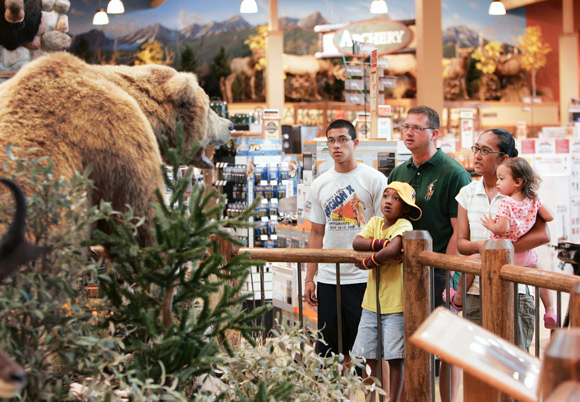
Photograph: Nati Harnik/AP
If you have shopped there in person, or ordered from them online, or see that the interrelation between the USA’s various communities are sometimes not easy to figure out, you know why this story is important:
…The growth of Cabela’s reflects Americans’ odd relationship with the outdoors: we mythologize it even as we pave it over. To accommodate their bulk and the crowds that they attract, Cabela’s stores are often built next to interstates and surrounded by giant parking lots. Generally, the only wildlife in sight are the crows picking over the litter. Some of the newest branches are on the edges of cities—Denver, Austin—that epitomize sprawl. In Greenville, South Carolina, where Cabela’s plans to open on a congested retail strip in April, other retailers are worried that traffic jams will scare away their customers. Continue reading
Chocolate, Climate Change, Future Scenarios

Reuters
The Atlantic’s website picked up this story about one of the world’s largest chocolate companies, and its approach to the future with regard to climate change:
…Now—in response to all this bigness, all this complexity, all these diversified models—it has prepared for a changing world. The Hershey Company is hiring a futurist.
That’s not what companies call it, exactly. Hershey’s is hiring a “Senior Manager” in “Foresight Activation,” someone with experience converting “existing foresight (trends, forecasts, scenarios) into strategic opportunities (SOs).” Continue reading
Ecofficiency And Happiness Correlate

A Nissan Motor Co. executive demonstrating quick charge of a Nissan Leaf by a solar-assisted EV charging system at Nissan’s global headquarters in Yokohama. File photo.
The Hindu today reports some green news from the north:
The Himalayan kingdom of Bhutan has tapped Nissan Motor Co to supply electric cars for its taxis and government fleet, hoping to reduce reliance on imported oil.
Under the agreement announced on Friday, Nissan will supply its Leaf electric car and set up charging stations in Bhutan. Continue reading
The Canopy Is A Portal

When we first met Dr. Meg Lowman last year we were already familiar with the use of tree climbing techniques for forest biology research. But the pioneer of canopy ecology includes an additional dimension to her REU (Research Experiences for Undergraduates) by acknowledging that physical mobility has little to do with being an effective field biologist. “To explore the canopy we climb ropes not trees, and in the lab we use microscopes, computers and minds, which have no limits.”
The Baker University program had been open to eight students, half of whom had ambulatory disabilities. All eight students were professionally trained to ascend into the canopy to collect moss, lichen and leaves to measure the impact of the invertebrates like tardigrades (water bears) on the habitat. Continue reading
Beauty of Idukki
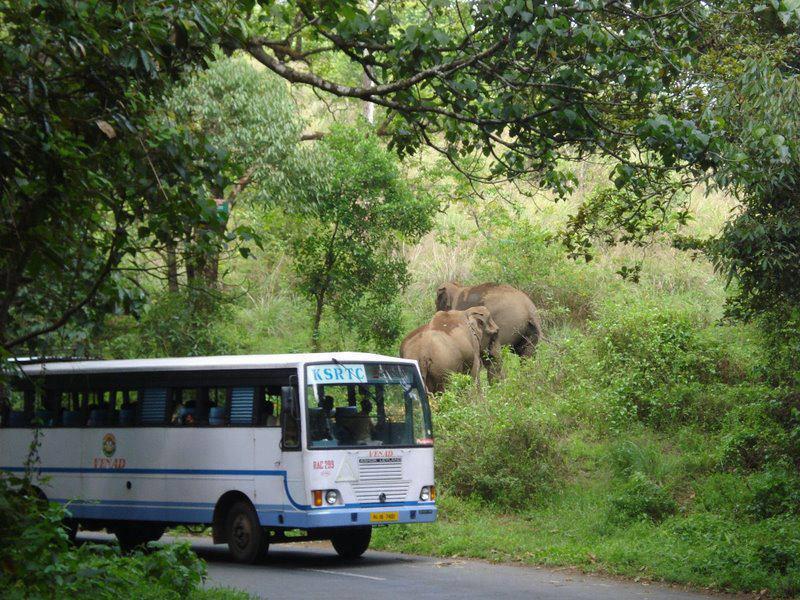
Photo credits: MN Shaji
Kerala’s Idukki District is known for its famous dams, forests and rich animal habitat. With an astonishing 50 percent of the total area under green cover this hilly region has managed to retain its charm and pristine environment. Idukki’s stunning natural beauty and diverse wildlife make it dream tourist destination. Continue reading
How Many Options Does It Take To Change A Lightbulb?

(From left) Incandescent, CFL and LED light bulbs. Many people are finding that choosing the right light bulb has a steep learning curve.
From National Public Radio, an update to the ongoing knowhow required to change a lightbulb efficiently (click the image above to go to the podcast):
Buying a light bulb used to be a no-brainer. Now it’s a brain teaser; the transition to more energy-efficient lighting means choosing from a dazzling array of products.
We’ve long identified bulbs by their wattage, but that is actually a measure of electricity, not the brightness of a bulb. The amount of light a bulb generates is measured in lumens.
An incandescent 60-watt bulb, for example, gives off 800 lumens of light. And LED bulbs, which are more energy efficient than their incandescent counterparts, can deliver the same amount of light using as little as 10 watts.
The Environmental Protection Agency says that if every household replaced just one incandescent bulb with an “Energy Star”-rated LED or CFL (compact fluorescent), Americans would save close to $700 million per year in energy costs.
But with so many types of bulbs with different price points and life spans now on the market, many consumers are confused.
When we asked for your questions about light bulbs, we got an earful. So we called in Noah Horowitz, director of the Natural Resources Defense Council’s Center for Energy Efficiency, to answer your most frequently asked questions. Continue reading
This Modern World, Its Conceptual Artists, Its Discontents

What with bird-counting, we almost missed the dumb hoax–not to say the hoax was dumb but that the hoax about dumb was almost lost on us. And not only because we do not always scan the “news” far and wide enough to catch such scintillating plums. Also because we might not have seen the art in this concept; only the discontent, the humor, the clever. Is it art? Protest? Both? The post below on the New Yorker’s website, as often happens, sheds the light we need to “get” what might otherwise have been lost:
Last weekend, a pop-up shop called Dumb Starbucks appeared in Los Feliz, Los Angeles, five miles east of the Hollywood Hills. It seemed like any other Starbucks store, but it gave away “dumb” versions of items sold by the Seattle-based coffee giant: Dumb Iced Vanilla Latte and Dumb Blonde Roast. For full effect, there were compact discs with names like “Dumb Jazz Standards,” “Dumb Taste of Cuba,” and “Dumb Nora (sic) Jones” by the registers. Californians waited in line for hours for the “horrible coffee,” while Starbucks grew flustered at the use of its “protected trademark.” Before the caffeine buzz could wear off, the loud voices of the social-media sphere started wondering: Who put up Dumb Starbucks? And was it a legitimate political statement about consumerism—perhaps an offshoot of Occupy Wall Street—or a well-executed viral marketing stunt? Continue reading
Xandari’s Great Backyard Bird Count
When you walk into the reception area at Xandari, the first thing you will see is an invitation to join into the count underway across North America and a few international locations, including India and Costa Rica. Raxa Collective properties are all in. Xandari is in perfect form, with excellent weather, and the birds are out in full force. And what a backyard it is…
Calling On Solomon In A Birds-Versus-Science Conundrum
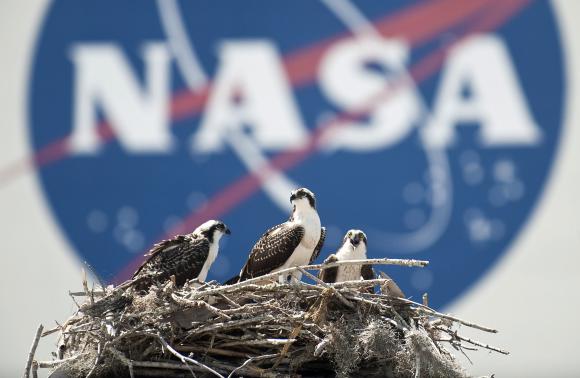
A family of Osprey are seen outside the NASA Kennedy Space Center Vehicle Assembly Building in Cape Canaveral, Florida in this file photo taken May 13, 2010. CREDIT: REUTERS, BILL INGALLS, NASA
Anyone who has been following Raxa Collective’s blog for more than a day is probably aware that we pay close attention to birds. We do this because many of the places where we operate conservation-focused lodging are also exceptionally biodiverse bird habitats. Most of the travelers who visit our properties are at least interested in birds, and many are serious bird-watchers. But we also pay attention to birds for the same reason we pay attention to science in general: they are an indicator of the health of our planet and we want to both pay attention to the indicators and understand them better. Science matters. So, in general, we are NASA fans. But the story here makes us wonder what Solomon’s wisdom might advise:
Florida’s plan to build a commercial space launch complex in a federal wildlife refuge surrounding the Kennedy Space Center drew sharp words from environmentalists and strong support from business boosters during the project’s first public hearing on Tuesday.
Advocates say the proposed spaceport is needed to retain and expand Florida’s aerospace industry, which lost about 8,000 NASA and civilian jobs after the shutdown of the space shuttle program in 2011.
Opponents of the plan to carve out about 200 acres from the 140,000-acre (57,000-hectare) Merritt Island National Wildlife Refuge cite concerns over protecting the refuge’s water, seashore, plants and wildlife, which include 18 federally listed endangered species. Continue reading
Grid Growth Gazing

(Thinkstock) Is there anywhere left on Earth where it’s impossible to access the internet? There are a few places, but you have to go out of your way to find them, discovers Rachel Nuwer.
As much as we encourage travelers to join us off grid in remote locations, to disconnect and engage in authentic experiences of communities and ecosystems not like home, nonetheless we depend on the grid for our ability to connect with those very same travelers. We are paying increasing attention to the evolution of connectedness, and this report by the BBC is of interest:
It can be easy to forget what life was like before the internet. For many, not a day goes by without checking email, browsing online or consulting Google. Some 1.3 billion people alive today are young enough never to have experienced anything else. Yet has the network of networks underpinning all this activity actually reached every part of the globe?
Various reasons still stop people accessing the internet where they live, of course. There’s censorship, for starters. “We don’t get much traffic from North Korea,” says John Graham-Cumming of CloudFlare, a content delivery network – the equivalent of a regional parcel distribution centre, but for web traffic. “Likewise, early in the Syrian civil war they cut off internet access and we saw a drop in traffic coming from those Syrian connections.” Continue reading
Yoga In Perspective
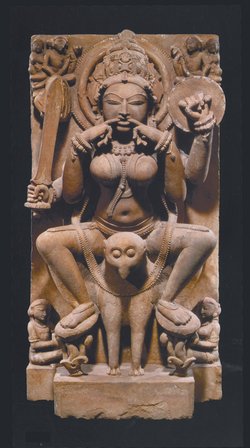
San Antonio Museum of Art. ‘Yogini’; sandstone statue, Kannauj, Uttar Pradesh, first half of the eleventh century. William Dalrymple writes that ‘in ancient India yoginis were understood to be the terrifying female embodiments of yogic powers who could travel through the sky and be summoned up by devotees who dared to attempt harnessing their powers.’
William Dalrymple, in the New York Review of Books, provides a summary of four books that should be considered essential reading to understand yoga in its proper historical context. The last few paragraphs are among the best:
…Yogis seem to have gone particularly out of control during the eighteenth-century anarchy between the fall of the Mughals and the rise of the British. This is a subject explored by William Pinch in his brilliant 2006 study of the militant yogis of the period, Warrior Ascetics and Indian Empires.
European travelers of the period frequently describe yogis who are “skilled cut-throats” and professional killers. “Some of them carry a stick with a ring of iron at the base,” wrote Ludovico di Varthema of Bologna in 1508. “Others carry certain iron diskes which cut all round like razors, and they throw these with a sling when they wish to injure any person.” A century later the French jewel merchant Jean Baptiste Tavernier was describing large bodies of holy men on the march, “well armed, the majority with bows and arrows, some with muskets, and the remainder with short pikes.” By the Maratha wars of the early nineteenth century, the Anglo-Indian mercenary James Skinner was fighting alongside “10 thousand Gossains called Naggas with Rockets, and about 150 pieces of cannon.” Continue reading
Black Box Exploration

It has been a while since we linked over to a Radio Lab podcast, but this one is a good comeback story (click the black box to go to the podcast):
This hour, we examine three very different kinds of black boxes—those peculiar spaces where it’s clear what’s going in, we know what’s coming out, but what happens in-between is a mystery. From the darkest parts of metamorphosis, to a sixty year-old secret among magicians, to the nature of consciousness itself, we confront the stubborn gaps in our understanding.
A Scientist, On Play
 Another keeper on the topic of play, from another of the Baffler’s notable contributors:
Rationalists tend to frown upon group activities that seem to serve no evident biological or political purpose, like the drumming and masking so often indulged in by protest movements like Occupy Wall Street. Or, for a more historically venerable example, consider the reaction of European conquerors and missionaries to the shocking spectacles they encountered during the “age of exploration.” Almost everywhere they went—from Africa to the Western plains of America, from Polynesia to the Indian subcontinent—Europeans came across native peoples engaged in ecstatic rituals involving dancing, drumming, body-painting, masks, costumes, and feasting. Failing to notice the parallels between these exuberant native rituals and the traditional carnivals of Europe, missionaries tended to explain them as outbreaks of demonic possession, or as proof that the natives were not human at all, only “savages.” Continue reading
Citizen Science Democratizing Research

New technology is dramatically increasing the role of non-scientists in providing key data for researchers. In an interview with Yale Environment 360, Caren Cooper of the Cornell Lab of Ornithology talks about the tremendous benefits — and potential pitfalls — of the expanding realm of citizen science.
Most of our ornithological attention these days is on the bird count just getting under way, but citizen science is never far from our minds, so thanks to Yale 360 for this article that combines both interests:
When biologist Caren Cooper carries out her avian studies, she’s aided by thousands of assistants, none of whom are paid for their work. That’s because Cooper, a research associate at the Cornell Lab of Ornithology, relies on the help of so-called citizen scientists, volunteers from across the country who contribute data to her research projects. These lay people provide information that enables her and other scientists to study bird life in ways that would otherwise be impossible.
But, as Cooper notes in an interview with Yale Environment 360contributor Diane Toomey, the uses of citizen science now go way beyond events like the National Audubon Society’s Christmas Bird Count. Continue reading
 Organikos