An Appreciation Of Words Well Used, And Masters Of The Same

Anthony Lane, film critic for the New Yorker, wrote an appreciation for Elmore Leonard that is now posted on their website.  When important literary figures pass away, that magazine’s editors and writers share personal stories that serve to celebrate the lives of those who will write no more. On this site, we have studiously avoided obituaries but occasionally shared links to celebrate contributions of the recently departed.

Here, a slightly different purpose for linking to Lane. Yes, read this and better appreciate the prolific author’s contributions, which helps ease remorse at his passing because the contributions keep on giving (if you choose to see it that way). But more to the point here, celebrate the critic’s appreciation.  It takes guts, and mastery of words, to pit pulp fiction against high art (this act of critical bravery is after the jump):

…“The Switch” was published in 1978. Leonard (or Dutch, as his friends called him) had been writing about cowboys since the start of the nineteen-fifties, but he moved on to modern gunslingers with “The Big Bounce,” in 1969, and by the late seventies he was in full spate. The fullness required no enrichment of the style, let alone beautification; incapable of primping, Leonard chose to plane and pare until he ended up with folks like Melanie and Frank. As for their conversation, swatted back and forth like Ping-Pong, the phrasing as dry as a scoreline: if you wanted that brand of comic beat, with all the frills torn off, where did you go before Leonard came along? Early Evelyn Waugh. Continue reading


Boy Makes Good In The World, Comes Home, Commands Attention With A Wand

Brian Harkin for The New York Times. Conductor Zubin Mehta, right, leading the Israel Philharmonic Orchestra at Carnegie Hall in New York, on Feb. 22, 2011.

Brian Harkin for The New York Times. Conductor Zubin Mehta, right, leading the Israel Philharmonic Orchestra at Carnegie Hall in New York, on Feb. 22, 2011.

Thanks to India Ink for this notice:

Beethoven Comes to Kashmir

By VISHNU VARMA

NEW DELHI— Zubin Mehta, the renowned Mumbai-born conductor of Western classical music, is going to perform in Srinagar, the summer capital Continue reading

Music From And Between Other Worlds

tumblr_mr9rgx8ipO1qd9dz2o1_500

Photo via last.fm. Mr. Ondar was a superstar in Tuva. He’s often known for his prominent role in the 1999 documentary “Genghis Blues” about throat singing. He collaborated with Frank Zappa, Willie Nelson, Bela Fleck, among many others.

Whenever you first heard his music, you can probably remember who introduced you, or where you were. It does not sound like any other natural sound, musical or otherwise.  Sometimes it does not sound natural. The interview we link to below is the finest he ever gave (that we know of) because Ralph Leighton lucidly and intelligently explains his own experience working with and producing an album for Mr. Ondar, whose music will live on:

The technique known as throat singing is an ancient style still practiced in Tuva, a small republic between Siberia and Mongolia’s Gobi desert. Traditionally, it was practiced by herders.

In 1995, Kongar-Ol Ondar won a U.N.-sponsored international festival of throat stinging, and was honored by his nation with the title People’s Throat Singer of Tuva. He performed around the world and collaborated with Ry CooderThe Chieftains, Mickey Hart, Willie Nelson, Randy Scruggs and others. He was also featured in the 1999 film Genghis Blues... Continue reading

India’s Road Culture, Changing In Kerala

Young Indians aim to knock ‘honking’ off the roads

Young Indians aim to knock ‘honking’ off the roads

We missed this when it was first published, but better late than never for news like this:

The city branch of Young Indians (Yi), the youth wing of the Confederation of Indian Industry (CII), organised a silent march against noise pollution here in connection with the World Environment Day on Tuesday.

Twenty people, including school students and professionals, started their march from Greater Cochin Development Authority (GCDA) building in Kadavanthra.

They carried placards and banners displaying slogans like ‘Think Before Honking’ and ‘Reduce Noise Pollution’. Continue reading

A 2-Minute Primer On Why Solar Will Succeed

Screen Shot 2013-08-20 at 6.44.54 AM

Thanks to the Atlantic‘s website team of science writers (click the image above to go to the video), we never tire of getting a better understanding of why:

Solar is not like other energy sources. Continue reading

New Tourist-On-Arrival Visas For India

The Hindu

Photo credit: The Hindu. Thiruvananthapuram Airport along with the Cochin International Airport joined six other elite airports in the country to issue T-VoA

Thanks to the Hindu (click the image above to go to the source) for publicizing this new information about India’s ever-easier visa procedures. Decades ago, when it was downright Kafka-esque to obtain a visa, no one predicted that by 2013 efficiency would be a relevant word in a sentence about obtaining a visa.  But, to the credit of India, it is so. While not quite Hemingway lean, the prose is simplified, especially if you are from one of these countries:

Kerala on Wednesday became the gateway to India for holidaymakers from 11 countries who can get tourist visa on arrival (T-VoA).

Continue reading

Cricket Is Critical

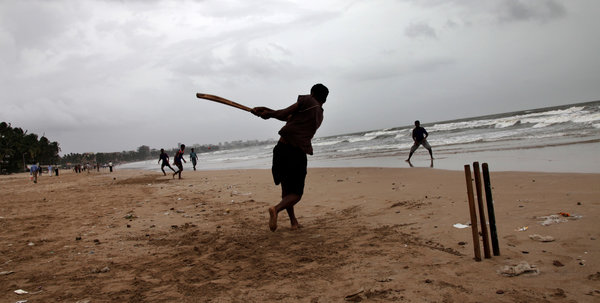
Kuni Takahashi for The New York Times. Juhu beach in Mumbai, India.

Kuni Takahashi for The New York Times. Juhu beach in Mumbai, India.

The abundant wildlife and traditional culture of India, especially Kerala and its neighboring states in the south, are our most common interests, both on this blog and within the lodging properties we develop and operate. Salim’s brief, daily posts are a mainstay of these interests. Selveraj’s frequent posts capture, in a single snapshot, the uniquely south Indian on-the-road experience.

What we offer less of, for good reason, is an attempt to capture “India” in small snapshots. The quotation marks denote that India is the name of a country, yes, but that it is realistically more the name of an idea; an ideal; any attempt to capture that in a single view or experience is futile because of the complex, diverse and dynamic components.

Continue reading

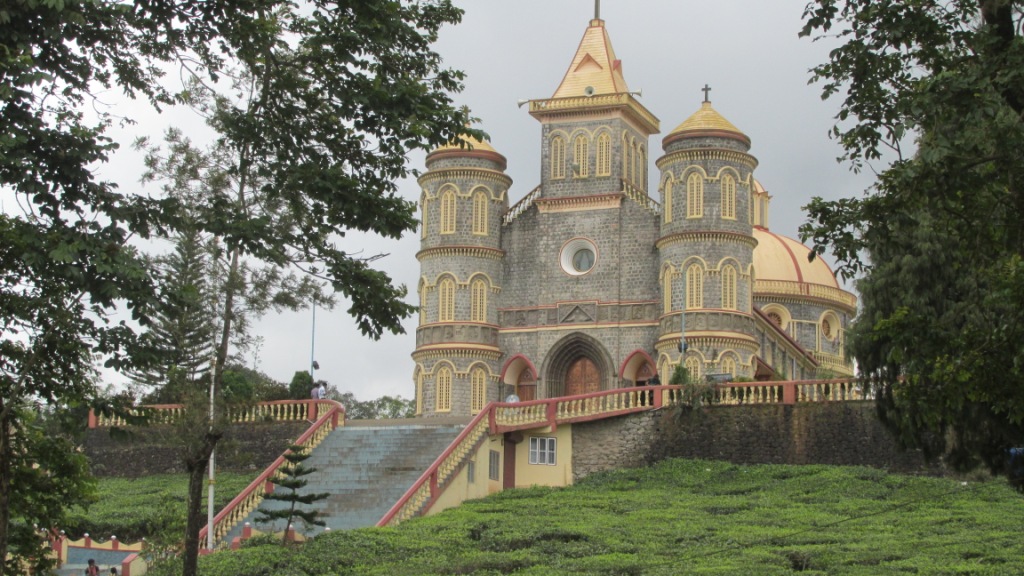
Velankanni Matha Church, Pattumala

Pattumala is a picturesque place with an unending expanse of lush green tea plantations along the Thekkady-Kottayam Route near to Vandi Periyar. The main attraction of the area is the Velankanni Matha Church, a structure built in granite that has become a famous pilgrimage spot. Continue reading

Superlative Sharing

India Republic Day Doodle

India Republic Day Doodle

Although the “Google Doodle” above was published to commemorate the day the Indian Constitution came into force, it seems appropriate to reshare it for Indepence Day as well. That spirit of sharing is evident in the internet giant Google’s launching of the Google Impact Challenge in India. Nikesh Arora, Google’s senior vice president and chief business officer, wrote

On the eve of India’s Independence Day, we’re celebrating the spirit of creativity and entrepreneurship of the world’s largest democracy by spotlighting the best local nonprofits that are using technology to make the world better. Continue reading

If You Happen To Be In San Francisco

This slideshow requires JavaScript.

We have plenty of thoughts on Detroit’s current state of affairs, and an occasional post on one oddity or another connected to the city; but only one recent post, and a brief followup, with a direct reference to its cultural heritage. Thanks to Wired for bringing this exhibit to our attention:

…Many famous architects, such as Albert Kahn, helped the city become an architectural hub, and Jarmain’s title, American Beauty, is named after Kahn’s American Beauty Iron Building. Even though Detroit is shrinking and structures are being destroyed almost daily, it still has one of the country’s best collections of late 19th- and early 20th century buildings…

And thanks to the Meridian Gallery for this description of the upcoming exhibit in San Francisco: Continue reading

Urban Pollinators

There are a growing number of websites, like the one above, that simply bring attention to an important issue in the ever-urbanizing world: how important plant life is to human life, and (not incidentally) the importance of how those plants get pollinated.  Click here for perhaps the leading blog on this issue, at least in the UK, which seems to lead the world on paying attention to this issue. The Guardian‘s Alys Fowler is the most consistent supporter in the journalistic world: Continue reading

Accordion’s Life Line, Alex

This slideshow requires JavaScript.

This is another in the series, on the New Yorker‘s website, providing short glimpses into the craft work of New York City. Click here to go to the video and source of this text:

For forty-five years, Alex Carozza has run a small accordion shop near Times Square. It’s one of the last fixtures of the old Music Row on Forty-eighth Street, and Carozza, after a lifetime of repairing musical instruments, still works six days a week while teaching some younger apprentices the skills of the trade. Continue reading

Writing To Clarify

The Washington Post is not one of our go-to sources for interesting stories, but we care deeply about journalism as a pillar of the communities we are involved in. What happens to this particular journalistic institution is of interest because of its perceived influence on policy in an influential community. For that reason, 12 minutes spent listening to the man who led the decision to sell the newspaper to one particular buyer may be worthwhile.  But there is a much better reason to listen to him, and it comes exactly at minute 10 in this interview, when he describes how meetings are conducted at Amazon, and the importance of writing to clear communication.

Monsoon Theyyam

Karkataka theyyam

Monsoon theyyam

The last month of the Malayalam calendar, Karkatakam (July 17 to August 16) falls towards the end of southwest monsoon and signals the arrival of the Monsoon Theyyam. Karkataka Theyyams are performed by boys under the age of 13. They visit houses and Temples to ward off diseases, hardships and evil spirits that may come during the rainy season. Continue reading

Global, Local & Perspective

We have only mentioned him once before on this site, but we like him more than that.  In less than one minute, he sums up what can sometimes take us years to get right in the development and operation of a conservation resort: framing local phenomena in such a way that reflects value beyond the locale, while avoiding as much as possible the homogenizing effects of globalization. Continue reading

Sport Beyond The Self

The tiresome doping scandals plaguing many sports are rivaled mainly by the ego blasts emanating from winner-take-all superstar players; but this conversation with Edson Arantes do Nascimento (better known as Pelé) has a soothing effect:

Pelé, when you are the best at something how hard is it not to get arrogant about it?

I used to tease the kids because I played better than them. But my father told me, “Don’t do this with the kids because you know how to play football; God gave you the gift to play football. You didn’t do anything. You have to respect people, because it is important to be a good man, a good person.  From now on, you must be this example.” Continue reading

170 Million Year Old Barometer For River Water Quality

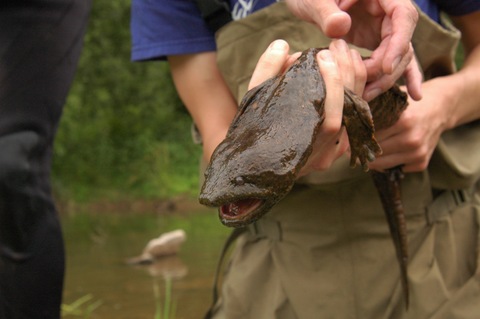
Matt Neff from the Smithsonian’s National Zoo holds a hellbender salamander that he caught in the Blue Ridge mountains of Virginia. Scientists hope to learn how healthy and viable the population is. Photo by Rebecca Jacobson

Thanks to the Public Broadcasting System of the USA for this story segment as their Science Wednesday feature this week:

…At the end of a long day snorkeling in the clear streams of southwestern Virginia’s Blue Ridge Mountains, Terrell and her team assumed their positions. As three scientists lifted a flat, heavy rock, Terrell groped underneath the stone, let out a muffled cry through her snorkel mask and popped out of the water.

“Where did it go? Did you see it?”

The biologists checked their nets and scoured the water. Sarah Colletti from the Aquatic Wildlife Conservation Center pointed at the slick rocks under the water. “Right there, he’s looking right at you.” One of the biologists lunged, secured a firm grasp, and triumphantly pulled it out: a nearly two-foot long hellbender. Continue reading

Prehistoric Hemispherical Face-Off

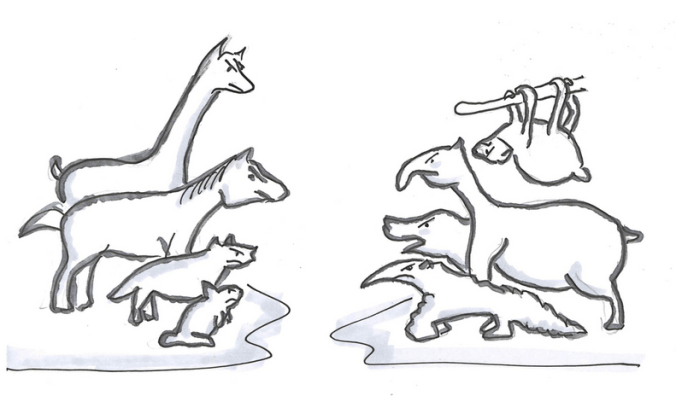
Robert Krulwich/NPR

Wondrous prehistory, thanks to Robert Krulwich:

This is the story of two continents doing battle, North America versus South America. It is also a biological mystery.

For a very long time, North America and South America were separate land masses. The Pacific Ocean slipped between them, flowing into the Caribbean. The Isthmus of Panama was there, but it was underwater. The two continents didn’t touch.

As a result animals on both continents, especially mammals, evolved independently. They didn’t, couldn’t, interbreed. And yet, both North and South America had mountains, plains, long lazy rivers, deltas and supported similar forms of mammalian life. In fact, when biologists look back at the fossils, they found almost mirror like populations. Continue reading

Innovation, Collaboration & Illustration

Thanks to the man who, without fail, coaxes a smile with another New York Times blogpost keeper:

After spending the first 15 years of my life drawing and painting analog, I first dabbled in computer-generated graphics in the mid-1980s on a Sinclair ZX81, followed by an Amstrad CPC664. “Drawing” with these machines meant entering strings of binary code to manipulate ASCII codes into something vaguely resembling images. Continue reading

Ecological Modernism Elucidated

Thanks  to Yale Environment 360 for this big mental poke:

New Green Vision: Technology As Our Planet’s Last Best Hope.

The concept of ecological modernism, which sees technology as the key to solving big environmental problems, is gaining adherents and getting a lot of buzz these days. While mainstream conservationists may be put off by some of the new movement’s tenets, they cannot afford to ignore the issues it is raising.

by Fred Pearce

There is a new environmental agenda out there. One that is inimical to many traditional conservationists, but which is picking up kudos and converts. It calls itself environmental modernism — which for many is an oxymoron. Continue reading