Metaphors For Understanding Climate Change

rovere-blog480

Justin Gillis/The New York Times. Alessio Rovere, a Columbia University researcher, examined an ancient shoreline deposit in Cape Agulhas, South Africa. Dunes moving inland ahead of a rising sea are believed to have buried trees at the site, with the decaying trunks producing the unusual features at center.

Thanks to Green Blog for linking to this article in the New York Times Science section on Tuesday:

In my article in Tuesday’s Science Times about the risks of long-term sea level rise, and in an accompanying podcast, I reported on the link between past instances of global warming, caused by natural fluctuations in the climate, and higher shorelines. Continue reading


Wind-Warped Willows

Recent research shows an excess of strengthening sugar molecules in the willows' stems, which attempt to straighten the plant upwards in the presence of windy conditions. These high-energy sugars are fermented into biofuels.

Recent research shows an excess of strengthening sugar molecules in the willows’ stems, which attempt to straighten the plant upwards in the presence of windy conditions. These high-energy sugars are fermented into biofuels.

Click the image to the right to go to the surprisingly accessible article from an otherwise engineer-oriented publication:

Willow trees cultivated for green energy can yield up to five times more biofuel if they grow diagonally, compared with those that are allowed to grow naturally up towards the sky.

This effect had been observed in the wild and in plantations around the UK, but scientists were previously unable to explain why some willows produced more biofuel than others.Now British researchers have identified a genetic trait that causes this effect and is activated in some trees when they sense they are at an angle, such as where they are blown sideways in windy conditions.

The effect creates an excess of strengthening sugar molecules in the willows’ stems, which attempt to straighten the plant upwards. These high-energy sugars are fermented into biofuels when the trees are harvested in a process that currently needs to be more efficient before it can rival the production of fossil fuels. Continue reading

Victory Is Good, Goodness Is Great

Fernández Anaya helps Mutai toward the line / CALLEJA (DIARIO DE NAVARRA

Fernández Anaya helps Mutai toward the line / CALLEJA (DIARIO DE NAVARRA

On the rare occasion that we highlight a sporting event, the reason for doing so in this case is simple: we have been on the lookout for acts of goodness, random or otherwise, since starting this site.  This is as random as it gets:

…Spanish athlete Iván Fernández Anaya was competing in a cross-country race in Burlada, Navarre. He was running second, some distance behind race leader Abel Mutai – bronze medalist in the 3,000-meter steeplechase at the London Olympics. Continue reading

Oil, Rainforest, Communities

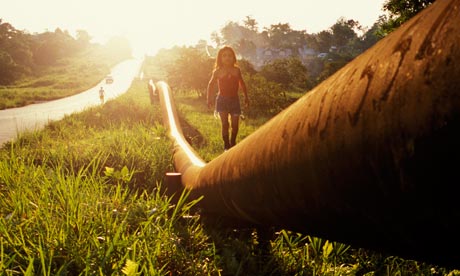
Pipe dreams: the 500km pipeline that transports oil from Lago Agrio to the port of Esmeraldas, on the Pacific Coast. The oil discovery destroyed the area. Photograph: Remi Benali/Corbis

Can there be happy endings related to oil discovery in remote, ecologically and culturally sensitive areas? Note likely.  But this story is worth a read:

American biologist Kelly Swing thwacks a bush with his butterfly net and a dozen or so bugs and insects drop in. One is a harvester, or daddy-long-legs, another a jumping spider which leaps on to a leaf where two beetles are mating. Continue reading

Really, Whole Foods?

conscious capitalism_book cover

John Mackey has a new book out.  He is a visionary, no doubt.  He co-founded and co-leads a company we admire.  But he is not the sole shareholder in Whole Foods, and when he decides to be provocative, as he often does, the company’s reputation is at stake along with his own.  He claims not to be a climate change skeptic, but also says he does not believe we need to take any action because climate change is likely going to benefit humans.  Specifically, in an interview in the Guardian he says:

We’ve been in a gradual warming trend since the ending of the “Little Ice Age” in about 1870, and climate change is perfectly natural and not necessarily bad. Continue reading

Nature’s Value

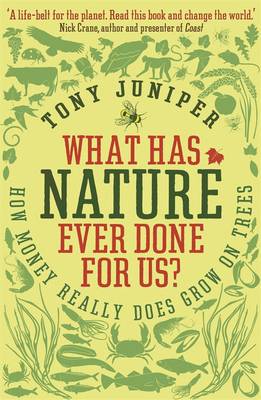
5606A review of this provocative book appears in the Guardian (click the image of the book to the right to go to the review) and an interview with its author is here, via mp3 download or as an iTunes podcast.  The book’s blurb supports the reviewer’s conclusion that it is worth the read:

Money doesn’t grow on trees. Or does it? From Indian vultures to Chinese bees, nature provides ‘natural services’, 24/7. Recycling miracles in the soil; an army of predators ridding us of unwanted pests; an abundance of life creating a genetic codebook that underpins our food, pharmaceutical industries and much more. It’s been estimated that these are worth an annual $50 trillion Continue reading

Prized Bird Activism

Click the image to the left to go to the National Audubon Society’s website to read the entire announcement:

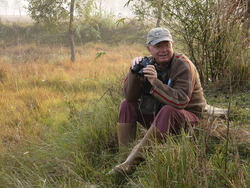
George Archibald is the first recipient of the Dan W. Lufkin Prize for Environmental Leadership.  As founder of the International Crane Foundation (ICF), he has devoted his life to protecting cranes and their ecosystems around the world and to helping thousands of people understand, and be inspired by, the global significance of bird conservation.

In 1973, with fellow Cornell University graduate student Continue reading

Opposition to Arctic Drilling

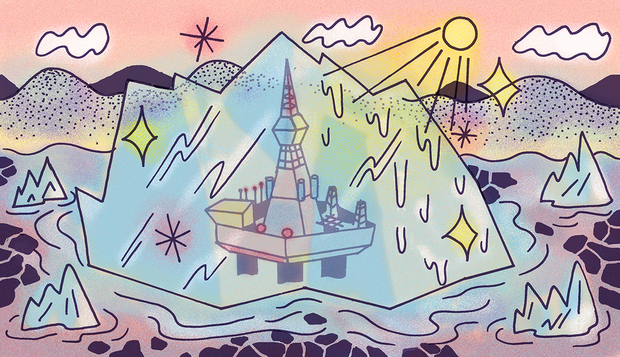
Illustration by Aisha Franz

Illustration by Aisha Franz

Click on the image above to read an open letter from two influential policy insiders:

Why We Now Oppose Drilling in the Arctic

By Carol Browner & John Podesta Jan 18, 2013
The Arctic Ocean is subject to some of the most volatile weather patterns on the planet. Geologists believe it also contains vast undersea oil and gas reserves. Continue reading

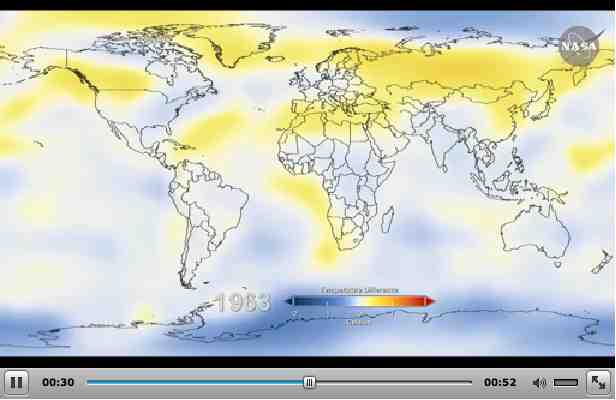
52 Seconds Of Silent, Strong Visual Representation Of Earth’s Temperature Since 1886

Nasa

Thanks to Atlantic’s coverage on this important topic, we have now this short but not very sweet visual message (click the image above to go to the video):

Whew! We did it! We didn’t have another warmest-year-on-record! Continue reading

Another Look At Sight

(Copyright: Thinkstock).  Our eyes are remarkable in making almost instant sense of the world around us in ways that even the most sophisticated machines can’t do. So what cues do we pick up that make sure we can see the wood for the trees?

(Copyright: Thinkstock). Our eyes are remarkable in making almost instant sense of the world around us in ways that even the most sophisticated machines can’t do. So what cues do we pick up that make sure we can see the wood for the trees?

The BBC provides this interesting view on the relationship between sight and other forms of sense:

One of the unforeseen boons of research on artificial intelligence is that it has revealed much about our own intelligence. Some aspects of human perception and thought can be mimicked easily, indeed vastly surpassed, by machines, while others are extremely hard to reproduce. Take visual processing. We can give a satellite an artificial eye that can photograph your backyard from space, but making machines that can interpret what they “see” is still very challenging. Continue reading

Science Scores One For The Bees

Bees-007

Environmental campaigners say the conclusion, by Europe’s leading food safety authority, sounds the “death knell” for the insect nerve agent neonicotinoid. Photograph: Alamy

There is a steady stream of unhappy news for bees in recent years, with scientists often being called to study the problem and propose solutions; today was just another such news day. We have a particularly soft spot for bees, so these actions taken, reported from Europe, are welcome additions to today’s news:

…”This is a major turning point in the battle to save our bees,” said Friends of the Earth’s Andrew Pendleton: “EFSA have sounded the death knell for one of the chemicals most frequently linked to bee decline and cast serious doubt over the safety of the whole neonicotinoid family. Ministers must wake up to the fact that these chemicals come with an enormous sting in the tail by immediately suspending the use of these pesticides.” Continue reading

Thoreau’s Flowers

orchid-blog480

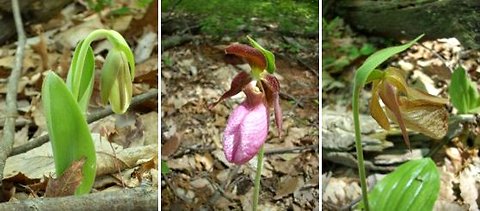
Zoe Panchen. Earlier flowering times: the progression of Cypripedium acaule, the pink lady slipper orchid, on April 23, May 7 and May 20, 2010.


From Green Blog:

Henry David Thoreau was a peculiar fellow. After his secluded stint at Walden Pond, his fixation with the natural world only grew. Starting in 1852, his journal turned into a two million-word project documenting seasonal observations around his small Massachusetts township, Concord. Over the next six springs he could be seen racing about town like a madman in an effort to spot and record that year’s first elusive blooms, all the while taking notes. Continue reading

If You Happen To Be In New York City

photo4384

Join Sea Shepherd Conservation Society NYC chapter for a training session for on-shore activists. Learn about Sea Shepherd Conservation Society, our history, our tactics, and our campaigns. Learn how to effectively outreach to individuals who attend our events and come to our tables. Please RSVP to nyc@seashepherd.org as space is limited.

From the Sea Shepherd Conservation Society’s website events calendar page:

On-Shore Volunteer Training – New York, NY

Wed, 23 Jan, 2013 6:30 PM – 8:00 PM

Continuum Coffee 199 Avenue B New York, NY

Fees:   Free

Largest Gathering On Earth

This slideshow requires JavaScript.

The Atlantic‘s photographic coverage of Kumbh Mela is accompanied by this explanation:

Tens of millions of Hindu pilgrims are now descending on Allahabad, India, joining an estimated 8 million already there for the Maha Kumbh Mela. Continue reading

What’s The Problem? The Key Question Of Entrepreneurship

Click the image above to watch this brief, powerful statement on entrepreneurship from Cornell’s 2012 Entrepreneurship Summit in New York last October. Between the fourth and fifth minute Jay Walker lays out in his own words the promoted purpose of the Summit:

BREAKING APART PROBLEMS.
TO FIND BETTER SOLUTIONS.

Every entrepreneur is pushed forward by the drive to fill an unmet need. Finding solutions to real-world problems is why we invent, build, and grow. At the first annual Cornell Entrepreneurship Summit, some of the world’s most innovative minds will share their experiences addressing complex challenges and paving new solutions. They will provide insights from their own achievements, as well as looking ahead to the problems we must tackle next.What are you solving?

Sculpture And Animation In The Interest Of Nature

Art or craft, we are inclined to sculptures and animation for reasons we cannot quite explain–sometimes just for fun, sometimes for contemplation, sometimes both simultaneously. What it means is best left to those experiencing it.  We categorize it as friendly to the themes we care about on this site, so hope to see more of his art. From the Asia Society’s website we learn that

U-Ram Choe is a Korean artist born in 1970 in Seoul. He is best known for his meticulously designed kinetic sculptures made of acrylic and stainless steel, each animated by robotics developed and programmed by the artist. Continue reading