Artisan Ethos

Further to the provocative statement on vegan ethics here, we have chosen this as a follow up to highlight this new publication’s value–on a subject we actually talk about in our office and a our resort operations:

Joy in the task

Even the finest restaurants are serving coffee made with capsules. Have we lost faith in the human touch?

Continue reading

Venturing For Impact

HBR Blog

A strong statement on Harvard Business Review’s blog site about the role of finance, specifically the venture capital model, in the future of social enterprise, which is in very close proximity to entrepreneurial conservation both conceptually and in practice.  Substitute ecosystem degradation for poverty or educational shortcomings and the framework with which Raxa Collective approaches its various initiatives:

During the past century, governments and charitable organizations have mounted massive efforts to address social problems such as poverty, lack of education, and disease. Governments around the world are straining to fund their commitments to solve these problems and are limited by old ways of doing things. Social entrepreneurs are stultified by traditional forms of financing. Donations and grants don’t allow them to innovate and grow. They have virtually no access to capital markets and little flexibility to experiment at various stages of growth. The biggest obstacle to scale for the social sector is this lack of effective funding models. Continue reading

Teacher Of Teachers In Natural History

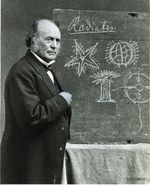
Because of its importance to this idea we work with, entrepreneurial conservation, we pay attention to the history of natural sciences.  We are curious, as individuals and collectively, about how we found our way here. In the Books sections of the New York Times Rebecca Scott reviews the Christoph Irmscher study on the Swiss immigrant scientist Louis Agassiz and his contributions to science–and therefore nature and conservation–in his adoptive country:

Nonetheless, there is no arguing with the claim that Agassiz, a Swiss immigrant, was pivotal to the making of American science. He was “one of the first,” Irmscher writes, “to establish science as a collective enterprise.” He was extraordinarily prolific and influential in many fields, including paleontology, zoology, geology and glaciology. Continue reading

Waste Reduction By Altruistic Design

This slideshow requires JavaScript.

If you search around long enough on words such as altruism and design–both topics we pay attention to on this site–eventually you will encounter these folks. This particular product caught our attention and we see no harm in promoting it:

GOEDZAK IS A SPECIAL GARBAGE BAG FOR ITEMS THAT ARE STILL USEABLE. IT’S A FRIENDLY WAY TO OFFER PRODUCTS A SECOND CHANCE AND STIMULATE SUSTAINABLE BEHAVIOR. Continue reading

Green Demolition

Schematic showing how buildings are disassembled from the inside out. Image via Taisei Corp.

Schematic showing how buildings are disassembled from the inside out. Image via Taisei Corp.

As Raxa Collective continues its work on a historic waterfront building in the Mattancherry section of Fort Cochin’s harbor–currently in the demolition phase of a portion of the property that was built in recent years–we have been doing our homework on methods that make the process as “clean” as possible. We came across EarthTechling, oriented to consumers rather than techno-professionals but with broad and deep coverage of clean tech.  This brief article is of interest to our demolition task:

We all know about ways to build greener more energy-efficient buildings, but what about the other side of this coin? Is there such a thing as “green demolition”? Many of today’s small buildings are torn down slowly with wrecking balls and earth-moving equipment. Taller structures are more economically brought down by explosives and gravity, becoming eye-popping media events that bring out the destructive inner-three-year-old in all of us. Continue reading

Whale Wonders

Whale

Beach-combing can yield wonderful surprises. Click the image above to see where this wonder was found:

A man finds a rare rock of valuable whale vomit on the beach in Morecambe that could be worth up to £100,000. Ken Wilman and his dog Madge were out on a walk when they discovered the valuable substance. The musky vomit comes from a sperm whale and is a rare commodity used in perfume

Dreamscapes

The Story Behind a Dream Shot – The Bird-of-Paradise Sunrise -A Greater Bird-of-Paradise (Paradisaea apoda) male greets the sunrise from his tree top display perch in the Aru Islands, Indonesia.

It shouldn’t seem surprising that the videos of such charismatic creatures have gone viral. But the study and associated film, book and lecture series seem to pack a similarly powerful punch.

Click the photo above to read about more about the million views and Tim Laman’s amazing stories.

Gorillas In His Midst

This slideshow requires JavaScript.

Yale Environment 360 has an excellent story on the various animals in this protected area, including the warden and those he is committed to protecting, but also the beasts who prey on those wards. Supporting national parks, wherever they may be and at whatever risk, has never been more critical:

The Perils and Rewards of Protecting Congo’s Gorillas

Virunga National Park, home to one of the last remaining populations of mountain gorillas, has witnessed years of war and civil strife. In an interview with Yale Environment 360, the park’s warden describes the lethal threats faced by his rangers and the remarkable survival of the park’s gorillas. Continue reading

Cleantech Solving Basic Needs In India

soler-articleInline

Continuing a topic covered recently in MIT’s Technology Review–namely the use of alternative energy to solve some basic needs in India’s rural areas–today’s Green Blog covers another innovation:

Milk? Garbage. Spinach? Garbage. Leftover Thai takeout? Garbage. For millions in the Northeast, clearing out the fridge after days without power was just one more unsavory chore that was part of the cleanup process after Hurricane Sandy passed through.

But in the developing world, throwing out food because of inadequate refrigeration isn’t just annoying, it’s a devastating and irreparable economic blow that keeps farmers trapped at the level of subsistence and threatens food security. In India, the government estimates that anywhere from 30 to 40 percent of food spoils long before it finds its way to the table. Continue reading

Nth Degree Ethics

After-Archimboldo-634x397

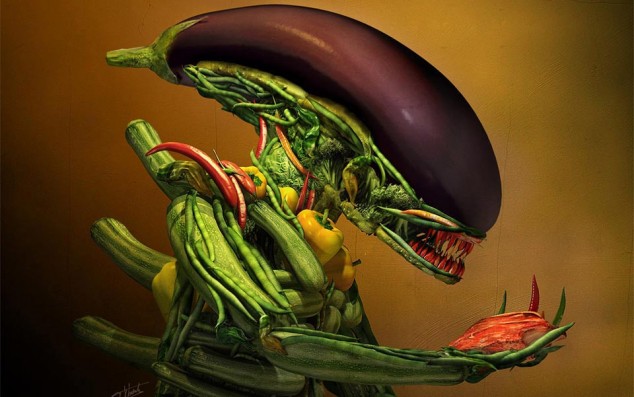
It is a new publication, and we like its irreverence.  Challenging vegan ethics, at least to those of us still carnivorously inclined, is a task best carried out by such audacious writers and editors tasked with building an audience (that actually reads) from scratch.  We wish Aeon the best and will point to it whenever the story seems worth passing on, and can recommend this for starters (as if the picture did not already capture your imagination):

The animal rights movement wants to prevent the most powerful species on the planet from oppressing every other species, just as human rights campaigners try to stop the most powerful people from oppressing those who are least powerful. The problem, they say, is ‘human privilege’, a privilege that almost all of us abuse.

Continue reading

Natural Born

It is well-documented on this site that we are feline-lovers, but our Bird Of The Day commitments force our full disclosure of the facts. Among those of us contributing to this blog–or anyone otherwise affiliated with Raxa Collective–we are contributors to the problem reported here (citing numbers specific to the USA only):

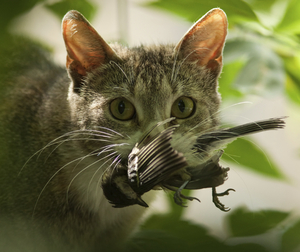
Behind This Cute Face Is A Cold-Blooded Killer

There are as many as 47 million pet cats out hunting for prey. Add that to the tens of millions of feral cats and strays, and researchers estimate that the furry felines are responsible for billions of bird and small mammal deaths every year.

Click the image above to go to the story. Don’t ask us what we plan to do about it.  If you have any suggestions, we are all ears.

One Man Brand

TataEntp

We sometimes think we see his family name in too many places in India–it is impossible to go through a day without seeing the name stamped everywhere you look: on tea bags, tea cups and tea spoons; telephones on up to tipper lorries; enough!  But when attached to this man, we are always delighted to see the name one more time. Click the image above to go to the video, which runs for just under one hour.

Star-Led Little Critters

Further on the the various compasses we navigate by:

Look up at the sky on a clear, moonless night, and you can make out the broad, hazy band of the Milky Way. For the longest time, observers were unsure what the milkiness was. Celestial clouds? Tiny stars? The “fiery exhalation” of large, sublunar stars, as Aristotle proposed? In 1610, using a telescope (a recent invention), Galileo revealed that the haze is made up of individual, barely visible stars; they are faint only because they are so distant. So continued the hard process of putting us in our proper cosmic place—an orientation that only gets more disorienting with each new scientific discovery. Continue reading

Power To The People, Dairy By Dairy

Prometheanchillerprototype

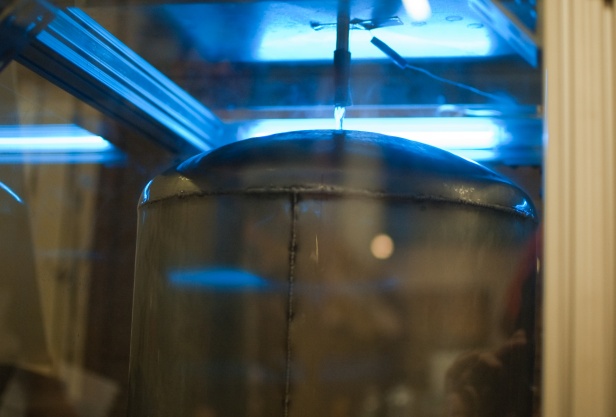
  This photo shows a prototype of Promethean Power’s thermal storage. Inside the tank is a phase-change material that rapidly chills milk when it’s poured over the surface. Credit: Martin LaMonica

The MIT Technology Review provides a readable explanation of new technology, made even more readable due to the application of that technology:

Novel Energy Storage to Chill Milk in Rural India

After a few technology U-turns, startup Promethean Power moves ahead with thermal battery to overcome unstable grid at Indian dairies. Continue reading

Guyana’s Jaguars

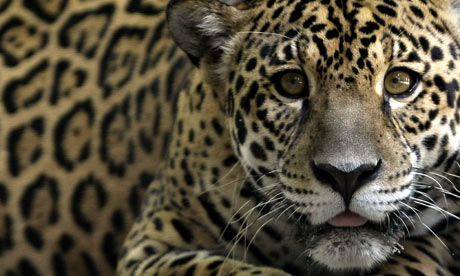
Jaguars once roamed widely from the south-western United States to Argentina, but have lost nearly half of their natural territory and have disappeared altogether from some countries. Photograph: Mauricio Lima/AFP/Getty Images

Jaguars once roamed widely from the south-western United States to Argentina, but have lost nearly half of their natural territory and have disappeared altogether from some countries. Photograph: Mauricio Lima/AFP/Getty Images

Bravo to Panthera for its achievements in the couple of years since we first learned about it in this 60 Minutes segment.  And thanks to the Guardian‘s ongoing coverage of such important topics:

The lushly forested nation of Guyana on Thursday joined a regional pact to protect jaguars, the elusive spotted cat that is the biggest land predator in the Americas but has become vulnerable as expanded agriculture and mining carves away at their fragmented habitat. Continue reading

Traveling From Carmania Toward Carsanity

car-lane

In a story first run in the Wall Street Journal, and picked up by this fantastic cleantech news aggregator, surprising news about the pace of decrease in demand for the automobile in Europe:

Increased environmental awareness does encourage some people to drive less, and travel by foot, bicycle, or public transit more often.

In 2007, 16 million cars were registered in the European Union, however, that many registrations is unlikely to happen again, and may instead drop down to 11 million registrations, which is equivalent to that of 1993 before the number of registrations stabilizes.

Read the whole story here.

Sweet Potato Tango

Ted Aljibe/AFP/Getty Images

Ted Aljibe/AFP/Getty Images

It wouldn’t be the first time that we’ve written about the “Columbian Exchange” on this site. So many of the foods now considered synonymous with “Old World” or “Asian” cuisines are actually endemic to the Americas, and according to NPR’s The Salt “anthropologists think that a few foods made the 5,000-mile trek across the Pacific Ocean long before Columbus landed in the New World.”

Sweet potatoes originated in Central and South America. But archaeologists have found prehistoric remnants of sweet potato in Polynesia from about A.D. 1000 to A.D. 1100, according to radiocarbon dating. They’ve hypothesized that those ancient samples came from the western coast of South America. Among the clues: One Polynesian word for sweet potato — “kuumala” — resembles “kumara,” or “cumal,” the words for the vegetable in Quechua, a language spoken by Andean natives.

But until now, there was little genetic proof for this theory of how the tater traveled. Continue reading

Uniquely No Direction Home

k9660

Those of us living nomadic lives, moving from one set of responsibilities (or lack thereof) to another set in a different context, are often living by a compass we cannot quite figure out. A frequent first greeting in India, upon seeing someone who is clearly not from India, tends to be a variation on the question of where were you born. “Where do you stay?” (i.e. where is your residence at this moment) is the follow up to wondering where you are from.  “Where are you going?” is rarely of concern.  It seems understood by all that there may be no return to the place of birth, or the place where you stayed before, or other familiar places.

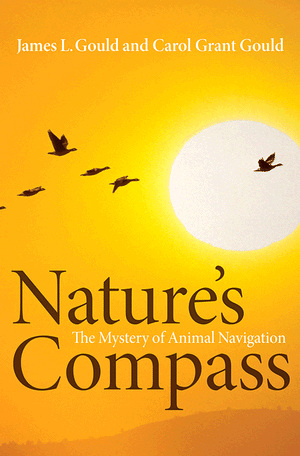
A new book surveys the animal kingdom for some remarkable examples of other creatures’ compasses. What about that cat that found its way 200 miles from an unknown location to the place where it normally lived? A review of the book in The Times Literary Supplement begins:

Curlews wing 6,000 miles, non-stop, along invisible bird-flying lanes in the sky as they travel from the South Pacific to Alaska. Spiny lobster crawl, one after the other, antennae to tail, for 30 miles along the ocean floor. Idaho salmon travel 900 miles and ascend 7,000 feet in elevation as they seek – and find – the tiny creek in which they hatched. Continue reading

Punctilious Wordplay

_65455118_pun_rogerquimbly

Wordplay sometimes distracts or diverts attention, on purpose, for the sake of levity.  Other times, such as punning in headlines, the opposite occurs and attention is drawn to something that might otherwise have been ignored or missed. The history of the pun is not as ignoble as an English major might have thought according to this story in the BBC Magazine (click the image above to go to the story):

…”Arrant puns” were the subject of attacks by the likes of Joseph Addison, 18th Century London’s pre-eminent literary tastemaker.  He decried them as debased witticisms and exulted that they had been “banished out of the learned world”. Continue reading