Tell Them It Cannot Be So

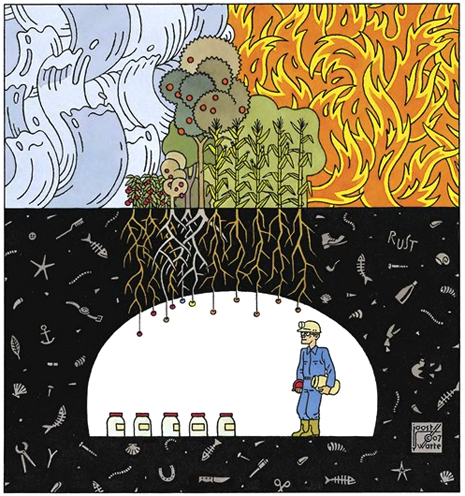
The Guardian and New York Times are the two newspapers of record in the English language that have invested well in coverage of environmental issues.  This news below is not welcome and we hope it is not final.  Why did we learn this news in the Guardian?  Can we influence the reversal of this decision?

The New York Times will close its environment desk in the next few weeks and assign its seven reporters and two editors to other departments. The positions of environment editor and deputy environment editor are being eliminated. No decision has been made about the fate of the Green Blog, which is edited from the environment desk. Continue reading

Mystery Bestseller

GetImage


Click the image of the book cover to go to the page in Guardian’s bookstore where it is available.  Click here to look at its standing on their best seller list.  Then, someone please explain its standing as the bestseller this week based on this synopsis:

Provides information on the fundamentals of biological oceanography. This book covers the properties of seawater which affect life in the ocean, classification of marine environments and organisms, phytoplankton and zooplankton, marine food webs, larger marine animals, life on the seafloor, and the way in which humans affect marine ecosystems. Continue reading

Cause For The Ages

noise-465

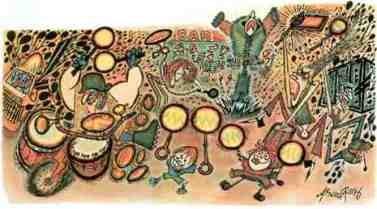
Click the image to the right to go to the story at the New Yorker website. We are not the only generation to be concerned about the boundaries between the beautiful and necessary sounds of life, and the excessive sounds of noise pollution. Even a century back in New York, sound had its judges and quiet had its activists:

…Sound does not persist, neither across space nor across generations, so the tremendous rattle of horse-drawn drays, the clink of cupboards, the sneezes and shuffles of domestic life fall into the vacuous, silent crevices of history. “How did diners respond to the switch from pewter to china?” Schwartz wondered aloud. “How did a midwife register the sound of a new baby coming into the world? How did a person walking out in the woods register the sound of thunder or lighting?” In the course of nearly two decades of research, Continue reading

Thank You, Zambia

Zambia's leopard

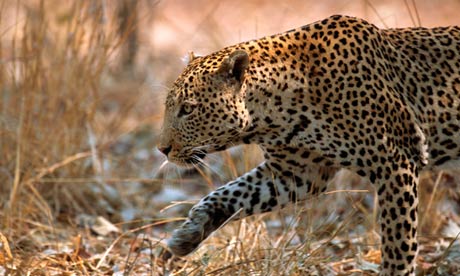
Zambia’s leopard numbers, as well as those of its lions, are too low for a sustainable hunting industry, says its tourism minister. Photograph: Brendan Raisbeck/Alamy

Click the image above to go to the whole story. No easy answers: sometimes hunting is the solution to conservation needs–refer to the US Fish & Wildlife Service for plenty of excellent case studies.  But big game hunting has an intuitively dangerous ring to it.  Zambia has made a decision for their territories:

Zambia has banned the hunting of lions and other endangered wild cats such as leopards because it sees more value in tourism than blood sport, the country’s tourism minister said. Continue reading

The Virtual Realist

Jlanier

Jaron Lanier was one of the creators of our current digital reality and now he wants to subvert the web before it engulfs us all. (Robert Holmgren)

Click the image to go to the story in Smithsonian, a noteworthy thought on where we are, and where we are going, with the internet:

…And so it is with Jaron Lanier and the ideology he helped create, Web 2.0 futurism, Continue reading

Privacy Disturbed

Emperor penguin colony

The newly discovered 9,000-strong emperor penguin colony on Antarctica’s Princess Ragnhild coast. Photograph: International Polar Foundation/PA

Click the photo above for the story in the Guardian. It sounds beautiful. They are so charismatic.  But it also raises the question of whether these creatures might have been happier without the visitors:

A previously unknown colony of about 9,000 emperor penguins has received its first human visitors.

Scientists from the British Antarctic Survey and US colleagues discovered the colony from satellite images. Continue reading

The Sun Also Rises In India

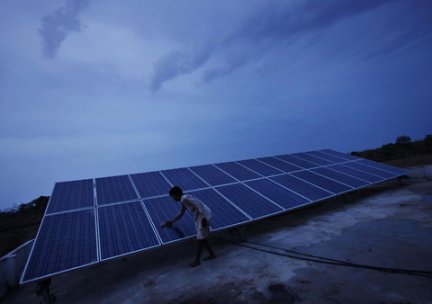
Green Blog updates us on the state of affairs in India with regard to solar energy:

After years of lagging behind China and the West in the adoption of solar power, some states in India are proposing to build solar farms at a galloping pace that leaves them at risk of falling short of electricity (a familiar problem here) or of paying higher prices for it. Continue reading

Zen, Mathematics, and the Art of Rock Relationships

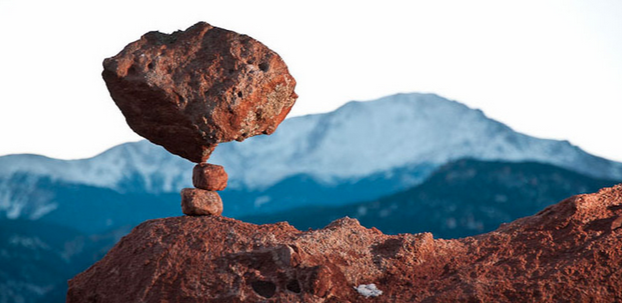
Robert Krulwich, always finding and sharing wonders we might otherwise miss, has a post on the process demonstrated in the video link below:

But how? How does he do it? First he says, you’ve got to “know the rocks.” I think this is a zen thing. Or maybe a sculptor’s thing. On his website, he says he is hyperaware of possible nooks on the rock’s surface: Continue reading

Questions Science Forces Us To Consider

Michael Specter has written on more than one occasion on topics that are of concern to any environmentally sensitive reader, but with an unexpected twist.  Not unexpected in a “denier” sense, nor in the typical skeptic‘s perspective.  A few months back he wrote a blog post on GMOs that caught our attention for its simple explanation of a piece of legislation, and then surprised us with the notion that the proponents of that legislation (including a food writer we point to frequently) might have it all wrong. Here is another:

It has been more than fifteen years since companies like Monsanto began intense efforts to export agricultural biotechnology from the United States to the fields of Europe and the United Kingdom. The battle continues to this day. Few opponents have been more militant or effective than Mark Lynas, one of the first people to break into fields that scientists had planted with genetically modified test crops—and then rip them out of the ground. Continue reading

Ecuador’s Modern Conundrum

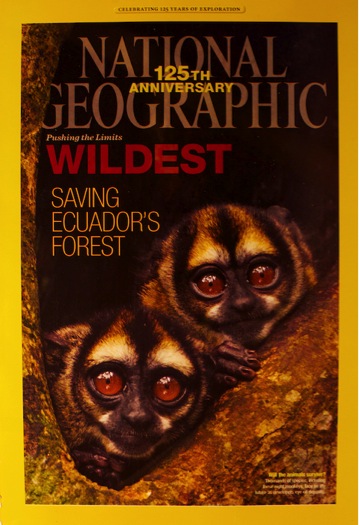
It used to be that Ecuador was in the news primarily due to the instability of its presidency.  That has changed in recent years. It is worth more than one magazine article to see what has changed in this amazing country. If you have an interest in conservation, Ecuador or both, you will appreciate this in depth coverage of both in detailed context:

The leaves are still dripping from an overnight downpour when Andrés Link slings on his day pack and heads out into the damp morning chill. It’s just after daybreak, and already the forest is alive with hoots and chatter—the deep-throated roar of a howler monkey, the hollow rat-a-tat-tat of a woodpecker, the squeal of squirrel monkeys

Continue reading

Rendering Climate Change With A Camera

This slideshow requires JavaScript.

Climate change is not only a major issue for scientists and politicians but for artists as well. Here are ten examples of photographers and other visual artists who are challenging viewers to consider the dangers of inaction by capturing the effects of extreme weather and a warming world.

Read the text to this slideshow, valuable for understanding the context, at the New Yorker website.


Voyager’s Dilemma

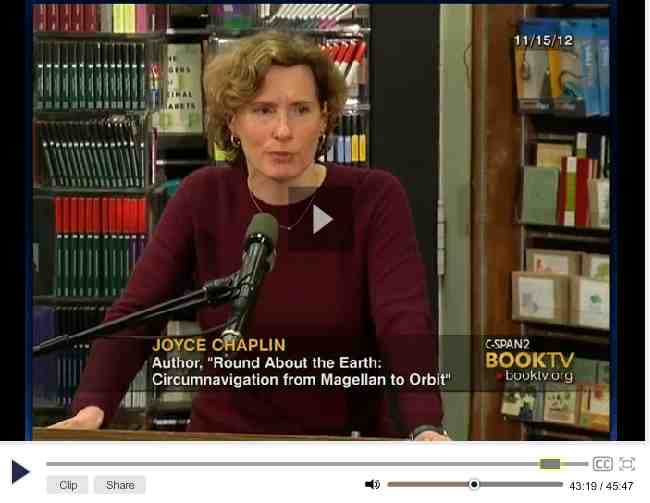
Harvard University Professor Joyce Chaplin talked about her book, Round About the Earth: Circumnavigation from Magellan to Orbit, in which she presents the history of the circumnavigation of earth, going back to the days of Portuguese explorer Ferdinand Magellan. Professor Chaplin spoke at Harvard Book Store in Cambridge, Massachusetts.

Three of our most viewed posts since starting this site in mid-2011 have to do with the intersection of travel (in all its various forms) and sustainability so when we saw this video and the related book reviews we could not help thinking it might resonate with readers who have enjoyed those three posts. One challenge for the modern voyager is an inverse of the same as that to a hospitality-providing organization such as ours going forward: how do we get there and back with the smallest footprint possible?  It is not the same question Magellan was asking but some of the “voyage issues” have not changed over the centuries.  Click the image above to go to the video, and here for a review of the book in the LA Times:

A trip on a 140-foot sailboat helped inspire Harvard professor Joyce E. Chaplin to write “Round About the Earth: Circumnavigation From Magellan to Orbit” — and that may explain the enthusiasm she brings to the many-stranded narrative. At the very least, it underlies her sympathy for sailors on small boats heading into rough, unknown seas.

This history, the first of its kind, is a lively charge through 500 years of worldwide exploration (and beyond). Chaplin sets to the task by carving that time span into three parts. Continue reading

Writer’s How

Another in our series of links meant to help each of us contributing to this site to write as well as we can:

In the morning, I don’t talk to anyone, nor do I think about certain things.

I try to stay within certain confines. I imagine this as a narrow, shadowy corridor with dim bare walls. Continue reading

What A Place, What A Pair, What A Story

01books

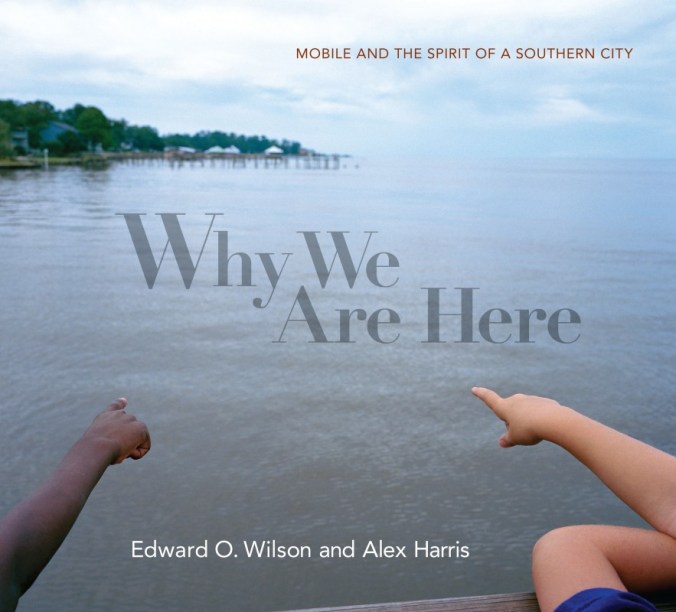
Thanks to National Public Radio in the USA for this amazing sense of people, and place and meaning (click on the image of the book above to go to the story in full) involving an evolutionary biologist we have mentioned more than once and a photographer we will start paying more attention to:

In 1991, photographer Alex Harris was nominated for a Pulitzer Prize in general nonfiction for his book River of Traps, written with William deBuys. It told the story, in words and pictures, of an old-time New Mexican villager. Harris didn’t win.

Instead, the prize went to evolutionary biologist E.O. Wilson for The Ants.

“It took me 20 years to get over that defeat,” said Harris.

Then, coincidentally, Continue reading

Writing Places

Wolfe

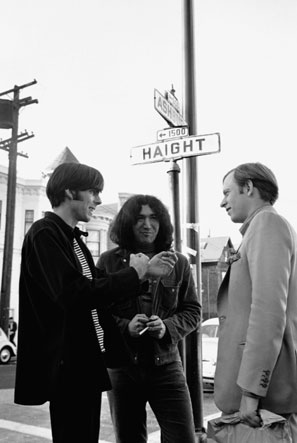
TED STRESHINSKY/CORBIS. Wolfe (right) with the Grateful Dead’s Jerry Garcia (center) and the band’s manager, Rock Scully, in 1966 San Francisco

In our quest to understand why and how great writers write greatly, we have started to pay attention to when and where they write.  This article, about one of the most influential writers of the last generation in the United States, focuses on the big picture role of place in his writing.  Click the image to go to the article:

Over the course of his career, Wolfe has devoted more pages to the Golden State than to any setting other than Gotham. In his early years, from the mid-1960s through the early 1970s, the ratio was almost one-to-one. More to the point, the core insights on which he built his career—the devolution of style to the masses, status as a replacement for social class, the “happiness explosion” in postwar America—all first came to him in California. Even books in which the  Continue reading

Sparking Activism

We have linked to 350, its various activities and sister concerns plenty of times before, but this three minute thought bubble is another good link to get the point: we all must do our part.  We link to organizations and actions instead of his name because we recognize the temptation to idolize Bill McKibben for his activism; if we do that without taking action, what is the point?

Is Telecommuting A Sustainable Solution?

Click the banner to go to the site created by Arizona State University, New America Foundation and Slate, and this particular article covering the topic of whether telecommuting is the solution it was expected to be:

The early case for telecommuting—made most prominently by Alvin Toffler in his best-sellingThe Third Wave in 1980—had a strong romantic flavor to it. For futurists like Toffler, the home office would be an “electronic cottage” that might “glue the family together again,” provide “greater community stability,” and even trigger a “renaissance among voluntary organizations.” Continue reading