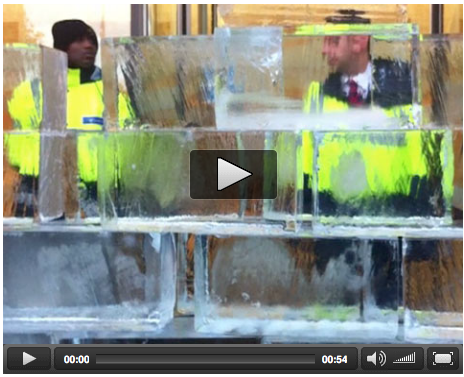
Click the image to go to the video of climate activists’ ice pyramid in London at Shell’s HQ.
Click the image to go to the video of climate activists’ ice pyramid in London at Shell’s HQ.

President Barack Obama shows students from Johnson College Prep in Chicago, Illinois, a model of Samuel Morse’s telegraph patent in the Oval Office last October. (The White House/Flickr)
We avoid politics, but call out the good, the bad and the ugly in the public sector when needed. Admittedly, too much of the latter two and not enough of the good. So hail to the geek in chief of the United States of America, who followed through on his promise in one of our favorite magazines two years ago:
When I was sworn into office, I had a chance to request objects from some of America’s finest museums to put on display in the White House. One of my requests was for patent models from the Smithsonian National Museum of American History…
What’s good? Telling your constituents you want to invest in the future through education; telling young students that innovation is the future of the economy; getting those dusty plates off the wall and celebrating the history of innovation instead. Continue reading

Photo credit: Stephen Crafts
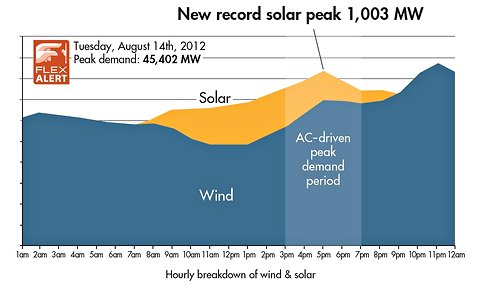
Thanks to one of our favorite informers, Felicity Barringer, whose past stories we have occasionally riffed on, for this piece in today’s Dot Earth section of the New York Times website (click the graph above to go to the source, and yes it counts as a non-subscriber article read):
From California to New Jersey, the summer sun was hot this year — and so was the solar industry. While the business of solar energy is still small enough and young enough to record firsts at the fearsome pace of a toddler, the milestones are getting more substantial. Continue reading

In a world where funding for national parks and rangers isn’t always in the budget, conservationists have to look to technologies to help protect the millions of acres that some of the world’s most threatened species make their home. The World Wildlife Fund has developed remote controlled planes that use simple enough technology to be launched by hand and be powered by rechargeable electric batteries. Click the image above to go to the story in the BBC:
Conservationists in Nepal will soon start using special drones…developed by the global wildlife organisation, WWF. Continue reading
Check out Gram Power, which we first read about here: Continue reading
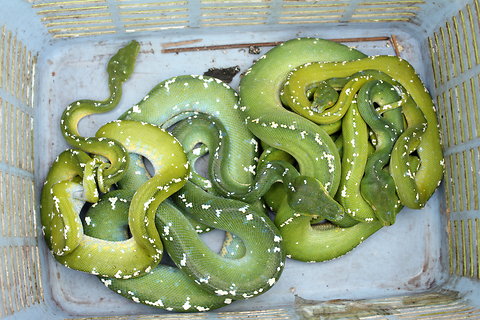
We have shared links to some amazing long form journalism on this topic, but here is a quick note of follow up. Click the image above to go to the story in the New York Times Green Blog: Continue reading
What if every artist made a love pact with something, anything, in the natural world? Mr. Goldsworthy, we noted after a recent post, had already made (to our eyes, a similar cairn included) such a pact a long time before his Australia work. Mr. Franzen, as we shall highlight as often as we can here, has made such a pact with birds. Walton Ford, in phantasmagorical manner, check. And this fellow, on the sands down under, too. More!
In other news from Russia, we return to Moscow via Other Russia. Yes, we are ignoring Mr. Putin’s adorable stunt with Siberian Cranes to return to Maxim Gorky’s legacy. No offense to Mr. Putin, of course, as we (for now) also choose to ignore news of an upcoming “Flashmob Kissing City in Gorky Park on September 23” and on that same date:
“…more than 3000 people will take part in a huge pillow fight in Gorky Central Park of Culture and Leisure! You can bring pillows from home or buy them at the place of the fight for very low prices (from 100 rubles). Except the flashmob “Pillow Fight”, the organizers will hold many interesting competitions for you while DJs will be playing their music all the time.”
That earlier news about Gorky Park reopening mentioned a museum in his honor, so we could not resist investigating. And we found an amazing collection of images (credits for all photos are embedded in the base of the images).
It is difficult to find any information about the museum, which seems not to have its own website, so desk research is limited to some travel magazines and books that cover Moscow, like this one: Continue reading
Thanks to our friends at Colossal for pointing us here:
I can’t speak from personal experience about the political climate in Yekaterinburg, Russia but if we take this video from the ad agency Voskhod at face value it appears the powers that be neglected the city’s infrastructure one day too long. Continue reading
Click the banner above for this article in which Rebecca Solnit discusses urban agriculture, aka gardening, as a revolutionary act of enormous import for our modern times:
We are in an era when gardens are front and center for hopes and dreams of a better world or just a better neighborhood, or the fertile space where the two become one. There are farm advocates and food activists, progressive farmers and gardeners, and maybe most particular to this moment, there’s a lot of urban agriculture. Continue reading

Photo credit: Stephen Crafts
Thanks to Alberto Yanosky, leader of Paraguay’s most important conservation organization, for bringing this old clip to our attention. Fitting tribute to the man in the clip who, according to INTELLIGENT LIFE magazine, September/October 2012 is celebrating an amazing milestone:
When David Attenborough joined the BBC, 60 years ago this September, Britain had only one television channel. Cameras had to be wound up like a clock and could only film live or in 20-second bursts. There was no way to capture sound and vision at the same time, or to broadcast from anywhere but the studio. Attenborough, like most people, did not own a television set; he thinks he had seen only one programme in his life. Continue reading

Click the banner to the left to go to Paul Griffiths’ review:
I have nothing to say, and I am saying it.” The line, probably John Cage’s most famous statement, appears three times over in his book Silence, which Wesleyan University Press has reissued in a smart fiftieth anniversary edition that also coincides with the centenary of the author’s birth. Continue reading
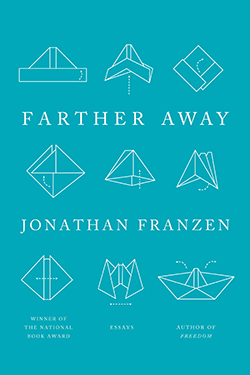 From the review in Smart Set (click to book image to go to the source) it is clear that we will enjoy this collection, whose title we had already seen in another context, from a writer we already had reason to admire for his attention to birds:
A novel is a bird. I learned this from Jonathan Franzen. It is the underlying message of his newest collection of essays, Farther Away.
Franzen became a bird watcher many years ago. He is almost apologetic about that fact, realizing that — in the opinion of most normal human beings — the birdwatcher is a slightly pathetic if otherwise harmless individual. In his commencement address at Kenyon College, “Pain Won’t Kill You,” Franzen writes: Continue reading

Click the headline above to go to the story:
On Sept. 1, 1914, the last passenger pigeon on earth died in captivity at the Cincinnati Zoo. The species, once numbering in the billions, had been hunted to extinction.
Around the same time, another iconic North American species, the bison, was also being hunted past the point of no return. But the bison didn’t die off steadily until the last one perished in an enclosure. Continue reading

Click the banner above for the press release from Stanford University’s Center for Health Policy on the results of a new meta-analysis published in the Annals of Internal Medicine:
They did not find strong evidence that organic foods are more nutritious or carry fewer health risks than conventional alternatives, though consumption of organic foods can reduce the risk of pesticide exposure. Continue reading
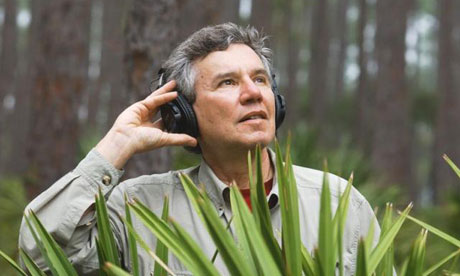
Musician and naturalist Bernie Krause has spent 40 years recording over 15,000 species in many of the world’s pristine habitats. Photograph: Courtesy of Hachette Book Group
Click his photo for the story. Never heard of him. But we have certainly heard his sounds:
Krause, whose electronic music with Paul Beaver was used on classic films like Rosemary’s Baby and Apocalypse Now, and who worked regularly with Bob Dylan, George Harrison and The Byrds, has spent 40 years recording over 15,000 species, collecting 4,500 hours of sound from many of the world’s pristine habitats.
But such is the rate of species extinction and the deterioration of pristine habitat that he estimates half these recordings are now archives, impossible to repeat because the habitats no longer exist or because they have been so compromised by human noise. His tapes are possibly the only record of the original diversity of life in these places.
Click the image below for the bigger story. Continue reading
Bravo to the good folks of Australia for their public spiritedness, and for sharing it on vimeo. Also thanks to the commenters (search on Goldsworthy and Australia and you will see there was lots of outcry on this) far and wide who shared their opinions. Like it or not, this is where we are: less and less nature, more and more people who want to do/say something about it.
Celebrations in Kerala are never focussed on the individual; they are about the land, the people and the society. The state’s most famous festival, the Harvest Festival of Onam takes place during the time when granaries overflow. In contemporary Kerala in addition to traditional customs there are exhibitions and sales across the state with music and dance events, flower shows and food festivals. These are some of the Onam festival pictures from Thekkady, which are organized by the Tourism department and Grama Panchayat (the local municipality).
 Organikos