
Photo credit: Stephen Crafts
Photo credit: Stephen Crafts
Give people options of what to look at. Members of one family will choose non-urban views most of the time (but not all of the time, as we have said more than once after visiting big cities). To each, their own. An article by Ariel Schwartz, a Senior Editor at Co.Exist, titled “The Hidden Beauty Of Suburban Sprawl” is on that magazine’s website: Continue reading
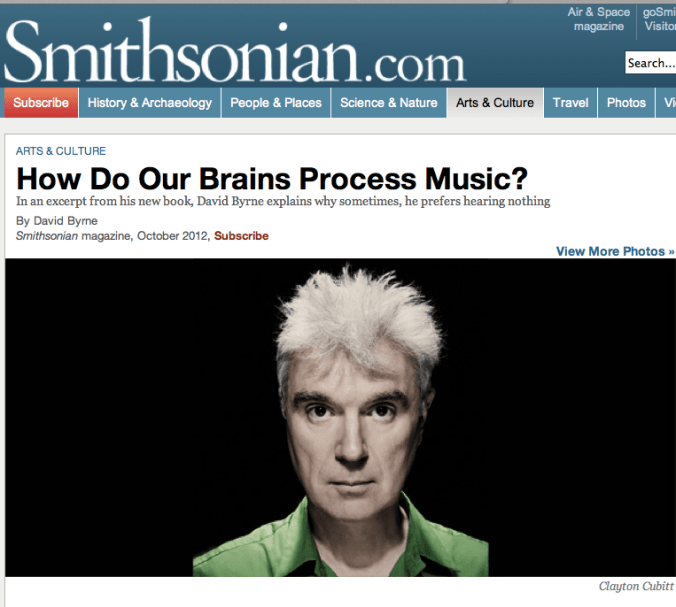
From a man who knows how to make loud noises worth listening to, the ideas (especially for those of us interested in reduction of noise pollution, click the image above to go to the full story) here are most welcome:
Music, more than many of the arts, triggers a whole host of neurons. Multiple regions of the brain fire upon hearing music: muscular, auditory, visual, linguistic. That’s why some folks who have completely lost their language abilities can still articulate a text when it is sung. Oliver Sacks wrote about a brain-damaged man who discovered that he could sing his way through his mundane daily routines, and only by doing so could he remember how to complete simple tasks like getting dressed. Melodic intonation therapy is the name for a group of therapeutic techniques that were based on this discovery.
On this site we have a commitment to, bordering on an obsession with, birds. Every day you can find at least one post featuring a bird that a member of our team (employee, intern, staff photographer, or staff photographer’s brother) or a member of our extended network of birders. Recently, we have run several posts featuring the bird-loving writer featured in this video. We will continue this thread until we run out of material. Promise.

One of the greatest photographers of people we have ever seen, Platon, has been returning home every few years to the Greek island where he grew up. These photos, even viewed merely on websites and in video, are somehow conveying mythic modesty, and are very different from his normal work: Continue reading
The IUCN released the most recent list of 100 Most Threatened Species last week. Read it and weep. Or get activated. Look at what SOS is doing and see what you can do to make a difference.
While a group of graduate and undergraduate students from Singapore, Korea, the Philippines and the USA were in Kerala generating content for the stop motion summary of their internship experience, another group of students in Lausanne were just finishing their own stop motion fun. Watch to the end to see the “making of” segment, which is just as fun as the finished product.

Photo credit: Stephen Crafts

Click the banner to the left to go to his blog site and on the image after the jump for the post in which Robert Krulwich wonders about the “Old Rice-Grains-On-The-Chessboard Con, With a New Twist”:
Once upon a time, says the science writer David Blatner, there was this con man who made chessboards for high-end clients — in this case, a king.
The craftsman was good; his chessboards were better than beautiful. The king, he knew, loved chess. So he hatched a plan to trick the king into handing over an enormous fortune. His plan? He figured, “This king is not too good at math.”
So when the craftsman presented his chessboard at court, he told the king,
“Your Highness, I don’t want money for this. Or jewels. All I want is a little rice.”
From the innovators who get paid to think outside the normal boundaries, and who brought us the disposable cup above, the website explains what they do in general and what they did in this case:
Sardi Innovation is an Outsourcing Business Innovation Center.
Cookie Cup, “Sip the cofee then eat the cup” The cookie cup is made of pastry that is covered with a special icing sugar that works as an insulator making the cup waterproof and sweetening at the same time.
Cookie Cup [has collected] very important Awards in Ecology, Marketing, Business Strategy and Design sectors.

From The Guardian’s website, in the Environment section, a bit of videography that puts the James Bond-type action films, which after all are merely entertainment without any deeper purpose, to a bit of shame:
Behind the scenes of Greenpeace’s Arctic oil protest Continue reading
Another session of Michael Pollan‘s course at UC Berkeley brings us back to the colorful, and colorfully clad, storyteller Peter Sellars, alluded to nearly one year ago. Intensely bracing. Give it the full 90 minutes it deserves (halfway through he begins making references to pre-vedic texts in India about food’s sacred role in life, and the importance of sharing it; at minute 56 he begins a very interesting discussion of Coca Cola in Kerala, and thereafter many references to wonderful phenomena in south India).
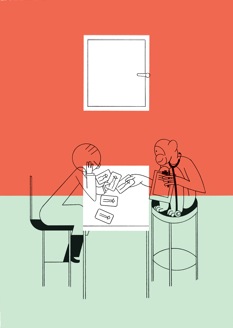
From last week’s New Yorker, a book review about the challenge to the dominant strain of science related to how mental traits evolved, saying it makes no practical difference. This is the stuff science is made of, starting with stories:
When Rudyard Kipling first published his fables about how the camel got his hump and the rhinoceros his wrinkly folds of skin, he explained that they would lull his daughter to sleep only if they were always told “just so,” with no new variations. The “Just So Stories” have become a byword for seductively simple myths, though one of Kipling’s turns out to be half true. Continue reading
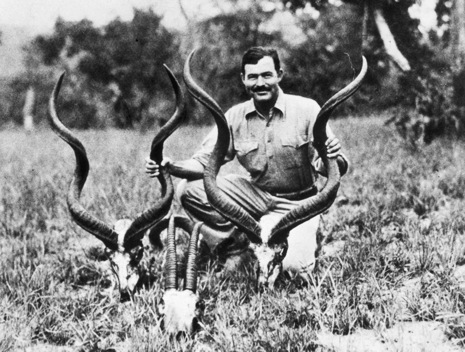
1937: American writer Ernest Hemingway (1899 – 1961) kneels while holding a pair of antelope horns during a safari, Africa. (Photo by Hulton Archive/Getty Images)
From The New Yorker‘s Page Turner series we highlight the last paragraph of a short comment by writer Brad Leithauser (click the image above to go to the source):
At his best, Hemingway creates a terrain where he is no longer breaking any rules of grammar or codes of good writing. In this particular territory, the codes no longer apply. After all his travels, he has taken the ultimate step and fabricated his own landscape, and those who come to inhabit it are his followers, abiding by his rules. They are legion. Turn any which way. Welcome to Hemingway country.
Thanks to The Edible Schoolyard Project and UC Berkeley, Michael Pollan‘s course about the challenges and opportunities of our food system is offered for all of us to share in. Course Description:
As the costs of our industrialized food system—to the environment, public health, farmers and food workers, and to our social life—become impossible to ignore, a national debate over the future of food and farming has begun. Telling stories about where food comes from, how it is produced—and how it might be produced differently—plays a critical role in bringing attention to the issue and shifting politics. Each week, a prominent figure in the debate explores: What can be done to make the food system healthier, more equitable, more sustainable? What is the role of storytelling in the process?
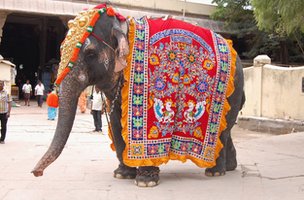
Cuisine and wellness, topics we think about mainly in the context of resort operations in India, also have a role to play in the life of a particular group of elephants, as this BBC story (click the image to go to the source) illustrates:
In parts of India, elephants are kept in temples for religious reasons – taking part in ceremonies and festivals.
Efforts are on in the South Indian state of Tamil Nadu to get these over-pampered tusked animals to slim down, officials have told the BBC. Continue reading

Photo by Lauren E. Oakes: Basil, tomatoes, and glass floats from the outer coast at a home in Gustavus, Alaska
An excellent recent post in Green Blog (click the image above to go to the source) begins:
Basking in a surprise dose of early morning sun, we sat together on a bench made from yellow-cedar at the Gustavus Forelands Preserve, a landscape of spruce and cottonwood forests and beaches overlooking the Icy Strait waters. We were staring at a diagram on a piece of paper I had handed to Hank Lentfer, a lifelong Alaskan and longtime resident of the tiny town of Gustavus. Continue reading

Photo credit: Stephen Crafts

An offshore wind turbine, part of the London Array wind farm site, located in the outer Thames Estuary, about 70 miles east of London. Image: phault via flickr
An article in Inside Science (click the image above to go to the article) discusses new research demonstrating that wind power might be able to generate all the world’s electricity needs without large atmospheric effects:
There is enough energy for people to reap from the wind to meet all of the world’s power demands without radically altering the planet’s climate, according to two independent teams of scientists.
Wind power is often touted as environmentally friendly, generating no pollutants. It is an increasingly popular source of renewable energy, with the United States aiming to produce 20 percent of its electricity by wind power by 2030. Still, there have been questions as to how much energy wind power can supply the world, and how green it actually is, given how it pulls energy from the atmosphere. Continue reading
This isn’t the first time we’ve applauded local libraries taking a stand to protect their place in public service. But the particular example above is prime in terms collective action lassoing social media. Kudos to Leo Burnett/Arc Worldwide agency for campaigning the hoax, and hurray for yet another library with the backbone to publicly roar.
Troy Public Library would close for good unless voters approved a tax increase. With little money, six weeks until the election, facing a well organized anti-tax group who’d managed to get two previous library-saving tax increases to fail, we had to be bold. We posed as a clandestine group who urged people to vote to close the library so they could have a book burning party. Public outcry over the idea drowned out the anti-tax opposition and created a ground-swell of support for the library, which won by a landslide.

 Organikos