Author: Organikos
Laughter Yoga!
Aquaserenity
Continue Here
A Reassuring Fable
Occupy Language!
 The collection of thoughts, links, images, etc here is meant to bring attention to ideas and actions for a challenged and challenging world. Written and spoken language, to say the least, have been important tools to this end for some time. The language we use on this site, by default, is a function of those of us who banded together on a given day at a given time to do this jig. Other languages, the cultural patrimony sometimes referred to as intangible, are hopefully strengthened, rather than weakened by this effort.
This fellow makes some very important points about the English language. We have not read his book, but from his excerpted thoughts there is good cause to read more reviews and add it to the maybe list. Meanwhile, we make our cultural case (another reason, beyond skiiing, to put Kashmir on your map?) to keep languages alive, perhaps especially of those not included on the most-alive list:
There are anywhere from 350 to 500 million native English speakers, and up to 1 billion more who use it as a second or additional language to some extent. That’s 20% of the world’s 6.9 billion people. There are close to 7,000 languages spoken around the world today, but according to Ethnologue, 39% of the Earth’s people speak one of eight brand-name languages: Chinese, Spanish, English, Arabic, Hindi, Bengali, Portuguese, and Russian (Japanese is number 9). Of these, only English can claim global dominance.
Life Looks For Life
Putting Kashmir On The Map
Guest Author: CJ Fonzi
I recently received this link from a Facebook friend. One of those Facebook friends that you meet on an adventure somewhere, instantly bond with, keep in touch with forever. This particular guy is an oil engineer from Norway- an unlikely friend of a sustainable business consultant in New York City. But that is what travel and exploration are all about.
Kashmir- the name brings images of war, struggle, and International politics. But to those of us who have been there the images that come to mind are more like the ones shown here.
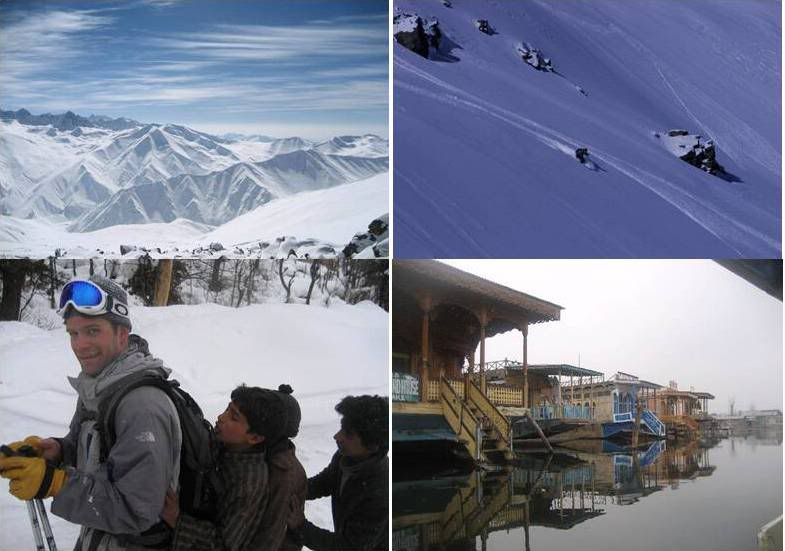
The village is called Gulmarg and it hands down has the best skiing in the world. Continue reading
Wordsmithing: Conservation
In a nod to recent posts on this site about new entrepreneurial conservation initiatives, some etymology to complement the OED‘s first entry in the definition of this noun:
The preservation of life, health, perfection, etc.; (also) preservation from destructive influences, natural decay, or waste…The preservation, protection, or restoration of the natural environment and of wildlife; the practice of seeking to prevent the wasteful use of a resource in order to ensure its continuing availability
No surprises there. A rather nice surprise, considering the world we live in today, is that most of the references, going back to 1398 and with a long line of ever-strengthening suggestions, point to a divine origin and in more recent centuries a responsibility of man to the divine, to engage in conservation.
Start Your Day Here
Refresher
4-Minute Symphony
New Energy From The Amazon
Guest Author: Tyler Gage
Crist asked if I would share some of our experience starting up Runa because, as a social enterprise, we are working in some of the same space–environmental and social responsibility being centerpieces of our business model–as other businesses that Raxa Collective showcases on this site. We agreed that a good place to start would be with some questions we encounter frequently. If there is interest in hearing more, I will be back to tell more of the story in finer detail.
Your website says Runa does not actually farm Guayusa. What do you do and why should people care about Guayusa?
Runa is creating markets for beverages created with Guayusa (“gwhy-you-sa), a native Amazonian tree leaf that contains more caffeine and double the antioxidants of any tea. With a flavor that is smooth and clean, guayusa offers a new kind of energy what the indigenous Kichwa people call “mental strength and courage”. Continue reading
Wordsmithing: Spa
When it is capitalized, this word refers to the mineral springs in Liège, Belgium, believed to have curative properties. In the last several centuries the meaning of the word has been generalized to refer to almost any place that has curative mineral waters, according to OED, so that “a town, locality, or resort possessing a mineral spring or springs; a watering-place of this kind” is fairly known as a spa.
The generalization has expanded further in recent decades through commercialization, and as always OED’s tracking of the etymology is intriguing:
A commercial establishment which offers health and beauty treatment (esp. for women) through steam baths, exercise equipment, massage, and the like. U.S.
1960 Life 8 Feb. 111/1 The submerged specter above‥is getting a hydraulic underwater massage at a plush health spa near San Diego called the Golden Gate beauty resort whose customers are usually female.1976 Vogue Dec. 214/1 Most American spas are designed exclusively for women.1981 W. Safire in N.Y. Times Mag. 21 June 10/2 Only fuddy-duddies go to the gym,‥the upscale‥crowd goes to the spa.
Breaking News! Prices of Old Newspapers Soar!
Guest Author: Diwia Thomas
While asking around for newspaper donations, I often meet with reluctance and wondered why? Ten years ago a kilo of old newspaper fetched only a meagre Rs 3/- , today the raddi-wala (the guy down the road who buys scrap) pays an enticing and irresistible Rs 7/- per kg. I promptly made a trip down there to broker a deal with him for a steady supply of newspaper for our paper bags. He tells me that newsprint companies in India have begun to recycle old newspaper into newsprint. In the past newspaper was recycled into boards or brown coloured paper for packaging and boxes because recycled newsprint turns a dull greyish colour unsuitable for printing. Indian newspaper companies have found ways to deink newsprint pulp and retain its brightness for printing purposes. Mammoth deinking machines do this job. Featured here is a small one, just to demonstrate the process. Continue reading
Sticky Sonics
Science Notes
Autumn’s Edible Rose
Wordsmithing: Dictionary Attack!
Another December 2010 addition to the OED brings to mind a phrase in our lexicon describing large books as “heavy enough to stun an ox”.
dictionary attack n.
While it is perhaps a matter for regret that the quotation paragraph for this term does not catalogue incidents of physical harm meted out by wielders of dictionaries—the 20 volumes of OED2, in particular, could cause someone considerable damage—it does provide an insight into one aspect of a very 21st-century preoccupation, the security of the information held on computer systems. Here the “dictionary” in question is nothing more than a word list held electronically, and although the attack for which it is used is unlikely to cause physical harm, the virtual damage might be very high indeed: if a dictionary attack is successful and an automated program correctly matches a password, the files on a computer network or system are at the mercy of the initiator of the attack.
Hold on to your words!
Modern India, Bootstrapping
 It may have seemed implied in the previous post that looking backwards is the only amazement India offers. Not so. To outsiders and locals alike, in India sometimes the Shock of the New is the only path forward. This week in The New Yorker there is an article (click on the image to the left to read the abstract, but either full subscription or pay-per-article is required for the full text) about one of India’s many new billionaires, and his private sector approach to a moonshot.
We could distinguish his approach from the entrepreneurial bootstrapping initiatives we highlight on this sight in a few obvious ways (ok, a few billion obvious ways), but why bother? We need only say we like it. And in a place with thousands of years of experience making things work against all odds, we can also say we have hope. Even optimism.
 Organikos