Mystical India, In Practical Terms

There have already been plenty of posts on this site that give the perspective of non-Indians living in or visiting India.  Here is another good example of an Indian describing a local feature of life that, to the non-Indian, is more of a phenomenon.  And so the style of delivery, while quite different from that of this man, is equally intriguing (fair warning: the accent is stronger here, but you can train your ear to understand)–both men talking about old stuff, rather genially and humbly, but clearly aware that they are sharing with the world something of value that might have been overlooked because it has been hiding in plain sight for so long.

The style of delivery, in fact, is as interesting as the content itself, if you are a non-Indian trying to figure out what makes the place called India so worthy of attention.  It is not what Robert Hughes called the Shock of the New, translated from art to service or organization; it is another example of the Shock of the Old.  And the style of delivery reinforces just that.

The joking self-effacement–no Silicon Valley-type innovation or technology, but we get by in our own way–belies an organizational philosophy made tangible that would be the envy of many organizations around the world.

Wordsmithing: Biophilia

Our usual thanks to OED, but a special one too this time.  One of the words we have been working into our sentences in recent years is this word that had two primary definitions different from the one we associated with one of our favorite biologists.  Now they have added a third definition, thanks to E.O. Wilson and everyone who follows his ideas and words, and repeats them:

3. A love of or empathy with the natural world, esp. when seen as a human instinct.


Jad!

You knew he deserved it, but never thought about it, did you?  Sounds like a question for Radio Lab.  If you agree with us on comfort food, you might agree that Jad has something in common with those oreos, mostly in that he helps us adjust to wherever we find ourselves, but also when introducing us to new words such as defenestration (about 26 minutes into the segment in this link). For those who feel as strongly about Robert Krulwich as they do about Jad–what a team–you know that the Radio Lab partner is beaming with pride, don’t you?  One word; good.

Cool-Schooling

If you are a parent, and ever had a challenge related to your child(ren)’s school (what is the opposite of an oxymoron? this must be an example of it, but where is George Carlin when you need him?), you will likely want to read Clifford Levy’s moving description (alert: if you are not a subscriber to The New York Times this link will count as one of your free sample views) of enrolling his three kids from Brooklyn in a Moscow school a few years back.

If you are anyone who ever had your own momentary thoughts about being too cool for school (again the opposite of an oxymoron: who hasn’t?  is it called a tautology?  or just plain old redundant?), you will definitely want to read at least one snippet about the founder of the school in Moscow that Levy is describing:

…Bogin added courses like antimanipulation, which was intended to give children tools to decipher commercial or political messages. He taught a required class called myshleniye, which means “thinking,” as in critical thinking.

That is the school everyone could use a bit of: the one that enlightens, that empowers its students to become too cool to be fooled.

Hello To The Galapagos

A pleasure to read this post from the Islands that Reyna has written about, especially that it is from someone celebrating their honeymoon; super-especially when they take great photos, write well, and share them with everyone.

Columbian Exchange & Bananas Ca. 2011

The book mentioned in this previous post is proving difficult to stop thinking about.  The historical clarifications are part of it in a purely fascinating way (no domesticated animals in the pre-Columbian New World, really?); better understanding of phenomenal events such as the potato blight of 150+ years ago, and kudzu in the present day southeastern USA, are equally illuminating, if more alarming.  For anyone who has lived in the old or new tropics, this naturally leads to thinking about bananas, and then the clicking starts.  And if you are lucky you end up somewhere like this (click on the image above): Continue reading

Wordsmithing: Possibilian

Breaking with the tradition established several Wednesdays ago, we will not adhere strictly to the OED definition for the word we want to consider today.  We could not, even if we wanted to, because according to OED it does not yet exist.  A close cousin does, and it is worth noting that possibilism (which neither MS Word’s spell-checker, nor WordPress’s, recognize as legitimate) has a meaning somewhat close to what we want to highlight.  The second sense of that word, anyhow, does:

2. Geogr. The belief that human freedom of action is not limited by the natural world.

A possibilian may be a person who does not let the natural world get in the way of doing things.  But it is actually much more interesting than that.  When you have twenty minutes set aside for some intrigue and inspiration, take a look at this for a fuller understanding of the word (from the smith who coined it):

Happy Go Lucky

Aesop’s fables are full of opportunities for the modern reader, re-teller, or listener to imagine different interpretations.  Thanks to the efforts of these folks we can easily access those fables and make what we will of them.  A favorite of ours, for its versatility, is this one:

One fine day in winter some Ants were busy drying their store of corn, which had got rather damp during a long spell of rain. Presently up came a Grasshopper and begged them to spare her a few grains, “For,” she said, “I’m simply starving.” The Ants stopped work for a moment, though this was against their principles. “May we ask,” said they, “what you were doing with yourself all last summer? Why didn’t you collect a store of food for the winter?”

“The fact is,” replied the Grasshopper, “I was so busy singing that I hadn’t the time.”  “If you spent the summer singing,” replied the Ants, “you can’t do better than spend the winter dancing.” And they chuckled and went on with their work.

Continue reading

The Best Is Yet To Come

Writing about that game, among other things, in this post (that breaks new media ground as a review in one magazine’s website of another magazine’s special edition on sports heroes), Giles Harvey reflects:

…he ends up missing—it’s the greatest goal never scored—but that hardly matters. If anything, the fact that he misses seems to intensify the aesthetic quality of the move. (As though Pelé were interested in something as utilitarian as scoring goals!)

The moment seemed to me to represent a summit not just of sporting prowess but of human civilization itself. Watching it, I felt what might be described as species pride: look what we’re able to do! Continue reading

Beta-Think Is Better

Jeff Jarvis has this to say in a post combining the topics Beta-Think and End Malaria Day:

The modern cure to Voltaire’s paradox [“Le mieux est l’ennemi du bien,” or “the best is the enemy of the good”]—and a gift of the digital age—is the beta: the unfinished and imperfect product or process that is opened up so customers can offer advice and improvements.

Those of us who have worked in bricks and mortar environments, especially hospitality businesses, might wonder: did he never hear of a “soft opening” before?  Those have been around since long before the digital age.  But he likely means, and we agree, that digital and especially social media facilitate more effective soft openings of all kinds, everywhere.

Go Grinnell!

The inauguration of Grinnell College’s 13th president Raynard S. Kington, M.D., Ph.D in 2011 marked a transition point for the college. The prize commemorates the occasion and celebrates Grinnell’s historic and future commitment to positive social change.

Borneo On Our Mind

If you enjoyed Nicole’s post, you will definitely want to watch this.  We had the opportunity to exchange emails with Willie and can affirm what you will see at 1:11 (one minute and eleven seconds) into this TED talk: being an activist for a cause you care about can be frustrating and challenging enough that applause is not a motivator.  He is already recognized by enough famous organizations that our two cents will seem a pittance, but we consider him a hero of entrepreneurial conservation, so must say: thank you Willie!

If you feel the same way after watching this video, say so by visiting this website and then this one.  Especially this latter link should give you some ideas about how to get involved and make a difference.

Borneoculars: Observations from a Scientific Expedition in Borneo

Guest Author: Nicole Kravec

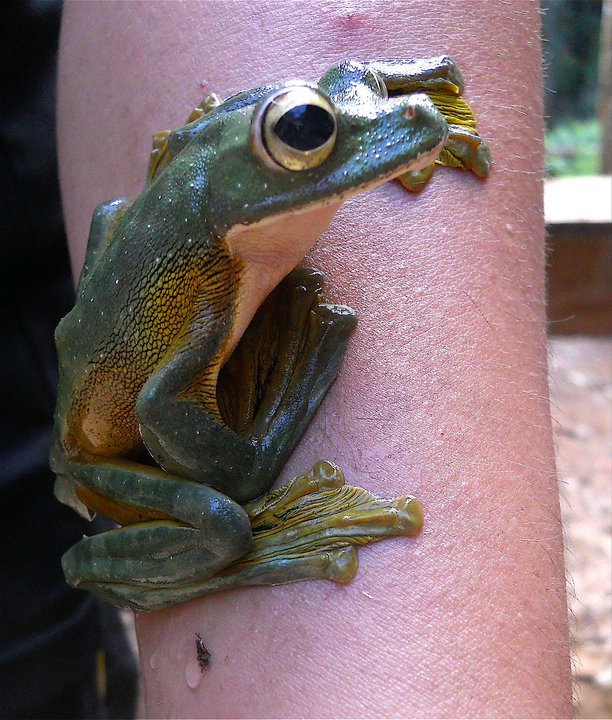
Indiana Jones would be proud of the entire scientific expedition team.  For two weeks we trekked through the jungles of Malaysia’s Imbak Canyon, the “biological gene bank” in the heart of the Malaysian state of Sabah in northern Borneo.  It was one of the best – and most adventurous – trips of my life.

Continue reading