Recipe From Another Time

10-02_cookbooks_kw_custom-7590cdc484b3905fc6f8b4d410b078f30cf1598a-s800-c85.jpg

The Yale Babylonian Collection houses four unique tablets that contain various recipes for stews, soups and pies. Three of these tablets date back to the Old Babylonian period, no later than 1730 B.C. Klaus Wagensonner/Yale Babylonian Collection

A meal from ancient history, decoded, and the scholar who sleuthed the recipe discusses it in a brief interview:

Eat Like The Ancient Babylonians: Researchers Cook Up Nearly 4,000-Year-Old Recipes

What did a meal taste like nearly 4,000 years ago in ancient Babylonia? Pretty good, according to a team of international scholars who have deciphered and are re-creating what are considered to be the world’s oldest-known culinary recipes.

The recipes were inscribed on ancient Babylonian tablets that researchers have known about since early in the 20th century but that were not properly translated until the end of the century.

The tablets are part of the Yale Babylonian Collection at the Yale Peabody Museum. Three of the tablets date back to the Old Babylonian period, no later than 1730 B.C., according to Harvard University Assyriologist and cuneiform scholar Gojko Barjamovic, who put together the interdisciplinary team that is reviving these ancient recipes in the kitchen. A fourth tablet was produced about 1,000 years later. All four tablets are from the Mesopotamian region, in what is today Turkey, Syria, Iran and Iraq. Continue reading

Beware The Cryptocurrency Footprint

191113092600_1_540x360.jpg

Computer screen listing cryptocurrencies (stock image). Credit: © Colin Cramm / Adobe Stock

Thanks to Science Daily for this summary of Environmental cost of cryptocurrency mines – Monetary price of health and air quality impacts:

Bitcoin, Ethereum, Litecoin and Monero — the names of digital-based ‘cryptocurrencies’ are being heard more and more frequently. But despite having no physical representation, could these new methods of exchange actually be negatively impacting our planet? It’s a question being asked by researchers at The University of New Mexico, who are investigating the environmental impacts of mining cryptocurrencies.

“What is most striking about this research is that it shows that the health and environmental costs of cryptocurrency mining are substantial; larger perhaps than most people realized,” said Benjamin Jones, UNM Researcher and asst. professor of economics. Continue reading

Crowd-Sourced Data from the Deep

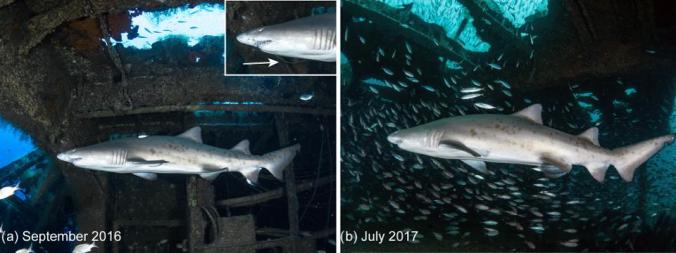
Female sand tiger shark observed on the wreck Aeolus in (a) September 2016 and (b) 10 months later in July 2017. In the older photograph (a), fishing gear is visible in the mouth of the shark (inset). SPOT A SHARK USA BY TANYA HOUPPERMANS.

A great example of how data crowd-sourced from Citizen Scientists is helping to improve understanding of shark populations and behavior.

Female Sand Tiger Sharks Love Shipwrecks… Really.

Site fidelity – the tendency to return to a particular area – isn’t exactly new in a species of shark (e.g. reef sharkslemon sharks, even great white sharks). But that place is usually some sort of habitat… not a over 100-feet (34 meter) deep shipwreck. However, that is exactly the case for female sand tiger sharks (Carcharias taurus) off the coast of North Carolina!

Sand tiger sharks, also known as grey nurse sharks or spotted ragged-tooth sharks, are found globally in subtropical and temperate waters. Despite looking quite scary due to their tooth grins that never quite close, they are a slow-moving shark that are listed as Vulnerable by the International Union for Conservation of Nature (IUCN). A grey colored shark with reddish-brown spots throughout its body, they feast on a variety of animals such as a fish, crustaceans, squid, skates and even other sharks!

In September 2016, a citizen scientist wasn’t surprised to see an individual female sand tiger shark while scuba diving on the Aeolus shipwreck. Continue reading

Really, E.P.A.?

00CLI-EPA1-jumbo.jpg

Matthew Brown/Associated Press

Of all the knuckle-headed ideas, this headline says knuckle louder than most:

E.P.A. to Limit Science Used to Write Public Health Rules

WASHINGTON — The Trump administration is preparing to significantly limit the scientific and medical research that the government can use to determine public health regulations, overriding protests from scientists and physicians who say the new rule would undermine the scientific underpinnings of government policymaking.

A new draft of the Environmental Protection Agency proposal, titled Strengthening Transparency in Regulatory Science, would require that scientists disclose all of their raw data, including confidential medical records, before the agency could consider an academic study’s conclusions. E.P.A. officials called the plan a step toward transparency and said the disclosure of raw data would allow conclusions to be verified independently. Continue reading

Big Cats Of The South, Present & Future

960.jpg

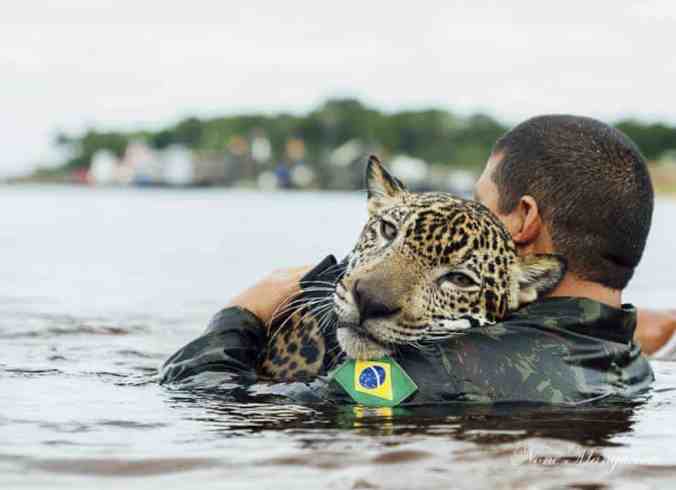
 A Brazilian soldier swims in the Negro river holding Jiquitaia, a two-year-old jaguar that was adopted by the military command of the Amazon. Jiquitaia was rescued as a cub after hunters killed his mother. Photograph: None Mangueira/AP

5472 (3).jpg

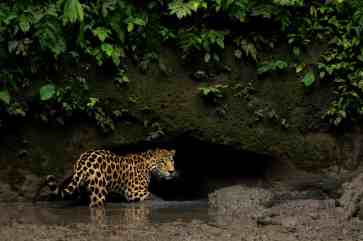
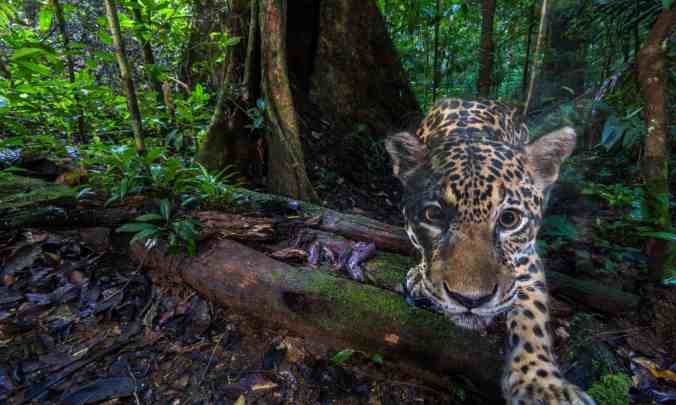
A jaguar in the Yasuni national park, Orellana, Ecuador. Photograph: Lucas Bustamante/NPL

Ecuador is mentioned in the title but is not the only country where deforestation is putting at risk the survival of one of the big predator species in the hemisphere. Thanks to Kimberley Brown, writing in the Guardian, for her reporting from our neighborhood to the south on one of the animals we have featured the most in our pages over the years:

Ecuador’s vanishing jaguars: the big cat vital to rainforest survival

Industries such as coffee and cacao have devastated the jaguar’s habitat, but its dwindling numbers leave a delicate ecosystem hanging in the balance

5184 (3).jpg

Jaguars are found across South America. This one was photographed deep inside the Nouragues Natural Reserve, in French Guiana. Photograph: Emmanuel Rondeau/WWF France

Across the American continent, from the north of Mexico to Argentina, the jaguar has long been revered for its strength and power. But in some parts of Ecuador, the largest cat in South America is increasingly at risk as roads, mining and agriculture take over the rainforests.

The loss of habitat is the biggest threat to jaguars in Ecuador, particularly along the coast, where more than 70% of the original forest cover has been lost. The vast majority of this destruction has taken place over the last 50 years with the expansion of the logging and agriculture industries, including coffee, cacao, palm oil and bananas, one of the country’s largest agriculture exports. Continue reading

Botanists Sleuthing, For Science & Conservation

00SCI-WAXPALMS1-jumbo.jpg

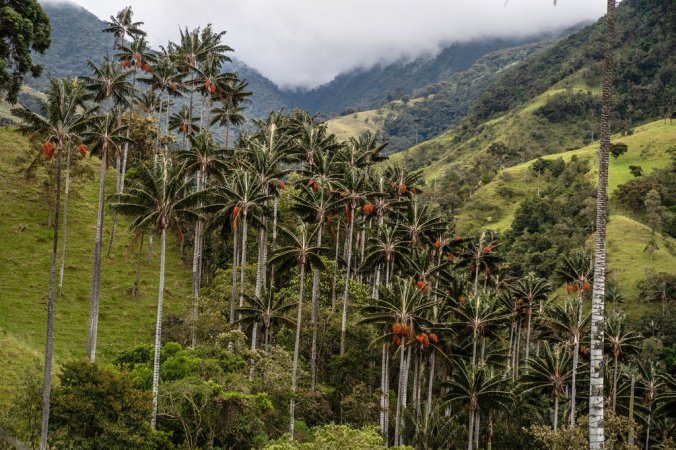
Quindío wax palms cover the hillsides of Colombia’s Tochecito River Basin. Before sequoias were discovered in California, the wax palm was considered the world’s tallest tree, with some growing 200 feet high.

The botanists who do this kind of work are heroes to us:

Stalking the Endangered Wax Palm

Colombia’s national tree, the wax palm, is endangered. Now, with decades of guerrilla war in retreat, scientists are rediscovering vast forests and racing to study and protect them.

By Photographs and Video by 

In 1991 Rodrigo Bernal, a botanist who specializes in palms, was driving into the Tochecito River Basin, a secluded mountain canyon in central Colombia, when he was seized by a sense of foreboding. Continue reading

Mr. Trash Wheel Is Going Strong

Kormann-MrTrashWheel.jpg

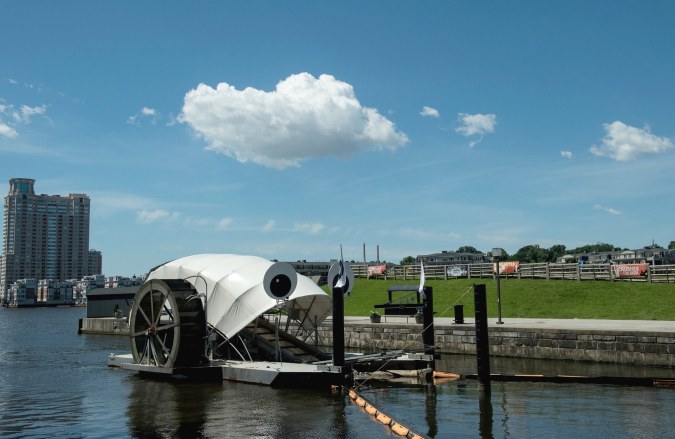
Since 2014, Mr. Trash Wheel has collected approximately twelve hundred and thirty-three tons of trash and debris that otherwise would have flowed into Baltimore’s Inner Harbor. Photograph by Nicholas Kamm / AFP / Getty

Thanks to a writer who never disappoints for this update to an inspiring story we lost track of:

The Promise of Mr. Trash Wheel

By Carolyn Kormann

John Kellett, the former director of Baltimore’s Maritime Museum, used to cross a footbridge over Jones Falls, the largest tributary feeding into Baltimore’s Inner Harbor, every day on his way to work. “When it rained, there was a river of trash flowing down,” he told me. He had spent twenty years working on the harbor, primarily in environmental education and shipbuilding, and had a deep knowledge of its hydrodynamics and history. City officials, he told me, “said they were open to ideas, so I started sketching.” He drew plans for a machine powered by an old-fashioned water wheel—a technology that had once been a staple throughout the city—designed to intercept trash at the mouth of Jones Falls, which is the main source of harbor pollution. A prototype was installed in 2008. By 2014, Kellett’s invention was reborn as Mr. Trash Wheel—a fifty-foot-long machine, weighing nearly a hundred thousand pounds, that resembles a friendly mollusk, with giant, googly eyes and its own Twitter account.

Five years later, Mr. Trash Wheel has spawned three replicas around Baltimore—Professor Trash Wheel, Captain Trash Wheel, and another that was announced last week but has yet to be named or installed in the water. Continue reading

Bioacoustics & Conservation

AcousticMonitor_web

The AudioMoth recording device in New Forest National Park, in the U.K., where it is searching for sounds of the New Forest cicada. COURTESY OF ALEX ROGERS

Yale e360 shares more on the value of new recording technology as it relates to conservation:

Listening to Nature: The Emerging Field of Bioacoustics

Researchers are increasingly placing microphones in forests and other ecosystems to monitor birds, insects, frogs, and other animals. As the technology advances and becomes less costly, proponents argue, bioacoustics is poised to become an important remote-sensing tool for conservation.

Mitch Aide, a tropical ecologist based in Puerto Rico, thinks we should listen to the earth a lot more than we do now — and not just listen to it, but record and store its sounds on a massive scale. His aims are not spiritual, but scientific: He, his colleagues, and other experts are developing and deploying audio recorders, data transmission systems, and new artificial intelligence software that together are rapidly expanding scientists’ ability to understand ecosystems by listening to them.

BioAcous1.jpg

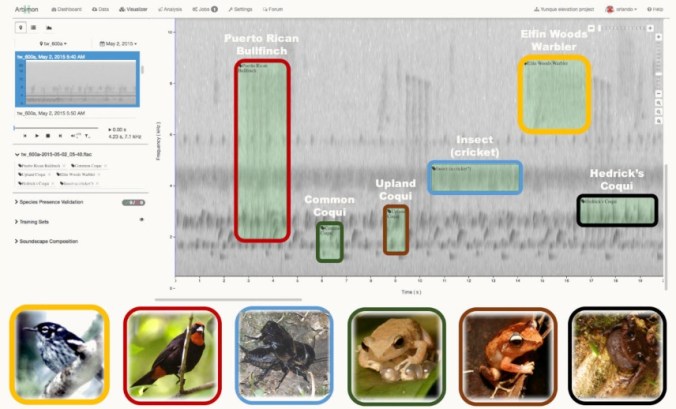
A 20-second spectrogram, showing various audio frequencies, from Puerto Rico includes the calls of these six species. COURTESY OF SIEVE ANALYTICS

Today, Aide can nail a cheap digital audio recorder to a tree in Puerto Rico’s Luquillo Forest and transmit its recordings to a computer running prototype software, which indicates almost in real time whether any of 25 species of frogs and birds are vocalizing in the forest. The system’s apparent simplicity belies its power – Aide thinks that it and similar systems will allow scientists to monitor ecosystems in ways we can’t yet imagine.

shutterstock_1411303766_birdsinging_web

A golden-browed chlorophonia (Chlorophonia callophrys) in Costa Rica. SHUTTERSTOCK

He dreams that one day soon, audio recordings of natural soundscapes will be like rainfall and temperature data, collected from a worldwide network of permanent stations, widely available for analysis, and permanently archived. Each clip will be “like a museum specimen,” he said, “but containing many species.” Aide says scientists will be able to efficiently determine how species are moving or changing in response to global warming, habitat destruction, or human disturbance, and chart population shifts over large areas. Continue reading

Charisma Catalyzes

OwlinBag-720x609

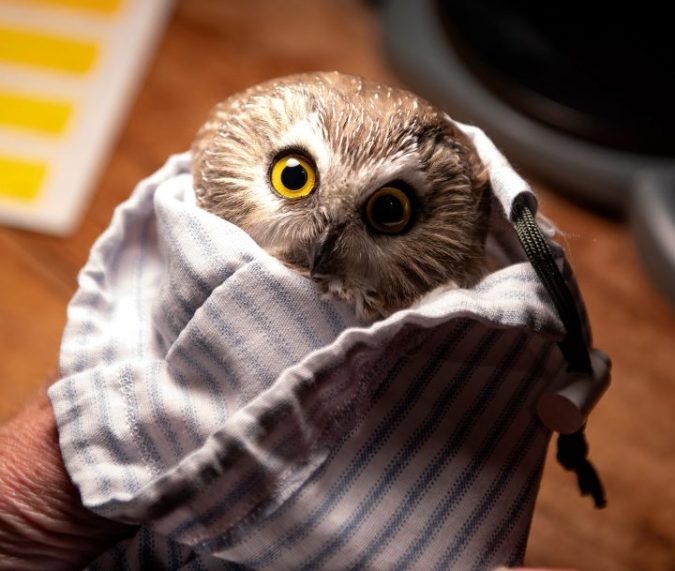
A saw-whet is ready for a quick exam when researchers will collect data and affix an identifying leg band.

No one is immune to the charisma of small owls, as far as we know. And that charisma would explain how the volunteers working to band this bird got catalyzed. Thanks to the Lab of Ornithology and this article from the current issue of Living Bird magazine:

A Grassroots Banding Project Reveals How Amazing Northern Saw-whet Owls Are

Story By Scott Weidensaul; Photography By Chris Linder

Owl1There is something wonderful about an autumn night; the sharp bite to the air, the rustle of a north wind in the last leaves clinging to the tops of the oaks, Orion shining in a moonless sky over the central Appalachian ridges of Pennsylvania—and echoing over it all, a repetitive, me­chanical beep that reminds most people of the warning alarm when a garbage truck is backing up. Continue reading

Really, Nestle?

5184n.jpg

A proposal for Nestlé to build a water bottling plant in Cascade Locks, Oregon, was one of the most heated battles in the state in its 2016 primary. Photograph: Don Ryan/AP

The fight to stop Nestlé from taking America’s water to sell in plastic bottles

Creek beds are bone dry and once-gushing springs are reduced to trickles as fights play out around the nation over control of nation’s freshwater supply

5249.jpg

The Forest Service recently determined Nestlé’s activities left California’s Strawberry Creek ‘impaired’ while ‘the current water extraction is drying up surface water resources’. Photograph: Nick Todd/Alamy

We are as tired of these stories, and the fights they require, as you may be. Nonetheless, here is a fight we can get behind. Nestlé, once again, back off. Thanks to Tom Perkins and the Guardian:

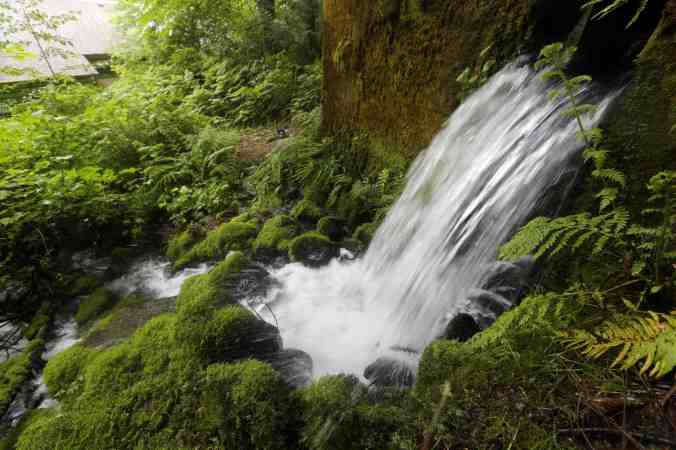
The network of clear streams comprising California’s Strawberry Creek run down the side of a steep, rocky mountain in a national forest two hours east of Los Angeles. Last year Nestlé siphoned 45m gallons of pristine spring water from the creek and bottled it under the Arrowhead Water label.

Though it’s on federal land, the Swiss bottled water giant paid the US Forest Service and state practically nothing, and it profited handsomely: Nestlé Waters’ 2018 worldwide sales exceeded $7.8bn. Continue reading

Rewilding Patagonia

Heroes who made it happen, and here is a bit of the story, thanks to Sierra Club:

The Fashion Executives Who Saved a Patagonian Paradise

Tompkins Conservation donations are the largest act of wildlands philanthropy in history

THE MINISTER of public lands was about to arrive, a television crew in tow, so everything had to be just right. It was 8:15 on a summer morning in February, and the office of Tompkins Conservation outside the Chilean hamlet of El Amarillo was hive-busy. The philanthropy’s controller was hunched over a laptop filled with spreadsheets. A supervisor was giving orders to groups of men in blue coveralls. Kristine McDivitt Tompkins, the organization’s president, sat at a conference table toggling between a pair of laptops and her cellphone. Continue reading

No Age Limit in Citizen Science

Our most recent post about marine ecosystem citizen science connects the dots between the amazing community of people involved in gathering much needed information about the health of biodiversity in the deep.

Women’s photography of greater sea snake, once believed to be an anomaly in the Baie des Citrons, help scientists understand the ecosystem

A group of snorkelling grandmothers who swim up to 3km five days a week have uncovered a large population of venomous sea snakes in a bay in Noumea where scientists once believed they were rare.

Dr Claire Goiran from the University of New Caledonia and Professor Rick Shine from Australia’s Macquarie University were studying a small harmless species known as the turtle‐headed sea snake located in the Baie des Citrons, but would occasionally encounter the 1.5 metre-long venomous greater sea snake, also known as the olive-headed sea snake.

Goiran and Shine believed the greater sea snake was an anomaly in the popular swimming bay as it had only been spotted about six times over 15 years. From 2013, they decided to take a closer look at the greater sea snake to better understand its importance to the bay’s ecosystem.

“The study zone is in the most touristic bay in Noumea, so I often meet people when I am doing field work on sea snakes,” Goiran said. “When I was snorkelling on my own studying sea snakes, I used to meet a friend of mine called Aline that was snorkelling and taking photos on the same reef. In order to help me, she started taking photos of sea snakes and would send them to me by mail.

“I was very happy, so she asked her neighbour and friend Monique to help me too. Monique asked another friend, and soon there were seven grandmothers helping me.” The group named themselves “the fantastic grandmothers” and range in age from 60 to 75. Continue reading

250 Miles Of Protected Bike Lanes, At Long Last

Today, good news from New York City resulting from some extended bad news. Instead of putting the headline and the photo from the news story (tragedy), we have placed the video above to digest before reading the news below:

Riding a bicycle in New York City is often a harrowing journey across a patchwork of bike lanes that leave cyclists vulnerable to cars. The dangers came into focus this year after 25 cyclists were killed on city streets — the highest toll in two decades.

Now Mayor Bill de Blasio and the City Council have agreed on a $1.7 billion plan that would sharply expand the number of protected bike lanes as part of a sweeping effort to transform the city’s streetscape and make it less perilous for bikers.

Its chief proponent, Corey Johnson, the City Council speaker, calls it nothing less than an effort to “break the car culture.’’

Such ambitions show how far New York has come since around 2007 when the city, under Mayor Michael R. Bloomberg, started aggressively taking away space for cars by rolling out bike lanes and pedestrian plazas. Continue reading

Time To Make Lemonade

3000u

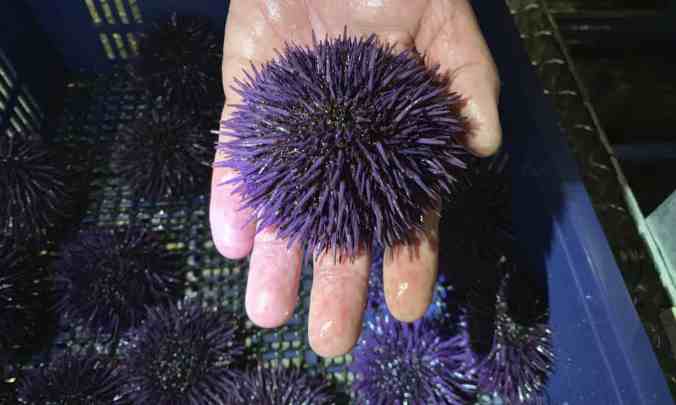
A purple urchin at Bodega Marine Lab in California, which is running a pilot project to remove purple urchins from the ocean floor, restore them to health, then sell them as premium seafood. Photograph: Terry Chea/AP

With invasive species, sometimes the only thing to do with such lemons is make them tasty:

Sea urchin population soars 10,000% in five years, devastating US coastline

Voracious purple urchins in waters of California and Oregon pose threat to kelp forests and risk upending delicate ecosystems

3000k

An aerial view of one of the last remaining kelp forests near Elk, California, on the Mendocino county coast, which has lost more than 90% of its bull kelp in less than a decade. Photograph: Terry Chea/AP

Tens of millions of voracious purple sea urchins that have already chomped their way through towering underwater kelp forests in California are spreading north to Oregon, sending the delicate marine ecosystem off the shore into such disarray that other critical species are starving to death.

A recent count found 350m purple sea urchins on one Oregon reef alone – more than a 10,000% increase since 2014. And in northern California, 90% of the giant bull kelp forests have been devoured by the urchins, perhaps never to return.

Vast “urchin barrens” – stretches of denuded seafloor dotted with nothing but hundreds of the spiny orbs – have spread to coastal Oregon, where kelp forests were once so thick it was impossible to navigate some areas by boat. Continue reading

A Color, Sans-Charisma, Worthy Of A Mission

ochre-hunter-slide-1J1C-jumbo

ochre-hunter-slide-8OK0-superJumbo.jpg

Inside Gustafson’s cabin are shelves lined with samples of ocher and the powdered pigments she makes from them. She likes to keep all processing to a minimum: She hand-grinds specimens with a mortar and pestle and then runs the resulting powder through a sieve. It’s more “personal and connective” that way, she says. Kyle Johnson

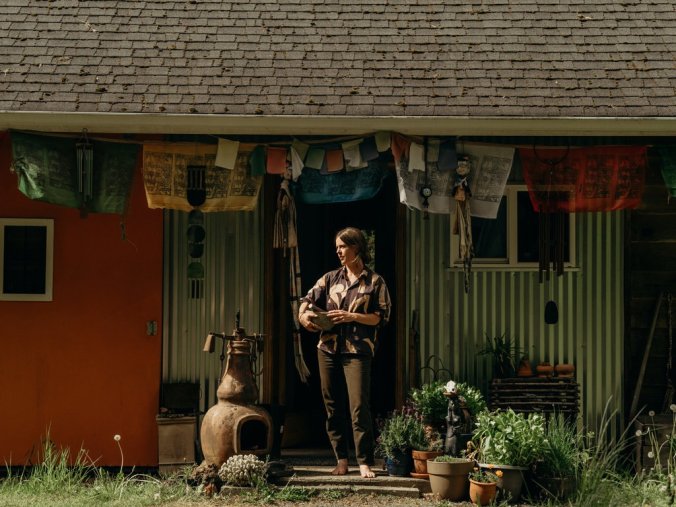
In the Pacific northwest of the United States there is a hunter-gatherer renaissance that we have been paying attention to in recent years, if only at our desks. The Willows Inn was the first story we started following, but they continue to come our way, including today. Improbably captivating, this story is about a need to know, and in the process conserve knowhow, about the source of naturally occurring colors that has a history as old as art. Even if some colors are not inherently charismatic (in the eye of the beholder), we take note:

The Woman Archiving the World’s Ochers

At her cabin in the woods of Washington, Heidi Gustafson is creating a many-colored library of one of mankind’s first pigments.
ochre-hunter-slide-7Q3A-jumbo.jpg

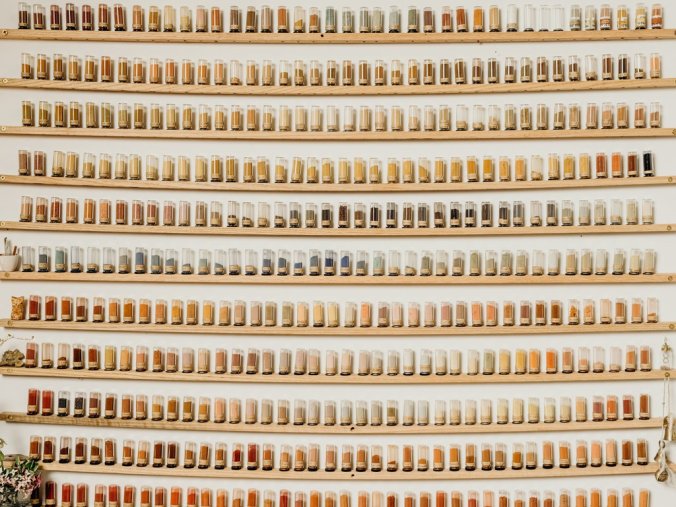
The archive at Gustafson’s cabin comprises over 400 vials of hand-ground ocher, and she doesn’t have an endpoint in mind. “I’ll keep doing it and see where it leads me,” she says. Chantal Anderson
ochre-hunter-slide-UHIP-superJumbo

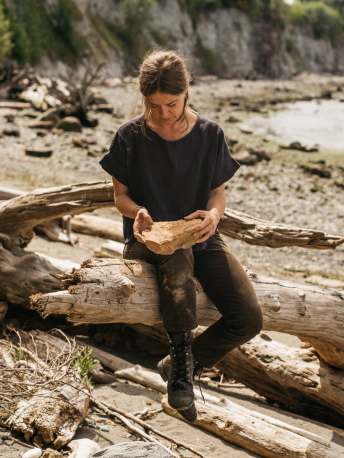
“This piece has a lot less iron in it and a lot more clay,” she says of a shard of rock discovered on the sand. “You can use it right away. It’s like a giant piece of sidewalk chalk.” Kyle Johnson

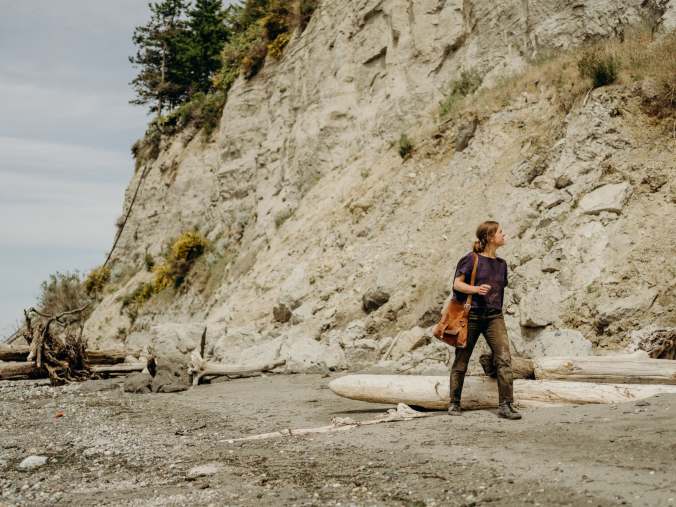
Heidi Gustafson has Whidbey Island’s Double Bluff Beach to herself. But she’s not sunbathing or scanning the waves for whales. Instead, she’s traveled to the northern end of Puget Sound in Washington to crouch, back to the ocean, foraging for ocher at the base of a cliff. Armed with a small magnet and a knife, she stoops low to assess the striations in the rock face, formed by glacial activity hundreds of thousands of years before.

Gustafson considers ocher to be any natural material primarily made up of iron (hence the magnet) that contains oxygen, a definition that she acknowledges is a bit “less strict” than ones used in various scientific communities. Seeking out the material has become, by happenstance, her life’s work.
ochre-hunter-slide-EQBY-superJumbo

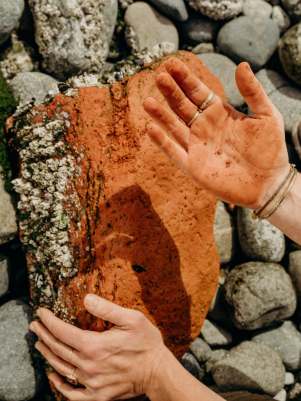
An especially low tide reveals a large piece of barnacle-clad red ocher that came from the nearby cliff. “It’s probably between 150,000 and 200,000 years old,” Gustafson says. She often contacts geologists if she needs help dating ocher from a particular site. Kyle Johnson

For years, she has been engaged in a wide-ranging, multidisciplinary exploration of the mineral: collecting samples all over the Pacific Northwest; grinding shards down into pigments she sells to artists through her website Early Futures; making her own art with ocher pigments; and, at her small cabin near the foothills of the Cascade Mountains, creating an extensive ocher archive to catalog samples she’s gathered along with submissions of the mineral sent in from all over the world. While there has recently been renewed interest in creating paints from natural pigments, Gustafson’s focus is on ocher alone — and it extends beyond the material’s artistic uses to its scientific, symbolic and spiritual properties.
ochre-hunter-slide-PNIO-superJumbo

Heidi Gustafson, who has spent the past five years collecting and working with ocher, walks along Whidbey Island’s Double Bluff Beach, off the coast of Washington, in search of the material. She came to scout this area, where she spent time as a child, after recalling its interesting cliff exposure. The beach is a scenic two-hour drive from her cabin near the foothills of the Cascade Mountains. Kyle Johnson

Her first encounter with the earthy compound began at a less scenic location than Double Bluff Beach: a Safeway parking lot in Oakland, Calif. Several years after earning a B.F.A. in sculpture at the Maryland Institute College of Art, Gustafson moved to the Bay Area to get a masters in philosophy, cosmology and consciousness at the California Institute of Integral Studies. After graduating in 2014, she wasn’t sure what to do. Continue reading

Putting the Reuse back into Recycle

Thanks once again to YaleEnvironment360 for sharing valuable information.

Scientists Find Way to Fully Recycle Plastics Without Losing Quality

A team of Swedish scientists have found a new way to break down plastic so that it can be recycled into material the same quality as the original — a process they say could help shift the focus of the plastics industry to recycling and drastically reduce the amount of pollution that ends up in the world’s oceans.

The technique involves heating discarded plastic to around 850 degrees Celsius until it turns into a gas mixture. That mixture “can then be recycled at the molecular level to become new plastic material of virgin quality,” Henrik Thunman, an environmental scientist at Chalmers University of Technology who led the new research, said in a statement. “Circular use would help give used plastics a true value, and thus an economic impetus for collecting it anywhere on earth.” Continue reading

Feeding Protesters

We were wondering how this worked. Thanks to Dan Hancox and the Economist for showing us how:

How to feed a protest movement: cooking with Extinction Rebellion

A peek inside the “Rebel Kitchen”

Taste the difference A view of Extinction Rebellion’s catering tent in Trafalgar Square, London

Running a kitchen in the middle of a protest camp presents some unusual operational challenges. “We’re cooking most of the hot food offsite at the moment,” says George Coiley, as he leads me past boiling stove-top kettles, catering-sized saucepans and two volunteers preparing a fruit salad of epic proportions. “The police keep taking our stuff…”

This is Coiley’s fourth Extinction Rebellion kitchen. Staffed by a rotating squad of around 30 volunteers, it serves food and hot drinks 24 hours a day to protesters and anyone else who needs it. All the food is vegan or vegetarian and is assembled from donations. Continue reading

Unsubtle Love Song

21tb-loudbird-02-jumbo.jpg

Female bellbirds lack a wattle and sing no songs. Anselmo d’Affonseca

Cara Giaimo provides additional perspective, perhaps the key question in the New York Times coverage of this story, which is about the female in this species, along with a great recording of the male’s call:

…One big mystery remains. The white bellbird sings its pile driver tune when a potential mate is nearby. It starts facing away from her, and then whips around to blast the loudest, record-setting note right into her face. Continue reading

Citizen Science Deepdive

By collecting images and GPS data from citizen divers, scientists can get a better sense of the health of the entire Great Barrier Reef. (Damian Bennett)

Citizen Science has been a common thread for us on this site, linking creatures of land, sea and air as subjects of study. Marine Ecosystem citizen science has especially  fascinated us in terms of the creative thinking applied to problems of invasive species.

The collaborative goal of documenting such a vast ecosystem as the Great Barrier Reef, and using creative solutions to combat threats to this wonder of the natural world is inspiring, to say the least.

Massive Citizen Science Effort Seeks to Survey the Entire Great Barrier Reef

Only about 1,000 of 3,000 individual reefs have been documented, but the Great Reef Census hopes to fill in the gaps

The majority of individual reefs that make up the Great Barrier Reef have not been directly surveyed. (Damian Bennett)

In August, marine biologists Johnny Gaskell and Peter Mumby and a team of researchers boarded a boat headed into unknown waters off the coasts of Australia. For 14 long hours, they ploughed over 200 nautical miles, a Google Maps cache as their only guide. Just before dawn, they arrived at their destination of a previously uncharted blue hole—a cavernous opening descending through the seafloor.

After the rough night, Mumby was rewarded with something he hadn’t seen in his 30-year career. The reef surrounding the blue hole had nearly 100 percent healthy coral cover. Such a find is rare in the Great Barrier Reef, where coral bleaching events in 2016 and 2017 led to headlines proclaiming the reef “dead.”

“It made me think, ‘this is the story that people need to hear,’” Mumby says.

The expedition from Daydream Island off the coast of Queensland was a pilot program to test the methodology for the Great Reef Census, a citizen science project headed by Andy Ridley, founder of the annual conservation event Earth Hour. His latest organization, Citizens of the Great Barrier Reef, has set the ambitious goal of surveying the entire 1,400-mile-long reef system in 2020.

“We’re trying to gain a broader understanding on the status of the reef—what’s been damaged, where the high value corals are, what’s recovering and what’s not,” Ridley says. Continue reading

Photos For A Moment Of Inspiration

5361.jpg

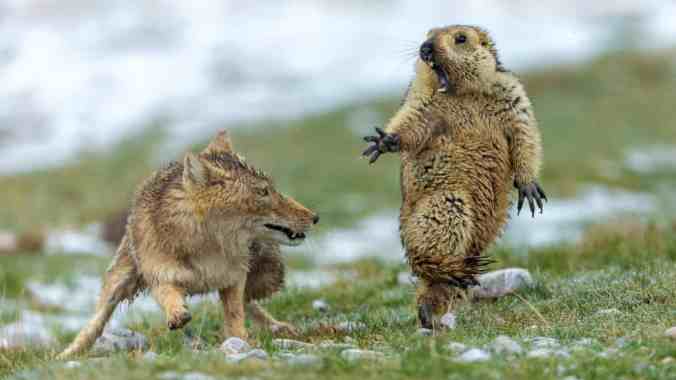
The Moment, overall winner and joint winner of the 2019 wildlife photographer of the year for the category ‘behaviour: mammals’. Yongqing Bao’s image shows a hungry marmot, not long out of hibernation, being confronted by a fox in China’s Qilian mountains. Photograph: Bao Yongqing/2019 wildlife photographer of the year

Today, not much to say, other than wow, thanks to the Guardian’s sharing of these photos, compiled by Eric Hilaire. Continue reading